

For years, the digital asset industry was viewed as experimental and disconnected from traditional finance. In 2026, that perception is rapidly changing.
What was once considered a niche market is evolving into financial infrastructure. Institutions are entering the space, governments are building regulatory frameworks, and enterprises are integrating blockchain technology into real-world operations.
Here are five signals showing how the industry has entered a new era.
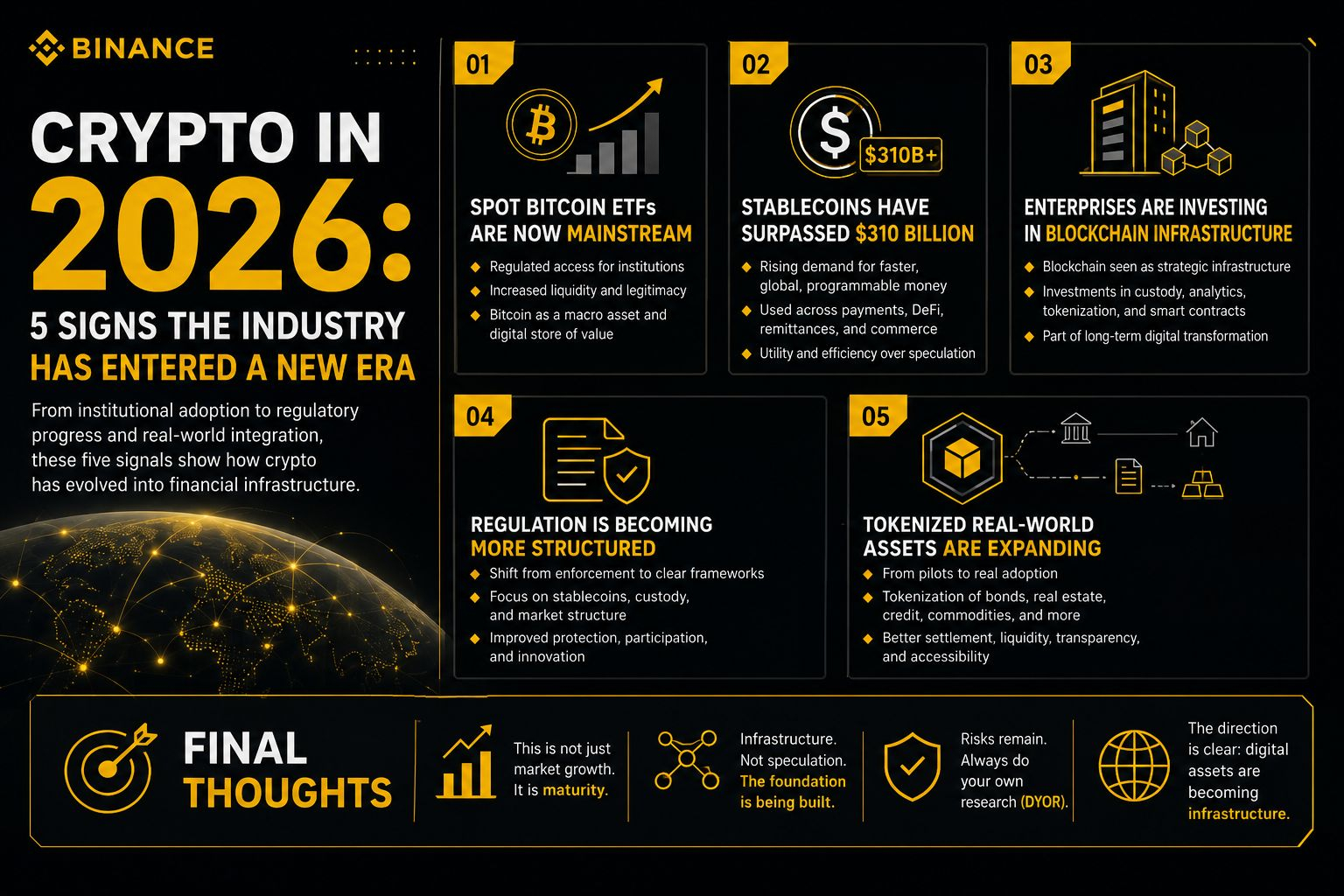
1. Spot Bitcoin ETFs Are Now Mainstream
Spot Bitcoin ETFs changed the relationship between traditional finance and digital assets.
Institutional investors, wealth managers, and publicly traded companies now have regulated access to Bitcoin through familiar financial products. This has increased legitimacy, liquidity, and long-term adoption.
Bitcoin is increasingly viewed as a macro asset and digital store of value rather than only a speculative instrument.
Readers can learn more about Bitcoin through .
2. Stablecoins Have Surpassed $310 Billion
Stablecoins are becoming one of the most important tools in blockchain-based finance.
Their growth reflects rising demand for faster payments, global accessibility, and programmable money. Stablecoins are now widely used in cross-border payments, DeFi, remittances, and digital commerce.
The focus is shifting from speculation toward utility and financial efficiency.
3. Enterprises Are Investing in Blockchain Infrastructure
Major companies are increasingly treating blockchain as strategic infrastructure.
The acquisition of crypto infrastructure firms by companies such as highlights how enterprises are moving beyond experimentation and into integration.
Organizations are investing in custody, analytics, tokenization, and smart contract infrastructure as blockchain technology becomes part of long-term digital transformation strategies.
4. Regulation Is Becoming More Structured
The regulatory environment is also evolving.
Instead of relying mainly on enforcement, policymakers are discussing clearer frameworks for stablecoins, custody, and digital asset markets. Greater clarity may help improve investor protection while encouraging institutional participation and innovation.
Educational resources about blockchain regulation are available on Binance.
5. Tokenized Real-World Assets Are Expanding
Tokenized real-world assets are moving from pilot programs into real adoption.
Governments and financial institutions are exploring tokenization for bonds, real estate, private credit, and commodities. Blockchain infrastructure may improve settlement speed, liquidity, transparency, and accessibility for traditional assets.
This connects blockchain technology more directly to the global financial system.
Final Thoughts
The biggest shift in 2026 is not only market growth — it is maturity.
Bitcoin ETFs, stablecoin expansion, enterprise adoption, regulatory progress, and tokenization all suggest that blockchain technology is evolving into a foundational financial layer.
The industry still carries risks, and users should always conduct their own research (DYOR). But the direction is increasingly clear: digital assets are becoming infrastructure, not just speculation.