
Most people still look at AI through the lens of chatbots, image generators, or automation tools.
But the deeper shift happening underneath all of this is actually about ownership.
Who owns the data?
Who controls the models?
Who captures the economic value once AI agents start interacting with each other autonomously?
That’s the part the market still hasn’t fully priced in yet.
Right now, almost the entire AI industry runs on a structure where contributors create value but very few participants actually capture it. Users generate data. Developers fine tune models. Communities test outputs. Researchers improve systems. Yet the economic upside usually concentrates around centralized platforms sitting at the top of the stack.
This is where @OpenLedger starts becoming interesting to me.
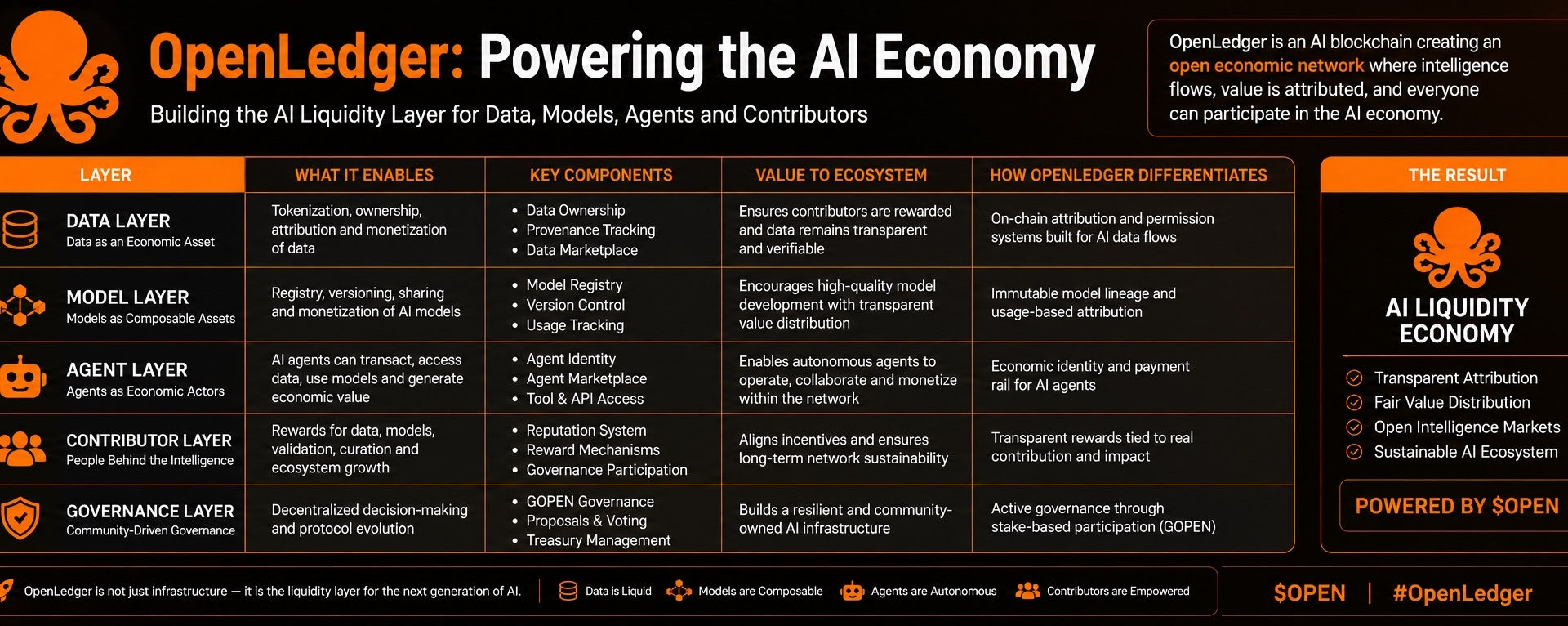
Instead of treating AI as a closed product layer, OpenLedger is approaching it more like an open economic network where data, models, agents, and contributors can all become participants inside the same liquidity system.
That distinction matters more than people realize.
The current AI market has a massive attribution problem.
A model gets trained on thousands or millions of data points coming from different sources, but once outputs are generated, tracing value back to contributors becomes extremely difficult. In traditional systems, contributors disappear into the background after submission.
OpenLedger seems to be trying to solve that structural gap by creating infrastructure where attribution itself becomes part of the architecture.
Not just storage.
Not just inference.
Not just model hosting.
Actual economic coordination around AI.
And honestly, that might end up becoming more important than raw compute power over time.
Because eventually AI stops being about who owns the biggest GPU cluster and starts becoming about who can coordinate the highest quality intelligence network.
That changes the game completely.
One thing I keep thinking about is how AI agents will likely interact in the future.
People imagine isolated chatbots helping users complete tasks, but the larger picture probably looks more like autonomous economic systems where agents exchange information, purchase datasets, verify outputs, call external tools, and continuously improve through network interactions.
If that future arrives, then AI needs native infrastructure for attribution, payments, verification, permissions, and liquidity.
Traditional cloud architecture was never really designed for that.
OpenLedger positioning itself as an AI blockchain suddenly makes more sense when viewed through that lens.
The interesting part is that they are not only talking about AI models. They are also building around data and agents as economic primitives.
That changes how value flows.
Most crypto AI narratives today still focus heavily on speculation around compute marketplaces or decentralized GPU access. Those are important pieces, but they mostly solve infrastructure bottlenecks.
OpenLedger feels more focused on the coordination layer sitting above infrastructure.
Who contributed?
Who trained?
Which model used what data?
How does value return back to participants?
How do agents monetize outputs?
How does attribution remain visible across iterations?
These questions sound abstract today but they become very real once autonomous systems start scaling.
And honestly, this is probably why the idea of AI liquidity keeps appearing around the OpenLedger narrative.
Liquidity is usually discussed in finance.
But AI liquidity is different.
It is about making intelligence economically transferable.
Data becomes monetizable.
Models become composable.
Agents become economically active.
Contributors become trackable participants instead of invisible labor.
That is a very different market structure compared to the current internet.
Another thing worth paying attention to is timing.
The broader market is finally starting to realize that AI value will not stay concentrated only at the application layer.
Infrastructure, coordination, ownership, and attribution are becoming narratives themselves now.
You can already see this shift happening across crypto.
Projects are moving away from simply saying “we use AI” and toward solving deeper problems around verification, economic incentives, and decentralized intelligence systems.
That transition matters because hype narratives eventually mature into infrastructure narratives.
And infrastructure is usually where long-term value compounds.
I also think people underestimate how large the data economy could become once AI agents operate independently.
Today, data is mostly collected passively by platforms.
Tomorrow, datasets themselves may become active economic assets traded between agents, applications, and models in real time.
That creates a completely different internet economy.
OpenLedger’s direction seems aligned with that possibility.
Not in a loud or overly promotional way either.
More like quietly building the rails before the market fully understands why those rails matter.
The governance side is also interesting.
A lot of protocols talk about decentralization while governance participation remains mostly passive. But OpenLedger introducing governance-enabled structures like GOPEN creates a stronger separation between passive holders and active participants.
That extra friction actually matters.
It filters governance toward people intentionally participating in network direction instead of random inactive wallets.
In crypto, small structural decisions often end up having massive long-term consequences.
Especially when networks start scaling.
One thing I keep noticing in AI discussions is that everyone talks about model performance, but very few people talk about trust infrastructure.
That may become one of the largest bottlenecks later.
Because once AI generated content floods the internet, attribution and verification become extremely valuable.
Knowing where intelligence originated from could become as important as intelligence itself.
And this is where blockchain architecture starts making more sense for AI coordination.
Not because blockchains magically improve models.
But because they create transparent economic systems around contribution, ownership, and verification.
OpenLedger seems to understand that distinction pretty well.
The market also tends to underestimate how difficult AI coordination actually is.
Training models is one challenge.
Maintaining aligned incentives across contributors, validators, datasets, and applications is another challenge entirely.
Those systems become economic networks very quickly.
And economic networks need liquidity.
That might be the simplest way to understand the OpenLedger thesis.
Not just AI infrastructure.
AI liquidity infrastructure.
There is a difference.
Personally, I think the next phase of crypto AI will move away from pure speculation around “AI coins” and toward protocols that can actually coordinate intelligence markets efficiently.
That includes:
data ownership,
model attribution,
agent monetization,
permission systems,
and transparent economic routing.
OpenLedger seems positioned directly inside that conversation.
Still early of course.
Still volatile like everything else in crypto.
And the broader market narrative around AI infrastructure is still evolving in real time.
But the underlying direction feels increasingly relevant.
Especially as the internet moves closer toward autonomous systems interacting with each other economically instead of only socially.
That future probably needs new rails.
And that may be exactly what @OpenLedger is trying to build with $OPEN.
The market may still see AI as a product story.
But eventually it could become a liquidity story instead.
And honestly, that shift might end up being much bigger than most people expect.