Took a break from the charts around midday. Nothing was moving in any interesting direction just that slow, indifferent kind of sideways that makes you click around aimlessly.
Ended up re reading some old threads about the AI data economy. Not for any particular reason. Just killing time.
Then I fell into something with OpenLedger that I'm still not quite done processing.
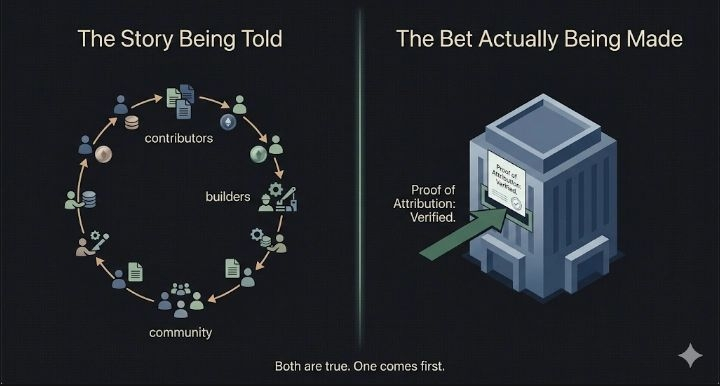
The framing everyone uses for this project is "open AI." Collaborative. Transparent. Contributors getting rewarded. The opposite of OpenAI's closed garden model. That's the pitch, and honestly it's a good pitch for the current moment people are genuinely frustrated with how AI development is concentrated in a handful of private labs and the idea of a blockchain alternative has real emotional resonance.
But here's what I actually think is happening, and I'm not sure people are reading it this way.
@OpenLedger isn't really building an alternative to closed AI. It's building the infrastructure for a world where closed AI has to justify itself. That's a completely different position.
The distinction took me a while to actually land. I thought the vision was decentralize the models, democratize access, everyone contributes.
And yes, that's in the language. But the actual mechanism proof of Attribution, traceable data lineage, on chain contributor records doesn't displace centralized AI. It creates an accountability layer underneath it. It's less we'll replace GPT and more eventually, any model that wants to operate in a regulated environment will need to prove what data it used and who owns it.
That's a quieter bet. And in some ways a more realistic one.
The reason this clicked for me was thinking about where AI regulation is actually going. Not the optimistic version. The slow, bureaucratic, liability driven version. The version where a company gets sued because their model trained on copyrighted data and they can't prove otherwise. The version where a financial institution needs to show regulators exactly which datasets influenced a credit decision.
OpenLedger's open and collaborative AI future might not be open in the sense people expect not open access, not open source necessarily but open in the sense of auditable. Provable. That's a different kind of open.
And weirdly, the beneficiaries of that future might not be the individual contributors the project talks about most. It might be enterprises and institutions who need the audit trail more than the data seller who uploaded a finance dataset in 2025 and wants micropayments.
But here's the part I can't fully resolve.
If the real demand is compliance infrastructure, then OpenLedger's community facing narrative "a future where AI contributors are fairly rewarded, where data has a voice" is technically true but practically secondary. The data contributor earns OPEN tokens. The institution gets regulatory cover. Those are very different value propositions wearing the same idealistic framing.
I'm not saying that's dishonest. A lot of infrastructure plays work exactly this way the idealistic community story builds the network, the enterprise use case monetizes it. That's fine as a strategy.
What bothers me is that the token economics and the community are being asked to fund and sustain a vision whose primary beneficiaries might show up much later, if at all, and might not be them.
I've seen this shape before. Not saying it fails. Just saying the timeline matters enormously, and right now the gap between the "collaborative AI future" story and the actual on chain attribution activity is... noticeable.
OPEN did $13.43M in volume two days ago on what looked like speculative momentum, not attribution demand. The contributors the narrative centers aren't the ones driving the number.
Maybe that resolves when the AI Marketplace actually launches and real usage accrues. Maybe the token unlock in September forces the hand and something has to show up on chain before then to hold the price.
Or maybe the "open future" narrative stays aspirational long enough that the real use case quiet, compliance driven, institutional sneaks up and validates the whole thing retroactively.
I genuinely don't know which of those is more likely. I've been going back and forth on it since I closed those tabs.
Anyway. Charts are still flat. Probably going to make tea and look at this again tomorrow with fresh eyes.