
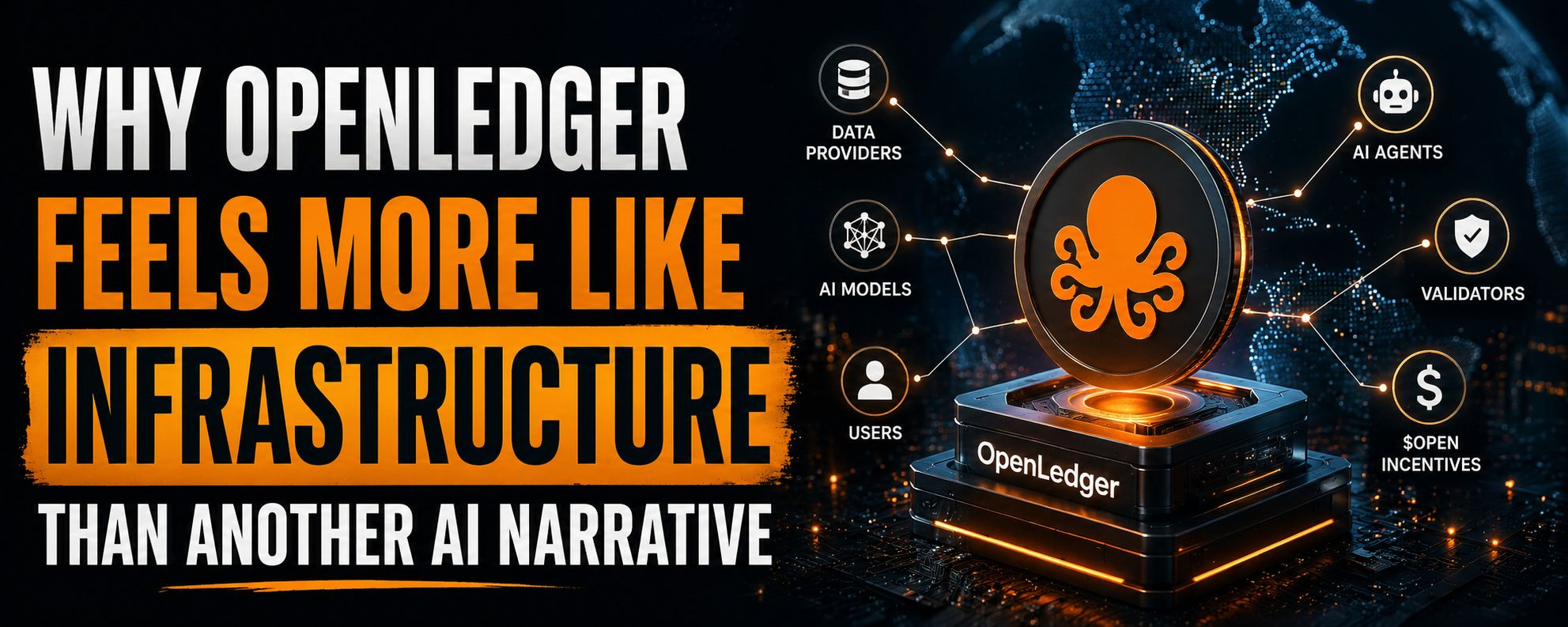
I’ve been watching the rise of AI-related crypto infrastructure for a while now, and one thing that keeps standing out to me is how quickly the conversation around “AI” became dominated by consumer products while the deeper infrastructure layer remained mostly ignored. Everyone talks about chatbots, autonomous agents, and model performance, but very few people spend time thinking about the economic system underneath those models. That’s why projects like @OpenLedger have started to feel more relevant to me recently, especially as the market slowly shifts from speculation around AI narratives toward questions about ownership, liquidity, and monetization.
What I find interesting about OpenLedger is that it does not position itself as another generic Layer 1 trying to compete on transaction speed or ecosystem size. The core idea seems much more specific. It focuses on turning data, models, and AI agents into economic assets that can actually move through a blockchain environment with transparent incentives attached to them. In simple terms, the project is trying to create a marketplace structure for intelligence itself rather than just building another chain where tokens trade against each other.
That distinction matters more than people realize.
Right now, most of the AI economy operates in an extremely centralized way. The data comes from users, the models are controlled by a handful of companies, and the value generated by those systems rarely flows back to the people contributing to them. Even open-source AI still struggles with monetization because contributors usually rely on donations, grants, or reputation rather than sustainable economic participation. I think OpenLedger is trying to address that imbalance by making AI resources liquid and economically trackable on-chain.
The timing also makes sense. We are entering a market phase where infrastructure narratives tend to outperform surface-level consumer hype. Earlier cycles rewarded applications that attracted attention quickly. This cycle feels different. Capital is starting to rotate toward systems that solve coordination problems underneath the market. AI coordination is becoming one of the biggest of those problems.
The difficult part about AI is not necessarily creating models anymore. Open-source development has already lowered that barrier dramatically. The harder problem is aligning incentives between data providers, developers, model operators, and end users. Most people overlook this because it is less exciting than flashy demos, but economically it is the real bottleneck.
From what I’ve observed, OpenLedger attempts to create a framework where these participants can interact through transparent economic mechanisms rather than closed corporate structures. That changes how value can circulate inside the AI ecosystem. Instead of intelligence being trapped inside isolated platforms, the network treats data and models as productive digital assets that can theoretically generate ongoing utility and liquidity.
What also stands out to me is how this model fits broader crypto behavior. Markets tend to reward systems that convert previously illiquid resources into tradable or economically active assets. DeFi did this with idle capital. Liquid staking did this with locked tokens. RWAs attempt to do this with off-chain assets. OpenLedger appears to be approaching AI from a similar perspective by treating datasets, agents, and models as underutilized economic resources.
I think many traders underestimate how important that framing could become if AI adoption continues accelerating.
At the same time, I do not think this is a simple story. There are obvious challenges here that deserve more attention than they usually get. Tokenizing AI infrastructure sounds elegant conceptually, but maintaining real utility is much harder in practice. The network only works if participants genuinely contribute valuable resources rather than low-quality spam designed purely to farm incentives. Every AI-focused protocol eventually runs into the same uncomfortable question: how do you measure actual contribution quality in a decentralized environment?
That problem becomes even harder when financial incentives enter the system. Markets naturally attract extraction behavior. If rewards exist for data or model contributions, participants will inevitably optimize for rewards rather than usefulness unless the architecture is designed very carefully. I think this is where many AI crypto projects could fail over time. Economic coordination is easy to describe and extremely difficult to sustain.
Another thing I’ve noticed is that AI narratives tend to create valuation distortions very quickly. Traders often price future potential long before usage metrics justify it. In OpenLedger’s case, I would pay closer attention to ecosystem activity, developer participation, and actual network utilization rather than purely short-term price action around $OPEN. Infrastructure projects usually reveal their real strength through consistency, not explosive hype cycles.
The token itself becomes important because it acts as the coordination layer for all these interactions. If the network succeeds in attracting meaningful AI activity, then the token potentially reflects demand for access, incentives, validation, or economic participation inside the ecosystem. But token utility only matters if the underlying activity becomes real and persistent. I think that distinction is critical because the market often confuses narrative relevance with sustainable demand.
One thing I personally watch with projects like this is whether the market behavior starts matching the theoretical model. If OpenLedger genuinely becomes useful for AI coordination, then over time you would expect on-chain activity, contributor participation, and ecosystem depth to gradually strengthen alongside token velocity. You would likely see more stable engagement patterns rather than purely speculative spikes. Infrastructure adoption tends to leave traces on-chain long before broader retail attention arrives.
The recent increase in discussion around decentralized AI also makes this sector more important than it was even six months ago. There is growing discomfort around centralized control of intelligence systems, especially as AI becomes integrated into finance, media, and software development. Crypto has always been strongest when it offers an alternative coordination structure to centralized industries. AI may become the next major testing ground for that philosophy.
Still, I do not think the outcome here is guaranteed.
There is a meaningful gap between having a compelling narrative and building a system that people consistently rely on. Many protocols look important during the narrative phase of the market cycle and then quietly disappear when attention rotates elsewhere. The difference usually comes down to whether the infrastructure solves a problem users actually feel every day.
What keeps my attention on OpenLedger is not the AI branding itself. The market already has too much AI branding. What interests me is the attempt to build economic rails around intelligence production and distribution. That feels more structural than speculative. If AI continues becoming a foundational layer of the internet economy, then the systems coordinating value around it could become more important than most people currently expect.
I still think the market is early in understanding what decentralized AI infrastructure even means. Most traders are still treating these projects as temporary narratives instead of potential coordination systems. Maybe that skepticism turns out to be correct. Maybe centralized AI remains dominant for years. But when I look at where crypto historically creates the most disruption, it usually happens where ownership, incentives, and liquidity collide with emerging technology. @OpenLedger seems positioned directly inside that intersection, and that alone makes it difficult for me to ignore.
