
A quiet shift has been happening in crypto and I do not think people talk about it enough.
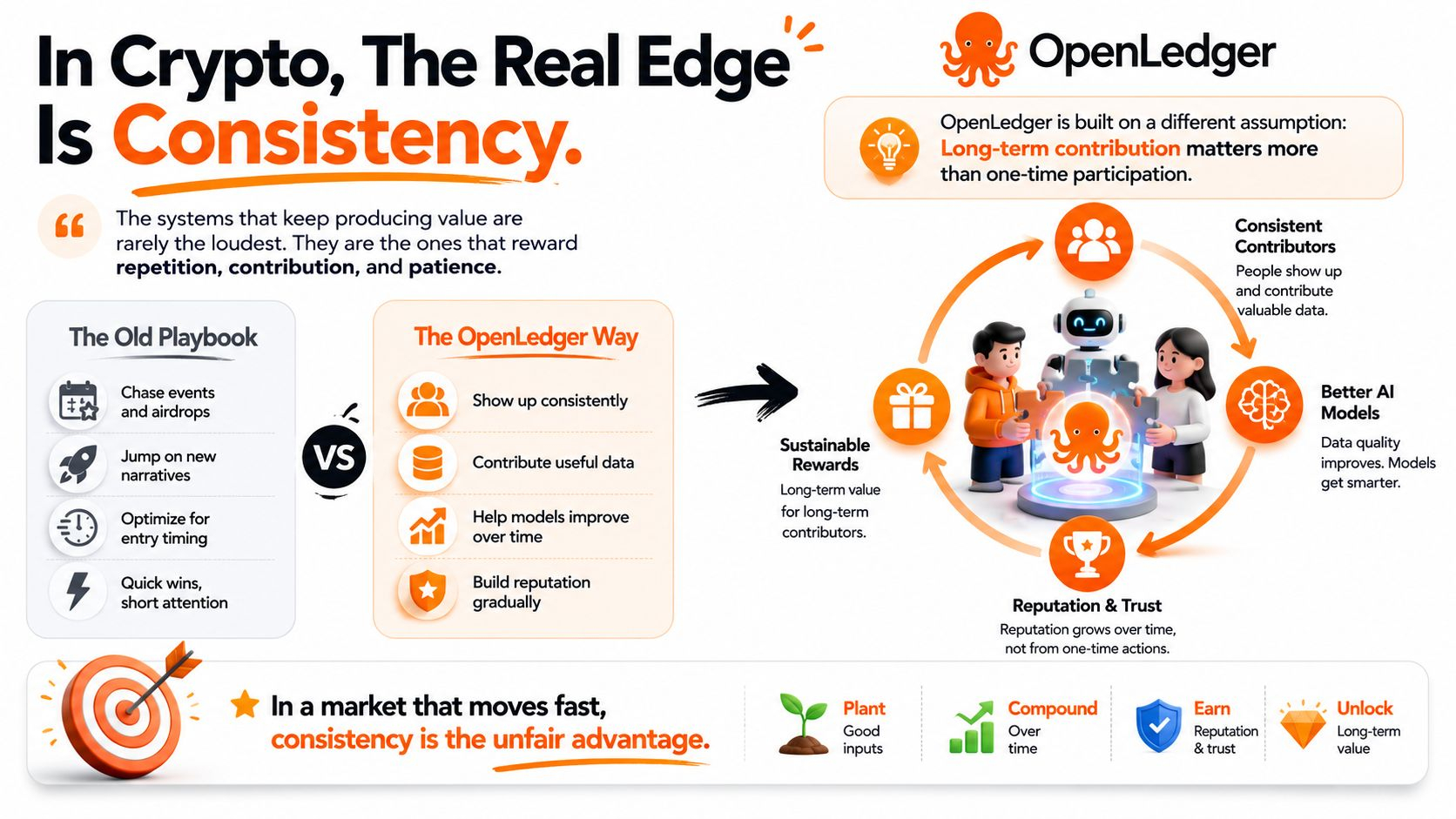
The market still moves fast. New launches appear every week. New narratives replace old ones almost overnight. But underneath that speed, I keep noticing something else. The systems that keep producing value are usually not the loudest ones. They are the ones rewarding repetition, contribution, and patience.
That feels strange in Web3 because consistency has never been the popular skill.
Most people still optimize for events. Airdrops. Narratives. Entry timing. But when I spent time looking deeper into @OpenLedger , I started feeling that it is built around a completely different assumption. It seems to assume that long-term contribution matters more than one-time participation.
OpenLedger’s AI network does not really work if people only appear when rewards are high. The whole structure depends on contributors showing up repeatedly with useful data, helping models improve over time, and building reputation slowly inside the system.
That changes the incentive layer.
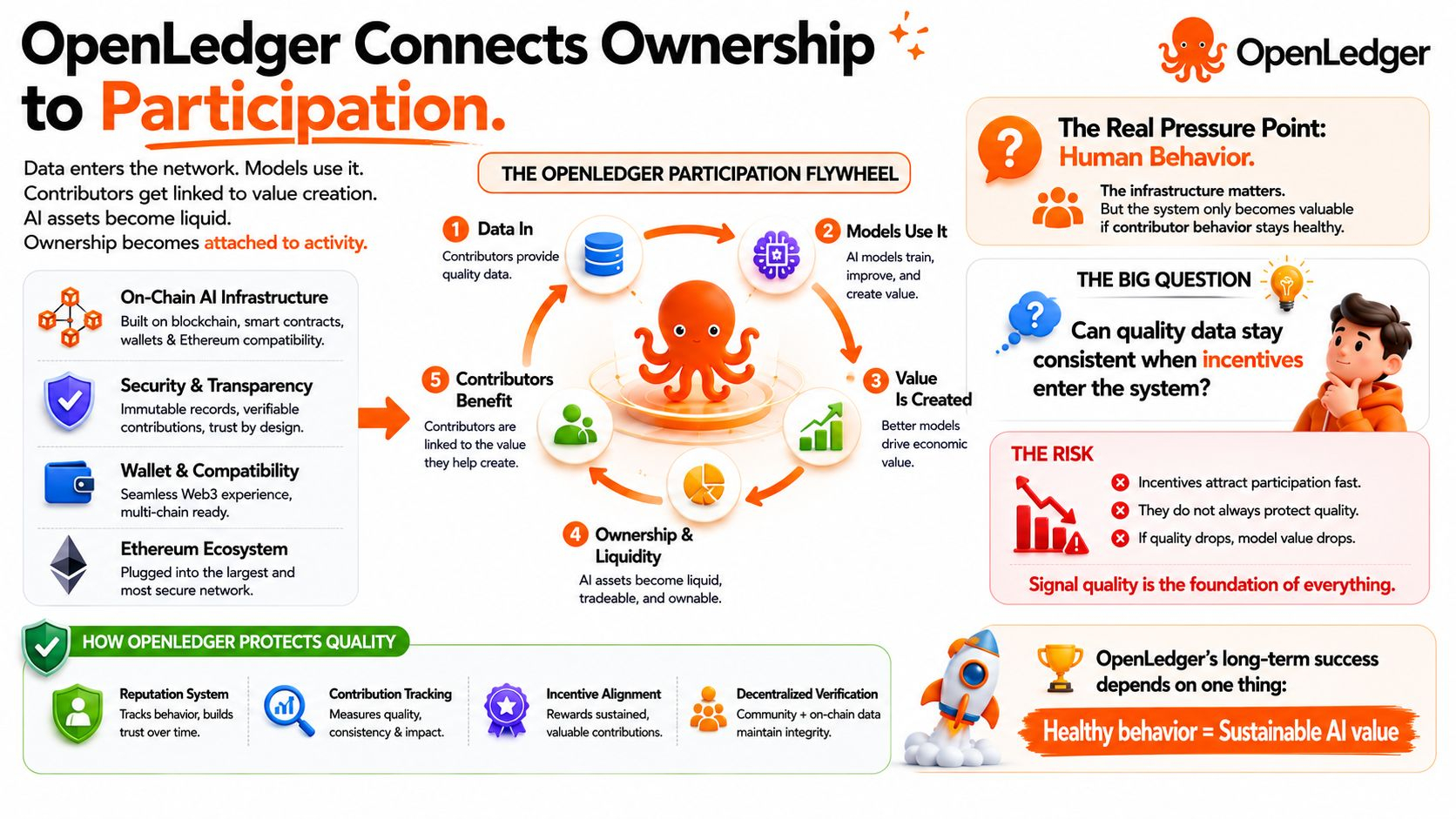
The interesting part for me is that OpenLedger is not only talking about AI ownership. It tries to connect ownership to participation. Data enters the network. Models use it. Contributors get linked to value creation. AI assets become liquid. Ownership becomes something attached to activity rather than pure capital.
I think this is where OpenLedger feels different from many AI narratives.
Its on-chain AI infrastructure only becomes valuable if contributor behavior stays healthy. The blockchain layer, smart contracts, wallet integrations, Ethereum compatibility, all of that matters. But the real pressure point is still human behavior.
Can quality data actually stay consistent when incentives enter the system?
I keep coming back to that question.
Because crypto has history here. Incentives attract participation fast. They do not always protect quality. OpenLedger tries to solve this through reputation systems and contribution tracking, but maintaining signal quality on chain over long periods is still difficult.
And if quality drops, model value drops too.
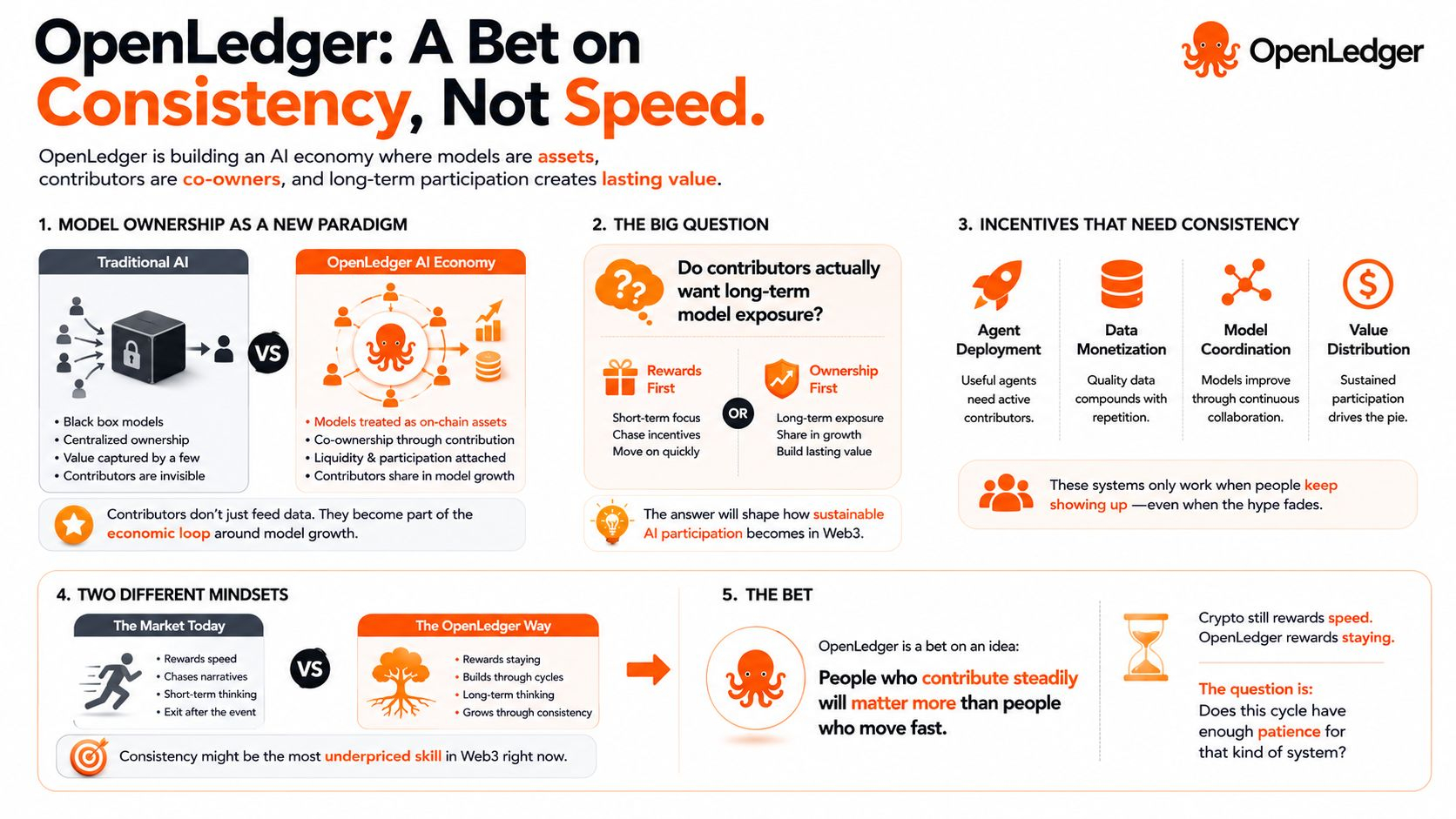
The model ownership side is also interesting to me. OpenLedger treats AI models more like assets with liquidity and participation attached to them. Contributors are not only feeding data into a black box. In theory, they become part of the economic loop around model growth.
But I still wonder how much users truly care about ownership.
Do contributors actually want long-term model exposure? Or are they still chasing rewards first and ownership second?
That question matters because AI participation inside OpenLedger depends heavily on incentive design. Agent deployment, data monetization, model coordination, all of it needs contributors who keep showing up even when excitement disappears.
And maybe that brings me back to the original thought.
Consistency might actually be the most underpriced skill in Web3 right now.
OpenLedger almost feels like a bet on that idea. Not on finding the next token. Not on timing narratives. Just on the assumption that people who contribute steadily will eventually matter more than people who move fast.
I am not fully sure the market is ready for that yet.
Crypto still rewards speed. OpenLedger seems to reward staying. The question is whether this cycle has enough patience for that kind of system.