
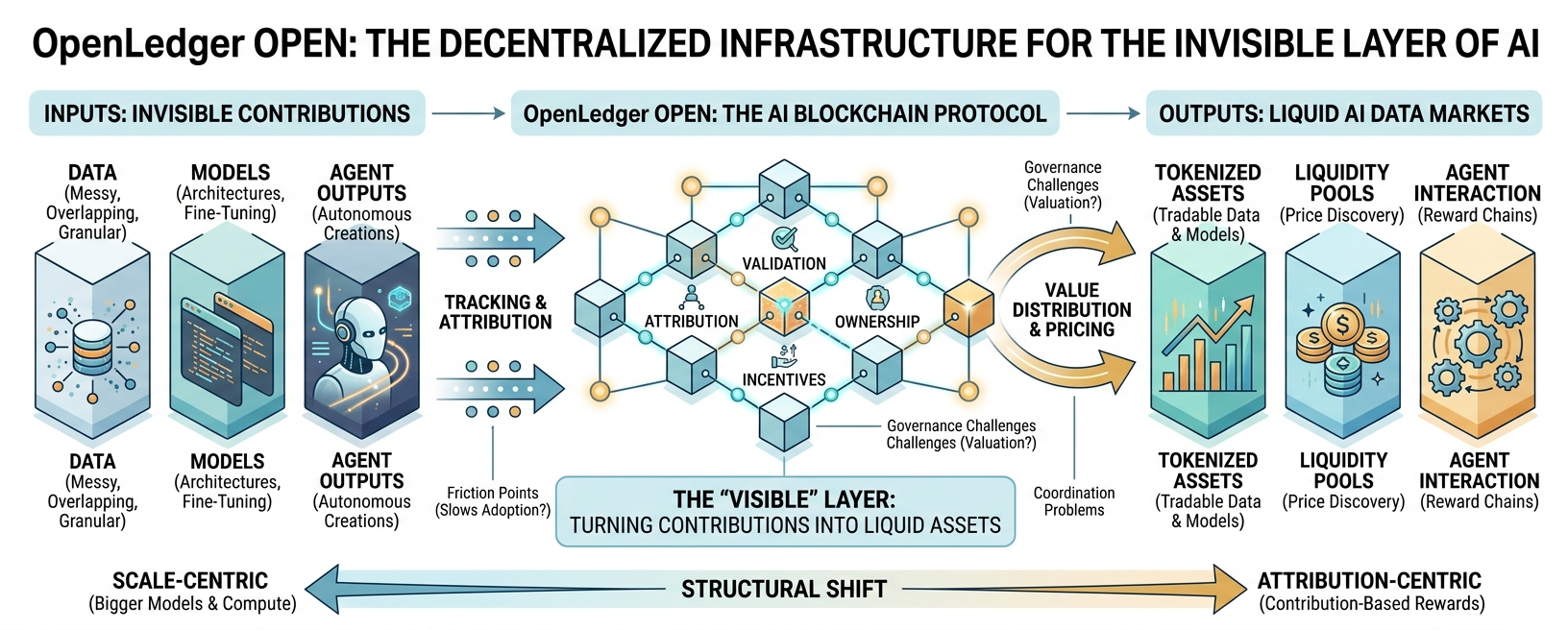

When I first came across OpenLedger OPEN I was not trying to find anything new. I was just scrolling charts late at night, the kind of habit that usually leads nowhere, just noise. But something about the idea of an AI blockchain built around data and model contribution made me pause longer than usual. I remember thinking why does this feel both obvious and still hard to believe at the same time
In most crypto cycles I have seen, value tends to concentrate at the end product. The app, the model, the interface. Everything underneath usually disappears from view. OpenLedger OPEN is trying to make that hidden layer visible and tradable in some form. That sounds simple on paper but I keep wondering if markets actually reward something so granular
The idea of turning data, models, and agent outputs into something liquid feels like it challenges how we usually define ownership in AI systems. I am not fully sure how clean that separation can be in practice. Data is messy. Contributions overlap. Still, the direction makes sense if AI becomes more distributed over time
I remember when AI projects were mostly about scale. Bigger datasets, bigger models, bigger compute. Now the conversation feels slightly different. It is shifting toward attribution and who actually contributed what. Maybe I am overthinking it, but this shift feels more structural than narrative
With OpenLedger OPEN the interesting part is not just the technology claim. It is the incentive question behind it. If every small contribution can be tracked and potentially rewarded then behavior changes. But I also wonder if that level of tracking introduces new friction that slows adoption instead of accelerating it
There is also a market layer to think about. Liquidity is a powerful concept in crypto, but it is not always clear what becomes liquid and what stays theoretical. Data as an asset class sounds appealing until you try to define price discovery for it in real time. I am not fully convinced we have a clean model for that yet
At the same time ignoring this direction feels risky. I have seen enough cycles where early infrastructure ideas looked abstract until suddenly they were not. Still I keep asking myself whether AI data markets are closer to infrastructure or just experimentation at this stage
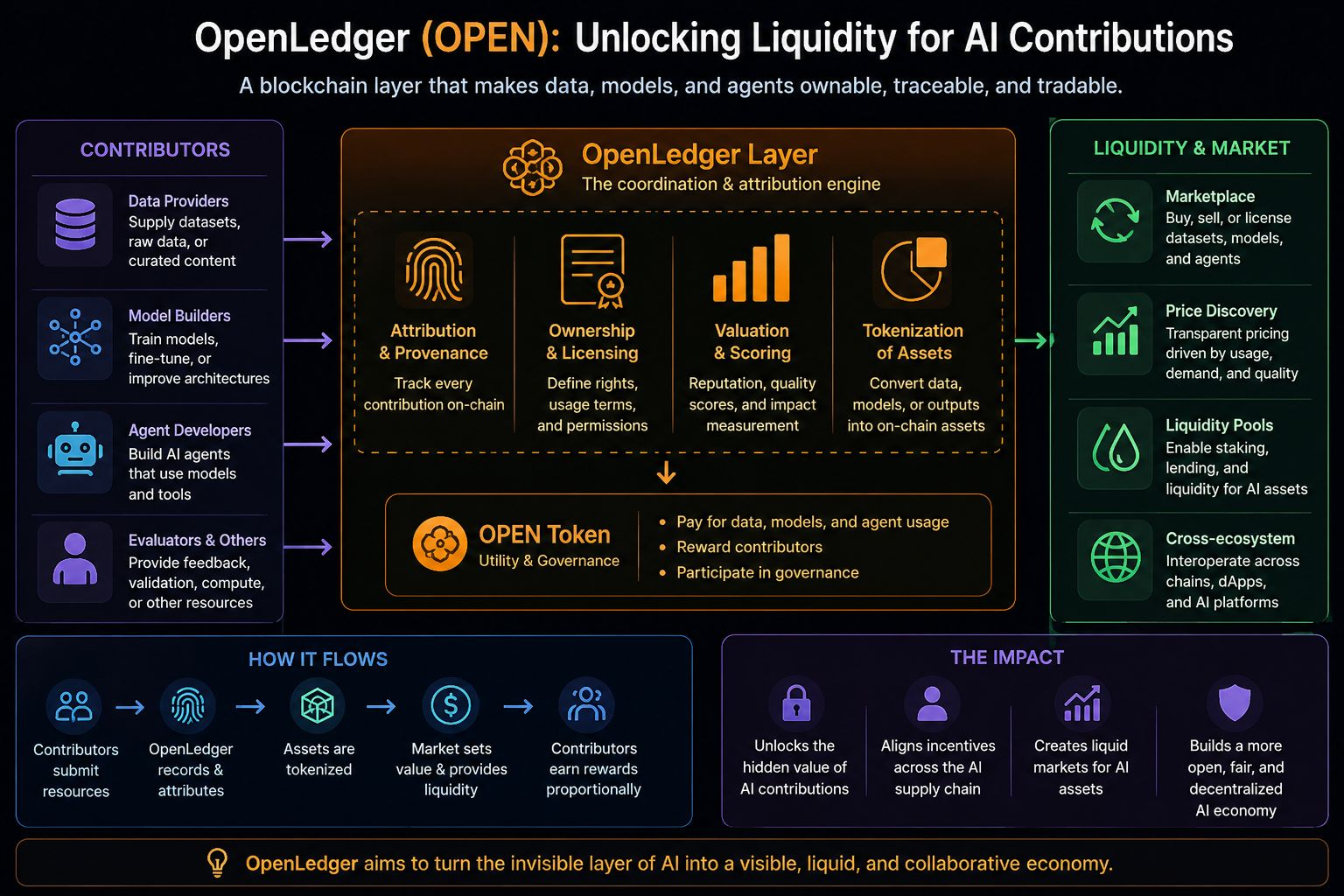
Another angle that stands out is the role of agents. If autonomous systems start generating outputs at scale then attribution becomes even more complex. Who owns the result when multiple models and datasets interact in a chain. This is where OpenLedger OPEN tries to position itself but I am not sure how enforceable that vision is across open environments
The more I think about it the more it feels like a coordination problem rather than just a technical one. You can build tracking systems but getting participants to agree on value distribution is a different challenge entirely. That part is often underestimated in crypto design
There is also a subtle tension here. If everything becomes measurable then everything becomes negotiable. That can be powerful but also overwhelming. I do not know yet if ecosystems actually function better under that level of granularity or if they slow down
I keep coming back to one question. If data becomes capital in a real sense then who defines its productivity. Is it usage, model performance, or something else entirely. I do not have a clear answer and maybe that is the point
In trading and narratives I have learned that early ideas often feel incomplete. OpenLedger OPEN sits in that category for me right now. Not dismissed but not fully resolved either. It sits in that uncomfortable middle space where curiosity and doubt coexist
Maybe the real test will not be in the concept itself but in whether real builders choose to align with it over time. Until then it feels like one of those ideas that quietly stays in the background of AI crypto discussions waiting for clearer signals that may or may not arrive
