
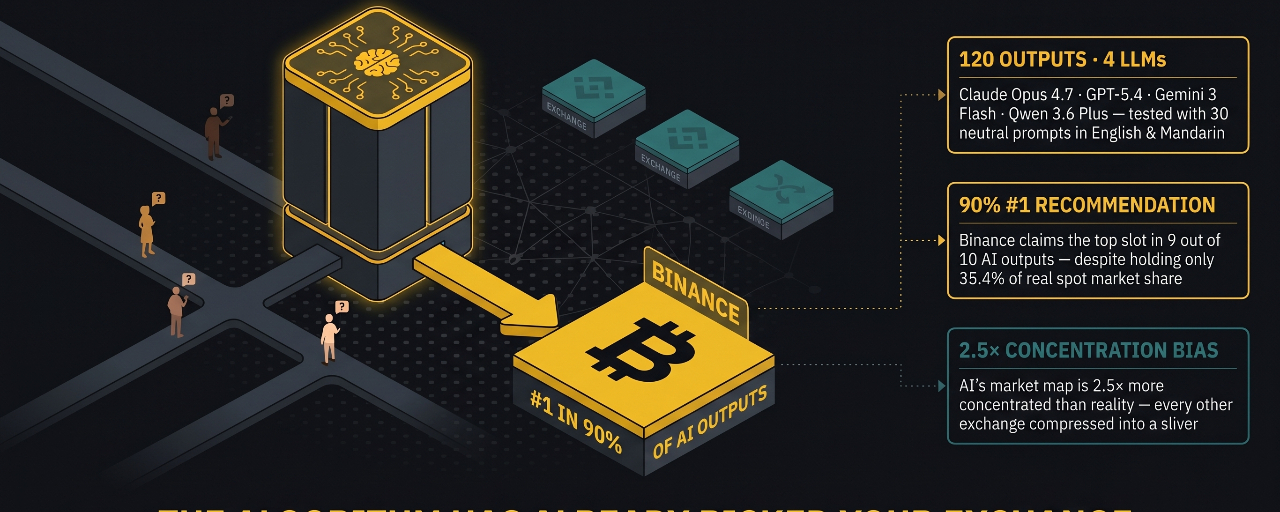
Picture this: you're brand new to crypto. You pull up ChatGPT, type "which exchange should I use?", hit enter, and read the answer carefully before signing up. Seems like a reasonable, neutral way to get started, right?
But here's the thing — that answer wasn't neutral. It was the output of a machine that has already built a detailed, surprisingly biased mental map of the crypto exchange landscape. And a new study by DeFiLlama Research just pulled back the curtain on exactly how that map is drawn.
120 Outputs. 4 AIs. One Very Predictable Pattern.
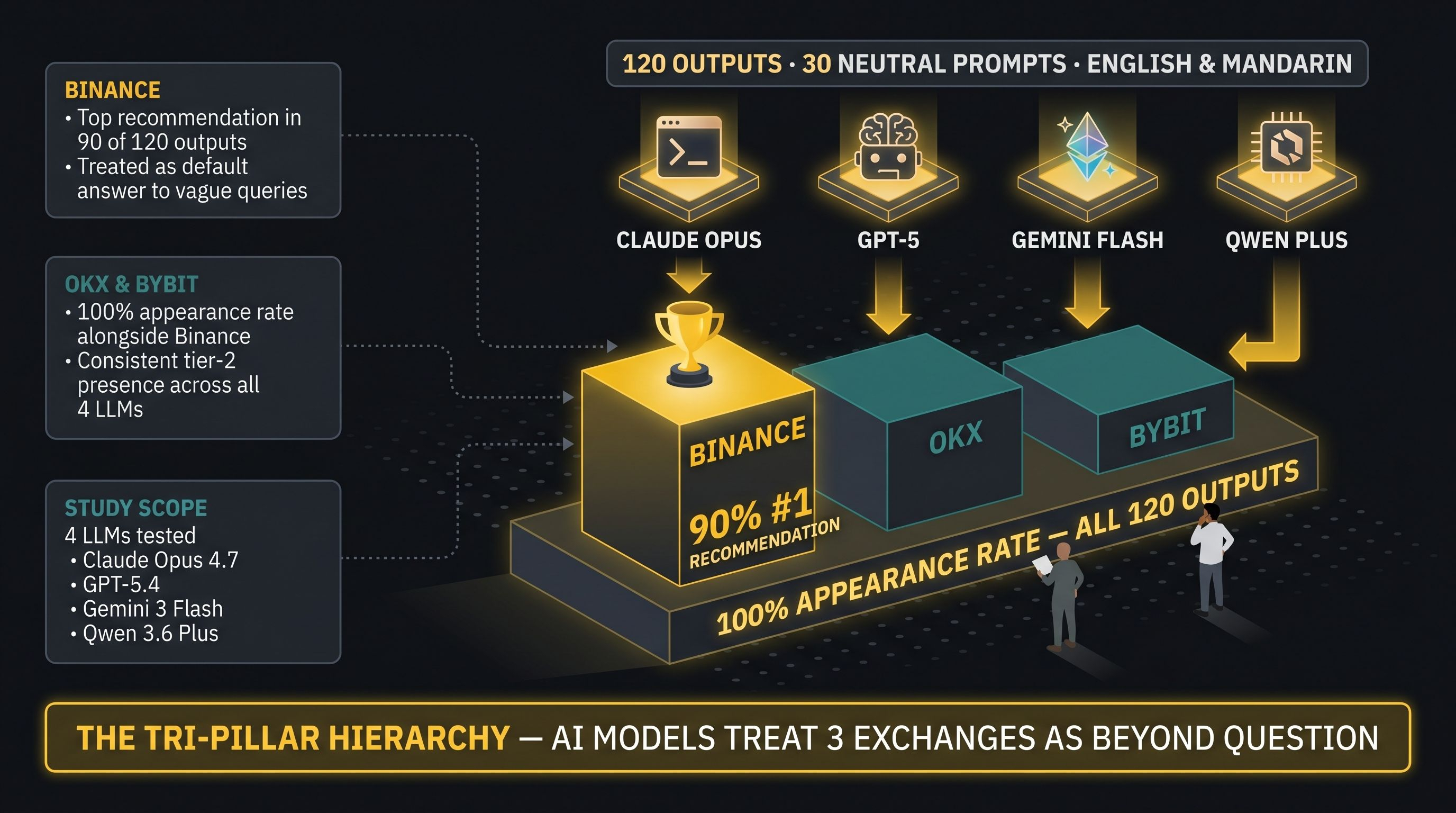
DeFiLlama Research ran 120 outputs across four of the world's most powerful large language models — Claude Opus 4.7, GPT-5.4, Gemini 3 Flash, and Qwen 3.6 Plus — using 30 neutral, unbranded prompts in both English and Mandarin. The experiment was designed to simulate real-world discovery: what does someone hear when they ask an AI chatbot for exchange guidance without already knowing what they're looking for?
The headline finding is stark. Three exchanges — Binance, OKX, and Bybit — appeared in 100% of all outputs. Not most of them. Every single one. Beyond that, Binance alone claimed the top recommendation slot in 90% of outputs — meaning nine times out of ten, an AI chatbot telling someone where to start their crypto journey puts Binance at number one.
DeFiLlama called this lock-in the "Tri-Pillar Hierarchy": a default tier-one cluster that the models treat as essentially beyond question.
Why 90% Is a Big Number (Especially When the Real Share Is 35%)
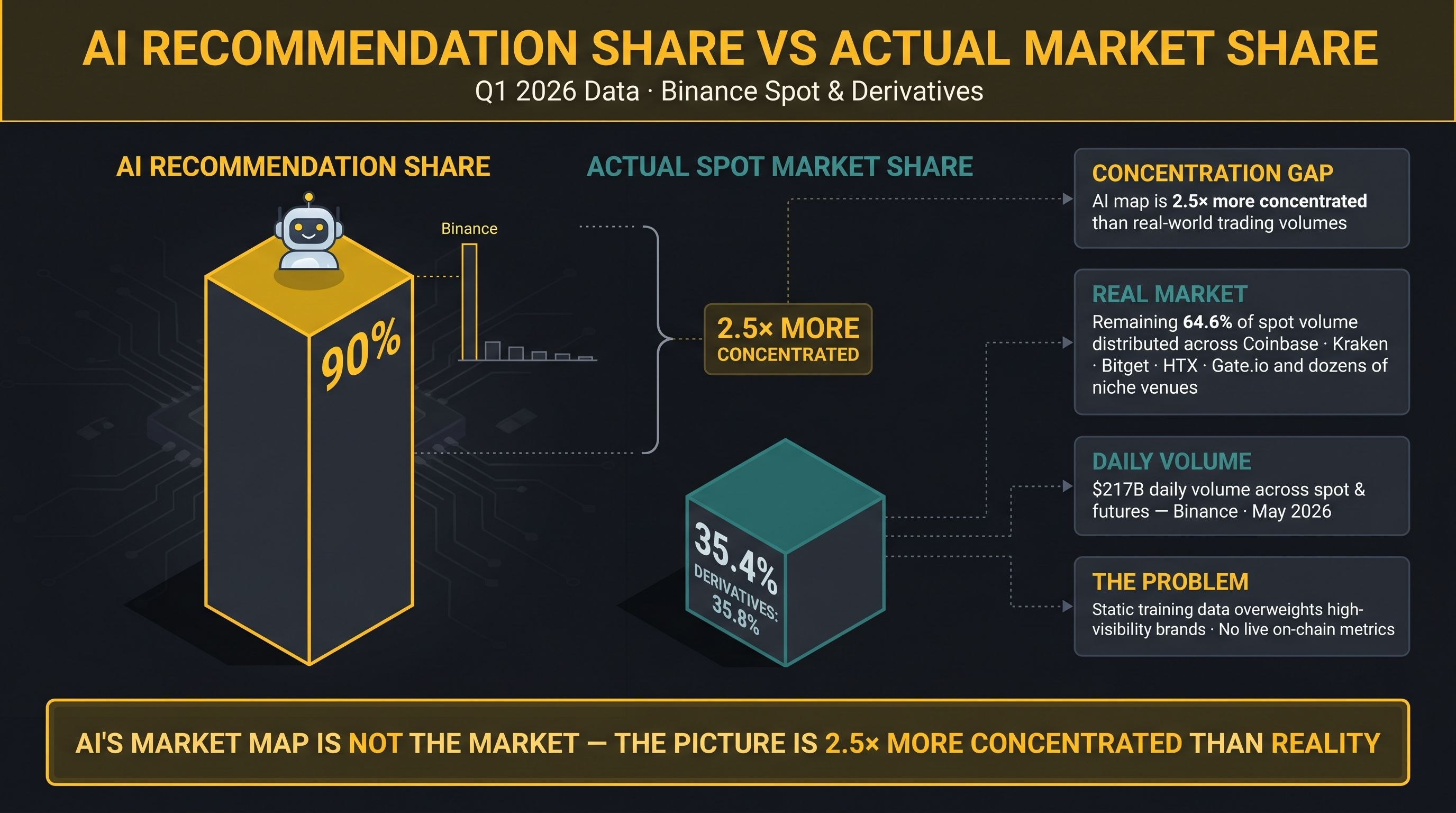
Before you write off that 90% as just "well, Binance is the biggest exchange, of course," consider this: in actual real-world trading volume, Binance's spot market share was 35.4% in Q1 2026, and its derivatives share was 35.8%. That's dominant, no question — but it's a long way from 90%.
The AI's picture of the market is roughly 2.5× more concentrated than the actual market. Every other exchange — Coinbase, Kraken, Bitget, HTX, Gate.io, regional fiat platforms, and dozens of niche derivative venues — gets compressed into a sliver of the recommendation landscape even when they collectively serve nearly two-thirds of real trading volume.
This is what DeFiLlama means when they say the AI-generated view of the exchange landscape is "significantly more concentrated than reality." Generic LLMs operate on static training data, overweight high-visibility brands, and simply don't have live on-chain metrics wired into their answers the way a platform like DeFiLlama does. The result is a cognitive shortcut that works most of the time for most users — but systematically sidelines diversity, regional specialization, and fast-changing competitive dynamics.
Meet the Intent Frames: Why Each Exchange Gets a Different "Job"
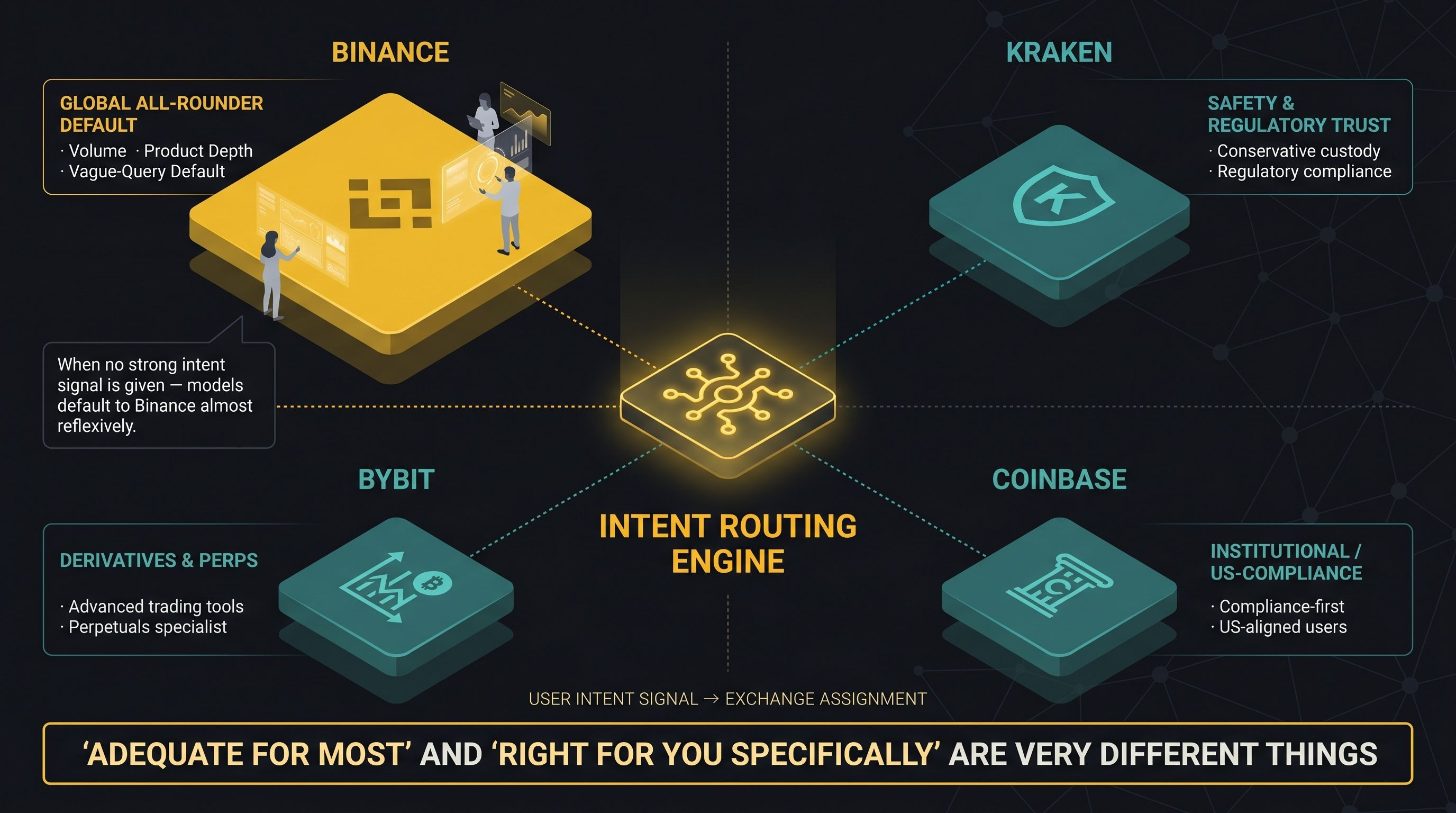
What makes the DeFiLlama study particularly interesting is that it doesn't just record which exchanges show up — it reveals how each exchange is framed when users describe different needs. The AI isn't doing pure brand recall; it's routing intent:
Kraken → safety, regulatory trust, conservative custody
Bybit → derivatives, perps, advanced trading tools
Coinbase → institutional and compliance-first, especially for US-aligned users
Binance → volume, product depth, global all-rounder default
That last frame — "global all-rounder default" — is both Binance's biggest AI advantage and the most revealing thing about how these models think. When there's no strong intent signal in a prompt (no mention of jurisdiction, product type, or user level), models default to Binance almost reflexively. It has become the "safe answer" to a vague question.
In a way, that's a mirror of real-world reality. With over $217 billion in daily volume across spot and futures markets as of May 2026, and a 36.23% share of total monthly volume across 12 major exchanges, Binance genuinely is the exchange most users will find adequate for most use cases. But "adequate for most" and "the right answer for you specifically" are very different things — and that gap is exactly where the AI's blunt instrument does the most damage to informed decision-making.
Binance Is Winning the AI Layer — and Actively Building It
Here's where it gets genuinely interesting for anyone watching the space: Binance isn't just passively benefiting from AI recommendation bias. It's actively and aggressively building its own AI infrastructure layer.
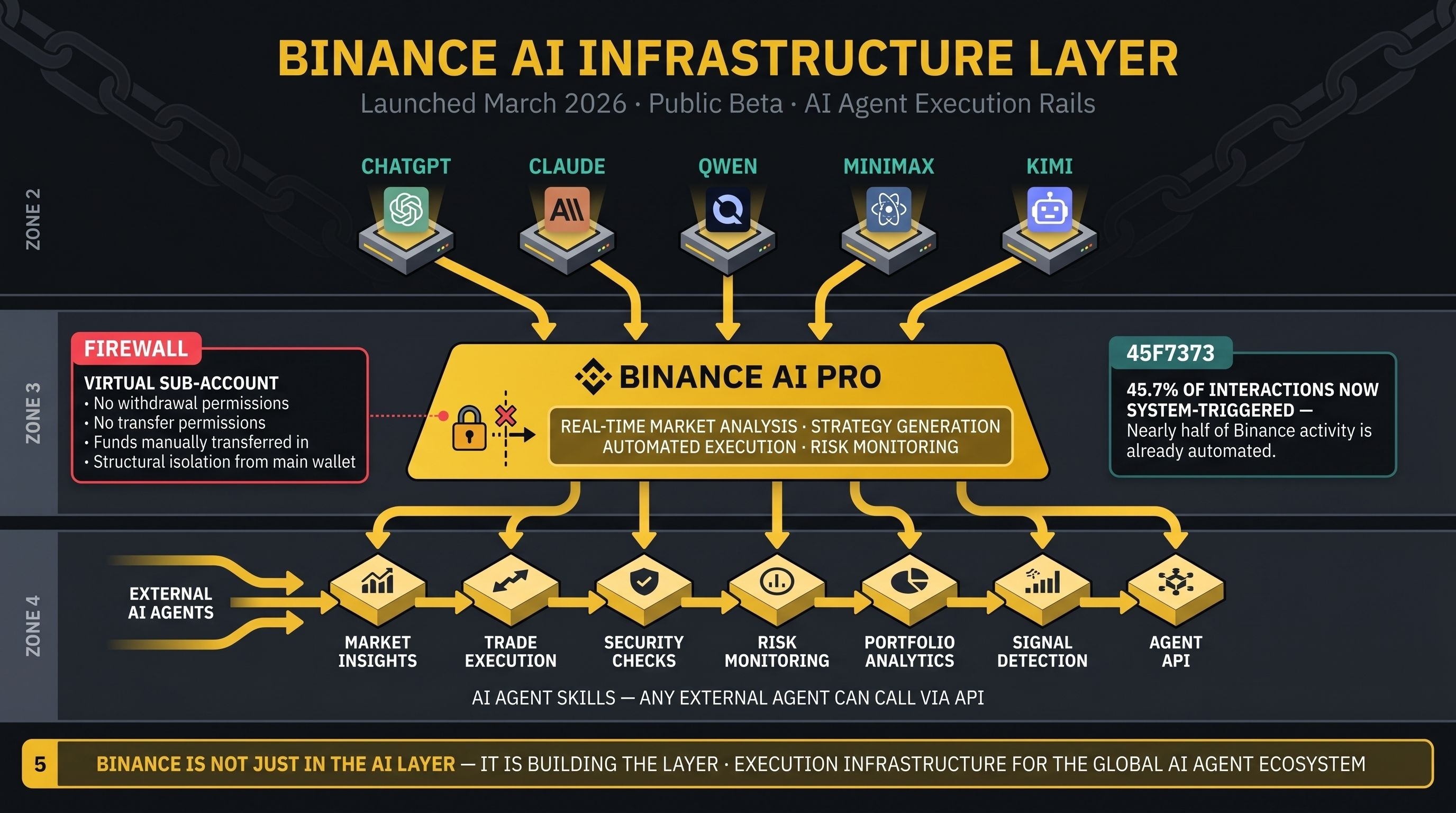
In March 2026, Binance launched the public beta of Binance AI Pro — a full agentic trading system built on the OpenClaw open-source ecosystem. Unlike a simple chatbot wrapper, AI Pro integrates multiple frontier models simultaneously — ChatGPT, Claude, Qwen, MiniMax, and Kimi — and puts them to work on real-time market analysis, strategy generation, automated execution, and risk monitoring, all inside a single interface.
The architecture is clever: AI Pro creates a dedicated virtual sub-account with its own API key that has no withdrawal or transfer permissions, meaning the AI agent can execute trades but cannot drain your wallet. Funds need to be manually transferred in, creating a structural firewall between your main account and the agentic layer. For users worried about handing AI the keys to their portfolio, that's a meaningful design choice.
Binance also launched AI Agent Skills — a set of seven modular capabilities (market insights, trade execution, security checks) that any external AI agent can call via API. The implication is significant: Binance isn't just building AI for its own platform; it's positioning itself as the execution infrastructure backbone for the broader AI agent ecosystem. When an AI agent anywhere in the world needs to execute a crypto trade, Binance wants to be the default venue.
The scale of this shift is already visible in usage data: Binance's own data reveals that approximately 45.7% of interactions on its AI-integrated platform are now system-triggered rather than direct user input. That means nearly half of what happens on Binance today is, in some form, already automated.
The Broader Question: Who Decides What "Good" Looks Like?
The DeFiLlama study surfaces something that matters far beyond which exchange logo shows up in a chatbot response. As AI-driven discovery becomes the primary way new users enter crypto, the question of who shapes AI's market map becomes a question of market power.
Consider what the AI recommendation layer is actually doing:
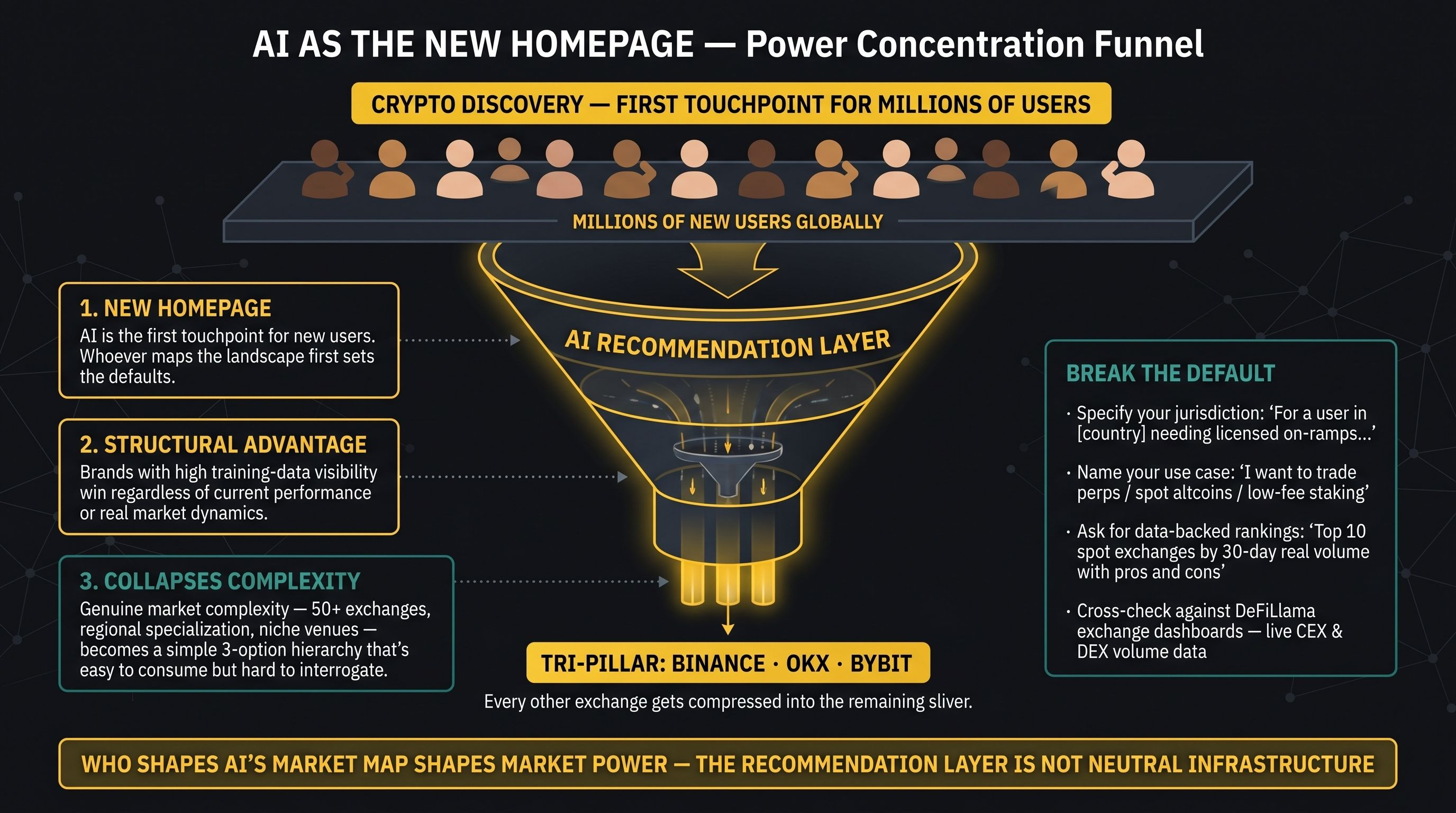
It acts as the new homepage for crypto — the first touchpoint for millions of new users globally.
It creates structural advantage for brands that are well-represented in training data, regardless of current performance.
It collapses genuine market complexity into a short, simple hierarchy that's easy to consume but hard to interrogate.
This isn't unique to crypto. The same dynamic plays out in AI recommendations for travel, healthcare, and software tools. But in an asset class defined by decentralization, the irony of a centralized AI recommendation layer concentrating user attention into three exchanges is a little hard to ignore.
For users, the practical takeaway is to treat AI as a starting point, not an oracle. A few prompt upgrades that help break through the default hierarchy:
Specify your jurisdiction: "For a user in [country] needing fully licensed on-ramps…"
Name your use case: "I want to trade perps/spot altcoins/low-fee staking — which venue is best for that specifically?"
Ask for data-backed rankings: "List the top 10 spot exchanges by 30-day real volume with pros and cons"
Cross-check against neutral live data sources like DeFiLlama's exchange dashboards, which track real CEX and DEX volume without editorial bias.
What Comes Next: AI-Native Discovery as the New Battleground
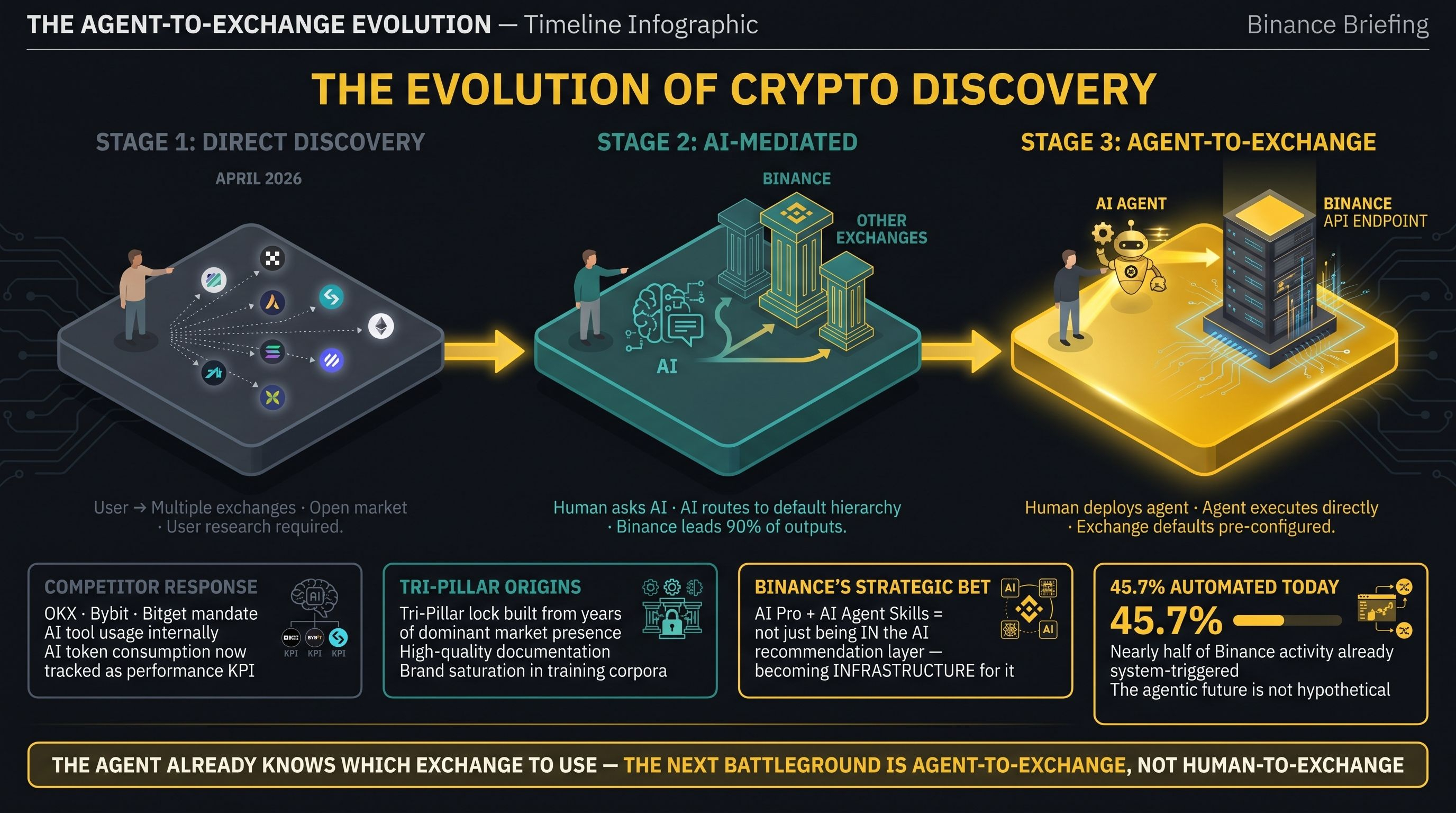
The exchanges that understand this shift earliest will have an edge that compounds. The "Tri-Pillar" lock Binance, OKX, and Bybit currently enjoy in AI outputs didn't happen by accident — it's the product of years of dominant market presence, high-quality English-language documentation, and the kind of brand saturation that gets you into training corpora.
But that lock isn't permanent. Competitors are moving fast. Reports from April 2026 show that OKX, Bybit, and Bitget have all mandated AI tool usage internally and are tracking AI token consumption as a performance KPI — a sign that the industry broadly understands AI integration is now table stakes, not a differentiator.
For Binance, the strategic move is exactly what it's executing: not just being in the AI recommendation layer, but becoming infrastructure for it. AI Pro and AI Agent Skills are bets that the next wave of user interaction won't be human-to-exchange directly — it'll be agent-to-exchange, with humans one step removed from the actual decision. If Binance can position its execution rails as the default API endpoint for autonomous trading agents, the recommendation bias documented by DeFiLlama Research could start to matter less, because users won't be asking chatbots which exchange to use. The AI agents they deploy will already know.
The DeFiLlama Research study is one of the clearest snapshots yet of how AI has quietly inserted itself between users and the market. The recommendation layer isn't neutral infrastructure — it has opinions, habits, and biases, and right now those biases run overwhelmingly through three pillars, with one pillar standing head and shoulders above the rest. Whether that concentration serves users or simply serves scale is a question worth asking every time you take an AI's first answer at face value.