
Sometimes crypto feels like it keeps coming back to the same question, who actually gets rewarded when value is created.
We have seen this play out in DeFi, gaming, social platforms, data networks, and now AI. The pattern is familiar. A new system gets built, users interact with it, data flows through it, models improve, demand grows, and somewhere in the middle, value is created. But the reward usually lands at the protocol level, the company level, or with whoever controls the main infrastructure. The smaller pieces that helped make the output useful often stay invisible.
That is why the idea of inference level rewards feels interesting to me. Not because it sounds flashy, but because it touches a real problem in the AI and crypto overlap. If an AI response, prediction, or output is useful, can we trace which model, data source, agent, or contributor helped create that usefulness? And if we can trace it, can rewards flow back more fairly?
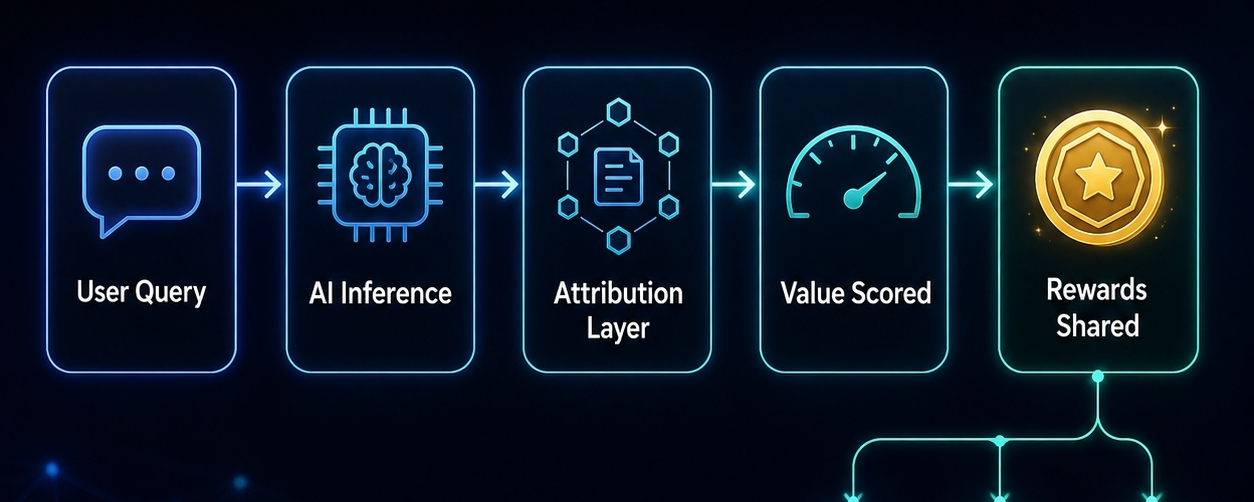
OpenLedger is trying to explore that exact area. Instead of only thinking about AI rewards in broad terms, like rewarding people for training data or rewarding builders for launching models, the focus moves closer to the moment where value actually appears. That moment is inference, when a user asks something, a model responds, and the output has some kind of real utility.
I’ve noticed that most people talk about AI incentives at the training stage. Who provided the data? Who built the model? Who paid for compute? Those are important questions, of course. But in everyday use, AI does not create value only because it was trained once. Value happens again and again every time someone uses it. Every prompt, every query, every response, every task completed by an agent becomes a tiny value event.
In crypto terms, that is a big shift. We are used to systems where value can be tracked through transactions. If someone swaps tokens, provides liquidity, validates a block, or pays gas, the activity is visible. But AI inference is messier. A useful answer may come from a combination of models, data layers, fine tuning, context, and routing decisions. OpenLedger’s idea is to make that invisible contribution layer easier to account for.
From my perspective, inference level rewards only become possible when the system can answer a few simple questions. What was used? Who contributed to it? Did it help produce the result? And how should the reward be split? These sound basic, but they are not easy when AI systems are dynamic and outputs are generated in real time.
Think about a simple example. A user asks an AI agent to analyze a market trend. The final answer might depend on a base model, a specialized crypto model, live market data, community generated insights, and maybe a smaller model trained on trading behavior. If the user pays for that result, why should only one layer capture the value? If each part helped make the answer better, the reward logic should be able to recognize that.
That is where OpenLedger’s approach starts to make sense. It is not just about storing AI related activity on chain for the sake of saying it is on chain. The deeper point is attribution. Crypto is good at creating transparent settlement systems. AI needs better attribution systems. When those two ideas meet, inference becomes something that can be measured, recorded, and rewarded more fairly.
One thing that stood out to me is how this changes the role of contributors. In many AI systems, contributors are treated like raw input providers. They give data, feedback, or expertise, then the platform absorbs it. But if rewards can happen at the inference level, contributors are not only rewarded once. They can potentially benefit whenever their contribution helps create useful outputs later.
That feels closer to how crypto people already think. If you provide liquidity, you do not only get recognized at the moment you deposit. You earn as trades happen. If you secure a network, you are rewarded as the network continues operating. Inference level rewards apply a similar mindset to AI value creation. Contribution becomes active over time instead of being a one time extraction.
Of course, the difficult part is avoiding fake attribution. Crypto has already learned this lesson the hard way. Whenever rewards exist, people try to game them. Wash trading, Sybil farming, low quality content farming, useless activity loops, we have seen all of it. So for inference level rewards to matter, the system needs more than just activity tracking. It needs a way to judge meaningful contribution without turning everything into spam.
Sometimes I wonder if this will become one of the biggest challenges in AI networks. Not compute, not even model quality, but reward quality. If rewards go to the wrong places, the network attracts the wrong behavior. If rewards are aligned with useful outputs, then builders, data contributors, and model creators have a reason to improve the system instead of just chasing emissions.
What’s interesting is that inference rewards could also make smaller AI models more relevant. Right now, the AI world often feels dominated by giant models and massive infrastructure players. But in practice, specialized models can be extremely useful. A smaller model trained for a narrow task might outperform a larger general model in a specific area. If inference level attribution works, these smaller specialized contributors could earn based on actual usefulness, not just brand recognition or size.
That matters for crypto because crypto communities are naturally niche. Traders, researchers, NFT users, DeFi builders, security analysts, and gaming communities all have different information needs. A general AI model may be decent across everything, but specialized intelligence can be much more valuable in context. OpenLedger’s model points toward a world where those specialized layers can plug into broader AI systems and still receive credit when they add value.
There is also a social angle here. A lot of users are becoming more aware that their activity trains, improves, or guides digital systems. People are starting to ask, “If my data, feedback, or expertise helps make the system better, where is my share?” That question is not going away. In fact, it will probably get louder as AI becomes more embedded in trading tools, research assistants, wallets, games, and creator platforms.
OpenLedger does not magically solve every problem around AI ownership or reward distribution. No system does. But the concept of rewarding value at the inference level feels like a meaningful step away from vague promises and toward something more measurable. It brings the reward closer to the actual moment of use, where the output either helps or it does not.
For everyday crypto users, this could change how we think about AI networks. Instead of only asking which AI project has the biggest model or the loudest narrative, we may start asking better questions. Can it track contribution? Can it reward usefulness? Can smaller participants actually earn from the value they help create? Can the system stay fair when incentives attract pressure?
I like that direction because it feels more grounded. Crypto does not need AI to become another hype cycle where everyone throws around big words and waits for the next token chart. The more interesting future is one where AI systems become open enough, accountable enough, and incentive aware enough that real contributors are not buried underneath the platform.
Inference level rewards are still early as an idea, but the logic behind them is worth paying attention to. If AI is going to become part of the crypto stack, then value should not only flow to the surface. It should reach the layers that actually make the output useful. And maybe that is where OpenLedger’s bigger point sits, not in promising a perfect system, but in asking crypto to rethink where AI value really comes from.