Genius Terminal — Why Privacy Might Become Crypto’s Most Important Missing Piece
A few years ago, I remember showing a friend how blockchain transactions work. At first, he thought it was impressive that everything was transparent and traceable. But after a few minutes, his reaction changed.
“So basically,” he said, “anyone can watch what you do?”
That question stayed in my head longer than I expected.
Crypto has spent years celebrating transparency like it’s automatically a good thing. And to be fair, transparency did solve real problems. It created open systems, public verification, and trust without middlemen. But somewhere along the way, the space drifted into an extreme version of openness where almost everything became visible all the time.
Wallet activity. Trading behavior. Asset movements. Strategies. Positions.
Sometimes it feels less like financial freedom and more like living inside a glass house.
That’s honestly why Genius Terminal caught my attention.
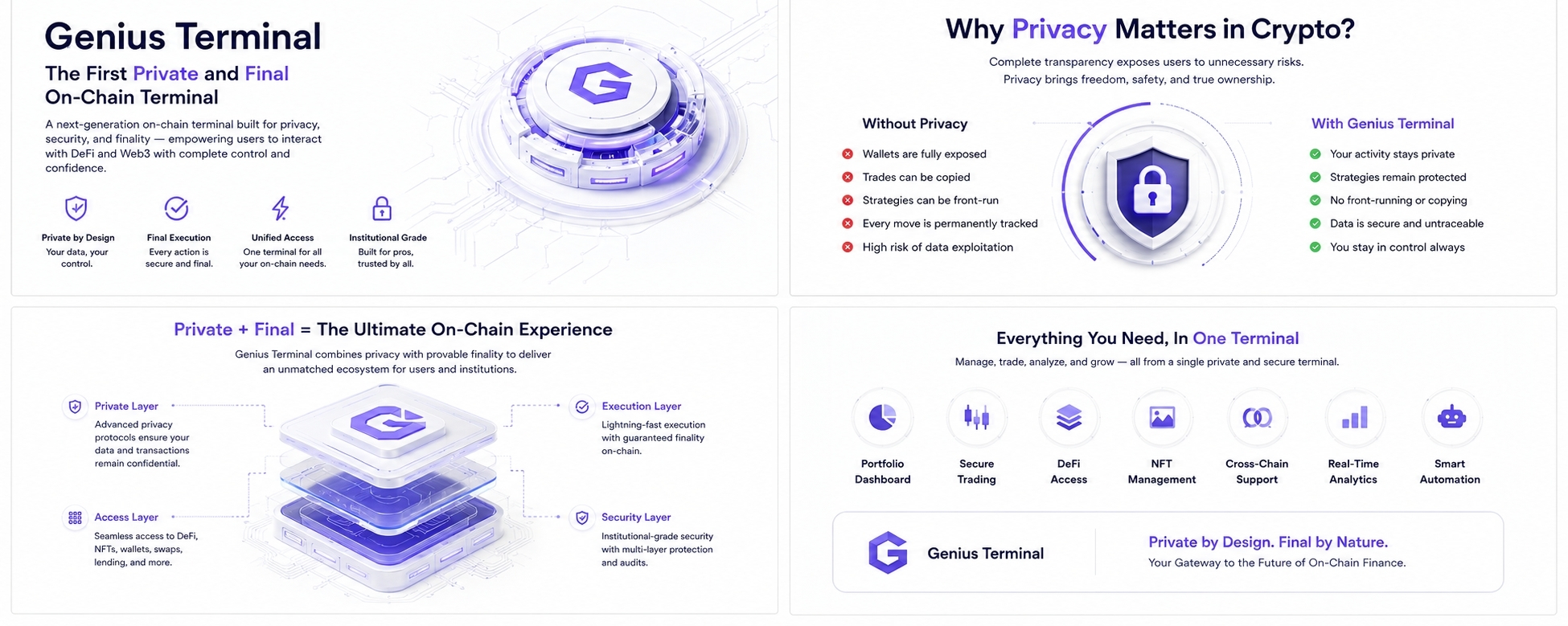
The project calls itself the first private and final on-chain terminal, and the more I thought about that phrase, the more it started to feel less like marketing and more like a reflection of where crypto may eventually need to go.
Because the truth is, privacy is slowly becoming one of the biggest missing pieces in blockchain infrastructure.
Crypto Accidentally Built a Surveillance Economy
I don’t think most people originally imagined crypto would evolve this way.
The early idea was simple: Give people ownership. Remove unnecessary control. Create open systems.
But what actually happened is that blockchain transparency became so powerful that entire industries were built around tracking people.
Now there are tools that can monitor wallets in real time, analyze trading behavior, follow capital flows, and map user activity across ecosystems. Some traders even copy other wallets automatically the moment they see movement.
At some point, “open finance” quietly turned into permanent visibility.
And honestly, I think many users accepted this simply because there weren’t better alternatives yet.
That’s why projects focused on privacy suddenly feel more important now than they did a few years ago.
Privacy Isn’t About Hiding — It’s About Breathing Room
One thing crypto discussions often get wrong is treating privacy like it automatically means secrecy or bad intentions.
I don’t see it that way at all.
Privacy is normal.
People close their curtains at night. People use passwords. People don’t publish bank statements online.
None of that makes someone suspicious. It just means humans naturally want control over personal information.
Financial activity is no different.
The strange thing is that traditional finance already understands this. Your banking history isn’t broadcast publicly to strangers. Your transactions aren’t displayed on a searchable global ledger for anyone to analyze forever.
But in crypto, users somehow normalized total exposure.
That model probably works for experimentation, but I’m not convinced it works for long-term mainstream adoption.
And I think Genius Terminal is tapping into that exact realization.
Why the Word “Final” Actually Matters
The “private” part gets attention immediately, but the word final may actually be just as important.
In blockchain systems, finality matters because users need confidence that actions are completed securely and reliably. Weak execution creates hesitation. Strong finality creates trust.
If a platform combines privacy with dependable execution, it changes the overall experience dramatically.
Instead of feeling like fragmented internet tools stitched together, the system starts feeling closer to real infrastructure.
That matters more than people think.
Because one of crypto’s biggest hidden problems is friction.
Even experienced users constantly move between wallets, bridges, explorers, terminals, dashboards, and protocols just to complete relatively simple actions. The experience still feels messy in ways that most outsiders underestimate.
Projects that simplify interaction while protecting users could become extremely valuable over time, especially as the industry matures.
Most Lasting Crypto Projects Solve Quiet Problems
One thing I’ve noticed after watching crypto cycles for years is that the loudest projects are not always the most important ones.
The hype usually goes toward speculation first.
But eventually, the market circles back to infrastructure.
That’s where long-term value often sits.
The projects that survive are usually the ones solving problems people consistently feel: speed, security, scalability, coordination, usability, privacy.
Not every important innovation looks exciting immediately.
In fact, infrastructure projects are often overlooked precisely because they feel less emotional and more technical. But once adoption grows, those systems quietly become essential.
I think privacy infrastructure may be entering that stage now.
The Bigger Shift Happening Beneath Crypto
What makes Genius Terminal interesting to me is that it feels connected to a broader shift happening across the space.
Crypto is slowly moving away from the phase where visibility alone was treated as progress.
Now the conversation is becoming more balanced.
People still want verification and trustlessness. But they also want ownership over their information. They want security without feeling exposed. They want openness without becoming permanently trackable.
That balance is difficult to build technically, which is why privacy-focused infrastructure is complicated and often underestimated.
The challenge isn’t simply hiding information.
The challenge is protecting users while still preserving trust inside decentralized systems.
And honestly, I think that’s one of the hardest problems blockchain still hasn’t fully solved.
My Personal Take
I don’t think Genius Terminal is interesting because it promises some dramatic revolution overnight.
What interests me more is the direction behind the idea.
The project seems to recognize that crypto cannot mature into global financial infrastructure if every participant is forced into complete public exposure forever.
At some point, users need breathing room.
Not because they have something to hide. Because normal people value control.
That’s the part many blockchain systems forgot.
So when I look at Genius Terminal, I don’t just see another crypto product trying to ride a narrative. I see a project attempting to address a structural weakness that has existed in the ecosystem for a long time.
And whether the industry fully realizes it yet or not, I think privacy is eventually going to become one of the defining conversatioGenius Terminal — Why Privacy Might Become Crypto’s Most Important Missing Piece
A few years ago, I remember showing a friend how blockchain transactions work. At first, he thought it was impressive that everything was transparent and traceable. But after a few minutes, his reaction changed.
“So basically,” he said, “anyone can watch what you do?”
That question stayed in my head longer than I expected.
Crypto has spent years celebrating transparency like it’s automatically a good thing. And to be fair, transparency did solve real problems. It created open systems, public verification, and trust without middlemen. But somewhere along the way, the space drifted into an extreme version of openness where almost everything became visible all the time.
Wallet activity. Trading behavior. Asset movements. Strategies. Positions.
Sometimes it feels less like financial freedom and more like living inside a glass house.
That’s honestly why Genius Terminal caught my attention.
The project calls itself the first private and final on-chain terminal, and the more I thought about that phrase, the more it started to feel less like marketing and more like a reflection of where crypto may eventually need to go.
Because the truth is, privacy is slowly becoming one of the biggest missing pieces in blockchain infrastructure.
Crypto Accidentally Built a Surveillance Economy
I don’t think most people originally imagined crypto would evolve this way.
The early idea was simple: Give people ownership. Remove unnecessary control. Create open systems.
But what actually happened is that blockchain transparency became so powerful that entire industries were built around tracking people.
Now there are tools that can monitor wallets in real time, analyze trading behavior, follow capital flows, and map user activity across ecosystems. Some traders even copy other wallets automatically the moment they see movement.
At some point, “open finance” quietly turned into permanent visibility.
And honestly, I think many users accepted this simply because there weren’t better alternatives yet.
That’s why projects focused on privacy suddenly feel more important now than they did a few years ago.
Privacy Isn’t About Hiding — It’s About Breathing Room
One thing crypto discussions often get wrong is treating privacy like it automatically means secrecy or bad intentions.
I don’t see it that way at all.
Privacy is normal.
People close their curtains at night. People use passwords. People don’t publish bank statements online.
None of that makes someone suspicious. It just means humans naturally want control over personal information.
Financial activity is no different.
The strange thing is that traditional finance already understands this. Your banking history isn’t broadcast publicly to strangers. Your transactions aren’t displayed on a searchable global ledger for anyone to analyze forever.
But in crypto, users somehow normalized total exposure.
That model probably works for experimentation, but I’m not convinced it works for long-term mainstream adoption.
And I think Genius Terminal is tapping into that exact realization.
Why the Word “Final” Actually Matters
The “private” part gets attention immediately, but the word final may actually be just as important.
In blockchain systems, finality matters because users need confidence that actions are completed securely and reliably. Weak execution creates hesitation. Strong finality creates trust.
If a platform combines privacy with dependable execution, it changes the overall experience dramatically.
Instead of feeling like fragmented internet tools stitched together, the system starts feeling closer to real infrastructure.
That matters more than people think.
Because one of crypto’s biggest hidden problems is friction.
Even experienced users constantly move between wallets, bridges, explorers, terminals, dashboards, and protocols just to complete relatively simple actions. The experience still feels messy in ways that most outsiders underestimate.
Projects that simplify interaction while protecting users could become extremely valuable over time, especially as the industry matures.
Most Lasting Crypto Projects Solve Quiet Problems
One thing I’ve noticed after watching crypto cycles for years is that the loudest projects are not always the most important ones.
The hype usually goes toward speculation first.
But eventually, the market circles back to infrastructure.
That’s where long-term value often sits.
The projects that survive are usually the ones solving problems people consistently feel: speed, security, scalability, coordination, usability, privacy.
Not every important innovation looks exciting immediately.
In fact, infrastructure projects are often overlooked precisely because they feel less emotional and more technical. But once adoption grows, those systems quietly become essential.
I think privacy infrastructure may be entering that stage now.
The Bigger Shift Happening Beneath Crypto
What makes Genius Terminal interesting to me is that it feels connected to a broader shift happening across the space.
Crypto is slowly moving away from the phase where visibility alone was treated as progress.
Now the conversation is becoming more balanced.
People still want verification and trustlessness. But they also want ownership over their information. They want security without feeling exposed. They want openness without becoming permanently trackable.
That balance is difficult to build technically, which is why privacy-focused infrastructure is complicated and often underestimated.
The challenge isn’t simply hiding information.
The challenge is protecting users while still preserving trust inside decentralized systems.
And honestly, I think that’s one of the hardest problems blockchain still hasn’t fully solved.
My Personal Take
I don’t think Genius Terminal is interesting because it promises some dramatic revolution overnight.
What interests me more is the direction behind the idea.
The project seems to recognize that crypto cannot mature into global financial infrastructure if every participant is forced into complete public exposure forever.
At some point, users need breathing room.
Not because they have something to hide. Because normal people value control.
That’s the part many blockchain systems forgot.
So when I look at Genius Terminal, I don’t just see another crypto product trying to ride a narrative. I see a project attempting to address a structural weakness that has existed in the ecosystem for a long time.
And whether the industry fully realizes it yet or not, I think privacy is eventually going to become one of the defining conversatioGenius Terminal — Why Privacy Might Become Crypto’s Most Important Missing Piece
A few years ago, I remember showing a friend how blockchain transactions work. At first, he thought it was impressive that everything was transparent and traceable. But after a few minutes, his reaction changed.
“So basically,” he said, “anyone can watch what you do?”
That question stayed in my head longer than I expected.
Crypto has spent years celebrating transparency like it’s automatically a good thing. And to be fair, transparency did solve real problems. It created open systems, public verification, and trust without middlemen. But somewhere along the way, the space drifted into an extreme version of openness where almost everything became visible all the time.
Wallet activity. Trading behavior. Asset movements. Strategies. Positions.
Sometimes it feels less like financial freedom and more like living inside a glass house.
That’s honestly why Genius Terminal caught my attention.
The project calls itself the first private and final on-chain terminal, and the more I thought about that phrase, the more it started to feel less like marketing and more like a reflection of where crypto may eventually need to go.
Because the truth is, privacy is slowly becoming one of the biggest missing pieces in blockchain infrastructure.
Crypto Accidentally Built a Surveillance Economy
I don’t think most people originally imagined crypto would evolve this way.
The early idea was simple: Give people ownership. Remove unnecessary control. Create open systems.
But what actually happened is that blockchain transparency became so powerful that entire industries were built around tracking people.
Now there are tools that can monitor wallets in real time, analyze trading behavior, follow capital flows, and map user activity across ecosystems. Some traders even copy other wallets automatically the moment they see movement.
At some point, “open finance” quietly turned into permanent visibility.
And honestly, I think many users accepted this simply because there weren’t better alternatives yet.
That’s why projects focused on privacy suddenly feel more important now than they did a few years ago.
Privacy Isn’t About Hiding — It’s About Breathing Room
One thing crypto discussions often get wrong is treating privacy like it automatically means secrecy or bad intentions.
I don’t see it that way at all.
Privacy is normal.
People close their curtains at night. People use passwords. People don’t publish bank statements online.
None of that makes someone suspicious. It just means humans naturally want control over personal information.
Financial activity is no different.
The strange thing is that traditional finance already understands this. Your banking history isn’t broadcast publicly to strangers. Your transactions aren’t displayed on a searchable global ledger for anyone to analyze forever.
But in crypto, users somehow normalized total exposure.
That model probably works for experimentation, but I’m not convinced it works for long-term mainstream adoption.
And I think Genius Terminal is tapping into that exact realization.
Why the Word “Final” Actually Matters
The “private” part gets attention immediately, but the word final may actually be just as important.
In blockchain systems, finality matters because users need confidence that actions are completed securely and reliably. Weak execution creates hesitation. Strong finality creates trust.
If a platform combines privacy with dependable execution, it changes the overall experience dramatically.
Instead of feeling like fragmented internet tools stitched together, the system starts feeling closer to real infrastructure.
That matters more than people think.
Because one of crypto’s biggest hidden problems is friction.
Even experienced users constantly move between wallets, bridges, explorers, terminals, dashboards, and protocols just to complete relatively simple actions. The experience still feels messy in ways that most outsiders underestimate.
Projects that simplify interaction while protecting users could become extremely valuable over time, especially as the industry matures.
Most Lasting Crypto Projects Solve Quiet Problems
One thing I’ve noticed after watching crypto cycles for years is that the loudest projects are not always the most important ones.
The hype usually goes toward speculation first.
But eventually, the market circles back to infrastructure.
That’s where long-term value often sits.
The projects that survive are usually the ones solving problems people consistently feel: speed, security, scalability, coordination, usability, privacy.
Not every important innovation looks exciting immediately.
In fact, infrastructure projects are often overlooked precisely because they feel less emotional and more technical. But once adoption grows, those systems quietly become essential.
I think privacy infrastructure may be entering that stage now.
The Bigger Shift Happening Beneath Crypto
What makes Genius Terminal interesting to me is that it feels connected to a broader shift happening across the space.
Crypto is slowly moving away from the phase where visibility alone was treated as progress.
Now the conversation is becoming more balanced.
People still want verification and trustlessness. But they also want ownership over their information. They want security without feeling exposed. They want openness without becoming permanently trackable.
That balance is difficult to build technically, which is why privacy-focused infrastructure is complicated and often underestimated.
The challenge isn’t simply hiding information.
The challenge is protecting users while still preserving trust inside decentralized systems.
And honestly, I think that’s one of the hardest problems blockchain still hasn’t fully solved.
My Personal Take
I don’t think Genius Terminal is interesting because it promises some dramatic revolution overnight.
What interests me more is the direction behind the idea.
The project seems to recognize that crypto cannot mature into global financial infrastructure if every participant is forced into complete public exposure forever.
At some point, users need breathing room.
Not because they have something to hide. Because normal people value control.
That’s the part many blockchain systems forgot.
So when I look at Genius Terminal, I don’t just see another crypto product trying to ride a narrative. I see a project attempting to address a structural weakness that has existed in the ecosystem for a long time.
And whether the industry fully realizes it yet or not, I think privacy is eventually going to become one of the defining conversations of the next phase of crypto infrastructure.
Not louder systems.
More usable systems.
Not total exposure.
Smarter control.ns of the next phase of crypto infrastructure.
Not louder systems.
More usable systems.
Not total exposure.
Smarter control.ns of the next phase of crypto infrastructure.
Not louder systems.
More usable systems.
Not total exposure.
Smarter control.
@GeniusOfficial #genius $GENIUS