
OpenLedger: The AI Revolution Nobody Is Talking About Yet
What If Your Data Could Finally Pay You?
Think about it for a moment.
Every day, billions of people generate data. We write posts, create content, upload images, answer questions, provide feedback, and interact with countless digital platforms. This data has become one of the most valuable resources in the modern world.
Now ask yourself a simple question:
Who actually profits from it?
For the last decade, the answer has mostly been large technology companies.
Artificial Intelligence models are trained on enormous amounts of information generated by ordinary people, yet those contributors rarely receive recognition, ownership, or compensation. As AI becomes more powerful and more valuable, this imbalance is becoming increasingly difficult to ignore.
This is exactly the problem that OpenLedger is trying to solve.
OpenLedger is not just another blockchain project. It is not simply another AI platform. And it is certainly not just another token looking for hype.
Instead, OpenLedger is building something much bigger:
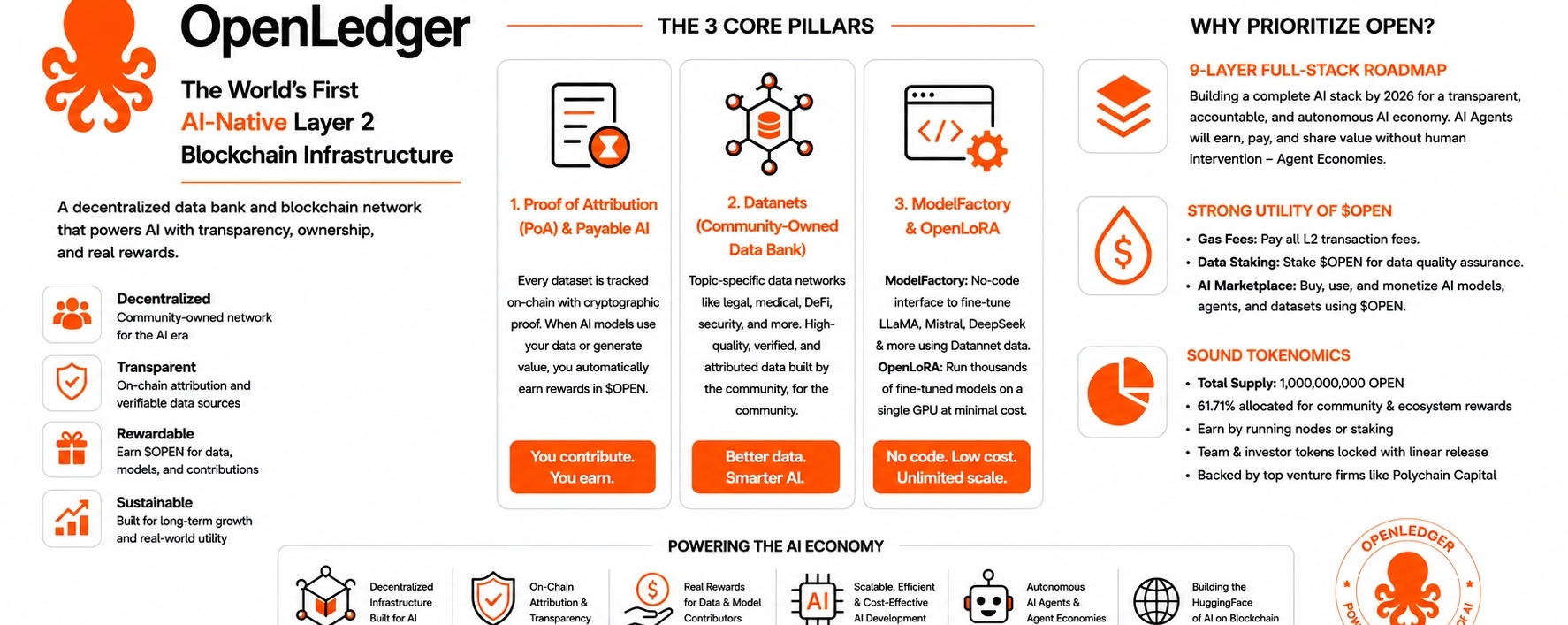
The world's first AI-Native Layer 2 Blockchain Infrastructure designed to transform data, AI models, and AI-generated value into transparent, traceable, and rewardable digital assets.
Its mission is ambitious but clear:
Create an economy where data creators, AI developers, and intelligent agents can all participate in the value they generate.
If successful, OpenLedger could become one of the most important bridges connecting Artificial Intelligence and Web3.
Why OpenLedger Exists
The current AI industry has a major flaw.
Most AI systems operate in a black-box environment.
Users often do not know:
- Where training data came from
- Who contributed that data
- Whether contributors were rewarded
- How AI-generated value is distributed
- Which datasets influenced specific outputs
This lack of transparency creates problems for users, developers, institutions, and regulators alike.
OpenLedger believes the next generation of AI must be built differently.
Instead of centralized ownership, OpenLedger introduces a decentralized framework where data contributions are verifiable, attribution is recorded permanently, and economic rewards flow back to contributors.
In simple terms:
The people who create value should participate in the value they create.
This philosophy serves as the foundation for everything OpenLedger is building.
The Three Core Pillars of OpenLedger
At the heart of the ecosystem are three major innovations that separate OpenLedger from traditional AI projects.
1. Proof of Attribution (PoA): The Technology That Rewards Data Ownership
This is arguably OpenLedger's most revolutionary innovation.
Traditionally, once data enters an AI training pipeline, it becomes almost impossible to identify who originally contributed it.
OpenLedger changes this through a mechanism known as:
Proof of Attribution (PoA)
PoA acts like a permanent digital fingerprint system.
Every dataset uploaded to the network is tracked and recorded on-chain.
This means the network can determine:
- Who contributed the data
- When it was submitted
- How it was used
- Which AI models interacted with it
- What value was generated from it
When an AI model produces value using attributed data, rewards can automatically flow back to the original contributors.
No intermediaries.
No manual calculations.
No centralized authority deciding who gets paid.
The entire process is handled transparently through blockchain infrastructure.
OpenLedger calls this concept:
Payable AI
Imagine contributing specialized legal knowledge.
Months later, an AI model trained on that dataset assists thousands of users.
Instead of receiving nothing, you earn rewards because your contribution helped create value.
This introduces something the AI industry has never successfully implemented at scale:
A sustainable economic model for data contributors.
Why Payable AI Could Become a Massive Industry
Many people compare AI to oil.
But there is an important difference.
Oil is extracted from the ground.
AI intelligence is extracted from data.
Without high-quality data, AI systems simply cannot improve.
As competition between AI companies intensifies, access to reliable datasets becomes increasingly valuable.
OpenLedger is attempting to create an entirely new marketplace where data itself becomes a productive asset.
Just as property owners can earn rent and investors can earn dividends, OpenLedger envisions a future where data owners earn recurring value from their contributions.
This is not merely a technological innovation.
It is an economic innovation.
2. Datanets: Building Community-Owned Intelligence
The second major component of OpenLedger is called Datanets.
A Datanet is essentially a specialized, decentralized knowledge network.
Rather than storing random information, each Datanet focuses on a specific category of expertise.
Examples include:
Legal Intelligence Datanets
Containing court documents, regulations, contracts, and legal research.
Medical Datanets
Containing healthcare information, medical literature, and clinical knowledge.
Financial Datanets
Containing market data, DeFi analytics, trading information, and economic insights.
Cybersecurity Datanets
Containing threat intelligence, exploit analysis, attack patterns, and security research.
Industry-Specific Datanets
Containing specialized information for sectors such as logistics, manufacturing, insurance, education, and energy.
Why Datanets Matter
The future of AI depends heavily on data quality.
Poor-quality data creates poor-quality AI.
Reliable data creates reliable AI.
Datanets introduce several important advantages:
Verified Origins
Every contribution has a traceable source.
Higher Data Quality
Contributors are incentivized to provide accurate information.
Transparent Attribution
Ownership records remain visible and verifiable.
Institutional Trust
Organizations can verify where training data originated.
This is particularly important for enterprises that must comply with legal and regulatory requirements.
In a future where AI influences healthcare, finance, law, and government decisions, data transparency becomes essential.
3. ModelFactory: AI Development Without Technical Barriers
Training AI models has traditionally been a difficult and expensive process.
Developers often need:
- Programming expertise
- Machine learning experience
- GPU infrastructure
- Complex deployment pipelines
OpenLedger aims to simplify this process through ModelFactory.
ModelFactory is a visual no-code environment that allows users to fine-tune large AI models using Datanet data.
Instead of writing extensive code, users can train specialized AI systems through a graphical interface.
This dramatically lowers the barrier to entry.
Researchers, businesses, educators, creators, and startups can all participate without needing deep AI engineering expertise.
OpenLoRA: Solving One of AI's Biggest Cost Problems
One of the largest expenses in AI development is compute.
Running thousands of customized models can quickly become financially unsustainable.
This is where OpenLoRA enters the picture.
OpenLoRA enables multiple fine-tuned models to efficiently share computational resources.
The result:
- Lower infrastructure costs
- Better GPU utilization
- Improved scalability
- Faster deployment
For developers and enterprises, this could significantly reduce the operational costs associated with AI products.
The Vision for 2026: A Fully Autonomous AI Economy
Perhaps the most exciting aspect of OpenLedger is its long-term roadmap.
The project is building a comprehensive 9-layer full-stack ecosystem designed to support every component of the AI economy.
The goal is not simply to host AI models.
The goal is to create an entirely new digital economy.
Enter the Era of Agent Economies
Today, humans initiate almost every economic transaction.
Tomorrow, AI agents may do much of this independently.
OpenLedger envisions a future where AI agents can:
- Earn revenue
- Purchase services
- Acquire datasets
- Rent computational resources
- Hire other AI agents
- Share profits automatically
All of this could occur without direct human involvement.
Imagine a research AI earning income from users, purchasing additional data to improve itself, and paying specialized AI agents to perform tasks.
This creates a self-sustaining ecosystem of intelligent economic participants.
If this vision becomes reality, it could fundamentally reshape how digital businesses operate.
Why the OPEN Token Could Play a Critical Role
Every successful blockchain ecosystem requires a native asset that powers network activity.
For OpenLedger, that asset is OPEN.
Unlike speculative tokens that struggle to find real-world utility, OPEN is positioned at the center of the ecosystem.
Network Transactions
Every operation on the network requires OPEN.
As activity increases, demand for the token potentially increases as well.
Data Staking
Data contributors must stake OPEN to demonstrate confidence in their submissions.
This helps improve overall data quality.
AI Marketplace Payments
Future AI marketplaces within the ecosystem are expected to use OPEN as the primary medium of exchange.
Models, agents, datasets, and AI services may all utilize OPEN for transactions.
Ecosystem Incentives
Rewards for network participants are distributed through the token economy.
This creates continuous engagement and participation.
Tokenomics Designed for Long-Term Growth
Tokenomics often determine whether a project succeeds or fails.
OpenLedger has structured its distribution model with long-term ecosystem growth in mind.
Key highlights include:
- Maximum supply capped at 1 billion OPEN
- Over 61% allocated to community and ecosystem incentives
- Mainnet reward opportunities for node operators
- Staking incentives for active participants
- Gradual token release schedules
- Reduced risk of sudden supply shocks
This approach aligns network growth with community participation rather than concentrating value among a small group of insiders.
Strong Backing and Industry Support
Technology alone is rarely enough.
Execution matters.
OpenLedger has attracted support from prominent venture capital firms and ecosystem partners, including Polychain Capital.
Such backing provides:
- Strategic guidance
- Industry connections
- Ecosystem expansion opportunities
- Long-term development resources
While investment support does not guarantee success, it does indicate confidence from experienced participants within the blockchain industry.
The Bigger Picture: Why OpenLedger Could Be One of the Most Important AI Projects of This Decade
Many blockchain projects focus on finance.
Many AI projects focus on intelligence.
OpenLedger sits at the intersection of both.
It is attempting to solve some of the biggest challenges facing AI today:
- Data ownership
- Attribution
- Transparency
- Fair compensation
- Decentralized infrastructure
- Autonomous economic coordination
Rather than treating AI as a closed system controlled by a handful of corporations, OpenLedger envisions an open ecosystem where contributors, developers, businesses, and AI agents can all participate in the value they create.
In many ways, OpenLedger aims to become the decentralized infrastructure layer for the future AI economy—something comparable to what cloud computing became for the internet era.
Whether the project ultimately achieves its ambitious vision remains to be seen.
However, one thing is clear:
As artificial intelligence becomes increasingly integrated into everyday life, the demand for transparent, accountable, and economically fair AI systems will only continue to grow.
And if that future arrives, OpenLedger may already be building the foundation beneath it.
