
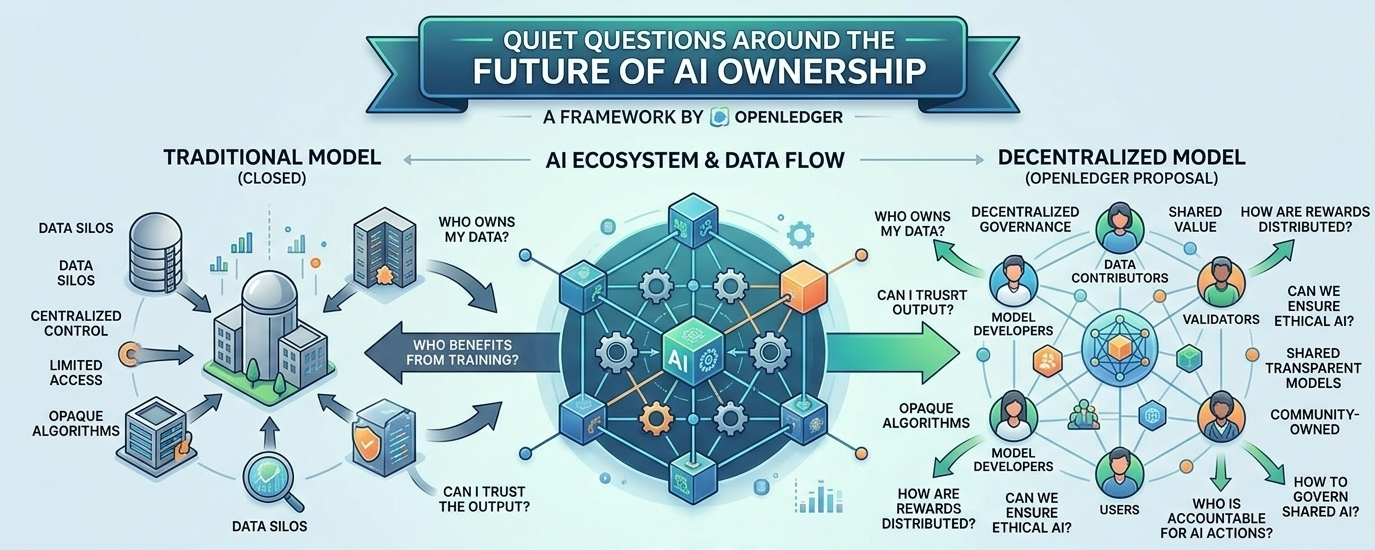
I keep watching how these new AI and crypto stories arrive with so much confidence, like they already know where they’re going to end up. OpenLedger feels like one of those moments where the language is doing most of the early work—data, models, agents, liquidity—big words placed carefully together, trying to sound like something inevitable.
I don’t really get swept up anymore. Not the way I used to. After enough cycles, you start noticing how quickly certainty ages in this market. Something feels important one month, and then a few months later it’s just part of the noise people scroll past. So when I look at OpenLedger, I don’t look for excitement. I look for what remains when excitement stops carrying it.
The idea itself isn’t hard to understand. Data being turned into something tradable, contributions being tracked, AI systems tied into some form of ownership or attribution. On paper, it fits neatly into a narrative I’ve seen forming for a while now: people want credit for the invisible work they’ve always been part of. That feeling is real. I don’t question that part. The internet has always been built on quiet extraction, and AI only made it more obvious.
But there’s a difference between recognizing a problem and actually surviving it in a system people will use without thinking. That’s where most of these ideas start to drift. Because users don’t interact with philosophy. They interact with friction. If something feels heavy, complicated, or constantly asking for attention, they slowly leave it behind, no matter how fair it claims to be.
I find myself thinking less about whether OpenLedger is right and more about whether it can stay simple enough to not collapse under its own intention. That sounds strange, but it happens often in crypto. The moment a project tries too hard to make everything fair, everything measurable, everything attributed, it starts adding layers. And those layers eventually become the thing people have to manage instead of the thing they enjoy using.
At the same time, I can’t ignore why this idea keeps appearing in different forms across the industry. Something in it is responding to a real discomfort. People are aware now that their data, their behavior, even their creative input feeds systems they don’t own. That awareness doesn’t always turn into action, but it lingers. And projects like OpenLedger are clearly trying to sit inside that gap.
Still, awareness alone doesn’t build retention. Attention doesn’t equal adoption. Most systems in this space feel alive at the beginning because they’re attached to a narrative, not because they’ve proven they can exist quietly in the background of someone’s daily behavior. And the background is where everything has to survive eventually.
That’s the part I keep coming back to. Not the promise, not the framing, but the question of what happens when nobody is paying attention anymore. When there’s no excitement left to carry the idea forward. When it becomes just another tool competing for a place in people’s already crowded routines.
OpenLedger might grow into something stable in that silence, or it might become another concept that made sense in the moment it was introduced but struggled to stay necessary after. I’ve seen both outcomes enough times that I don’t rush toward either conclusion anymore.
So I just stay in that in-between space with it. Interested enough to keep observing, cautious enough not to believe too early. There’s something in the idea that feels like it’s pointing at a real shift, but I’ve learned that pointing at a shift and actually holding it together are very different things.
And for now, that’s all it really is to me—something still forming, still untested by boredom and time, still waiting to see if it can exist without needing constant attention to stay alive.