

@OpenLedger is starting to feel less like a system chasing speed and more like one built to hold its ground.
I came across an old, unfinished note about it while cleaning up some files. At the time, I’d left it behind, thinking there wasn’t much worth saying. But reading it again this time with a tired mind and fewer expectations it clicked.Nisha pomi What’s been quietly holding my attention isn’t how fast the project moves, but how deliberately it’s shaping itself into something that can actually carry weight. Not just process results, but stand behind them.
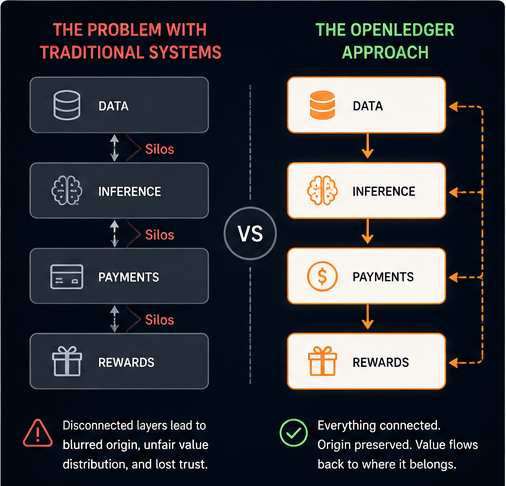
I’ve watched plenty of infrastructure projects follow the same arc. Early on, everything is about performance fast responses, smooth execution, that illusion of frictionless design. But as real usage begins,Nisha pomi deeper questions surface. Who’s actually creating value? Who gets recognized? And when things scale, who gets paid fairly?
That’s where Openledger feels different. It doesn’t seem overly concerned with surface metrics. Instead, it keeps circling back to a tougher, more meaningful problem: how to keep data, inference, payments, and rewards connected so they don’t drift into isolated layers that no longer speak to each other.
What stands out most is its focus on preserving the origin of every result. A lot of systems are good at delivering outputs, but they lose track of everything behind them the data, the contributors, the path value is supposed to take back. Openledger, at least in its direction, seems to push against that. It suggests that an answer shouldn’t be the end of the story. It should come with a trace clear enough to show where it came from, who contributed, and how value should flow in return.
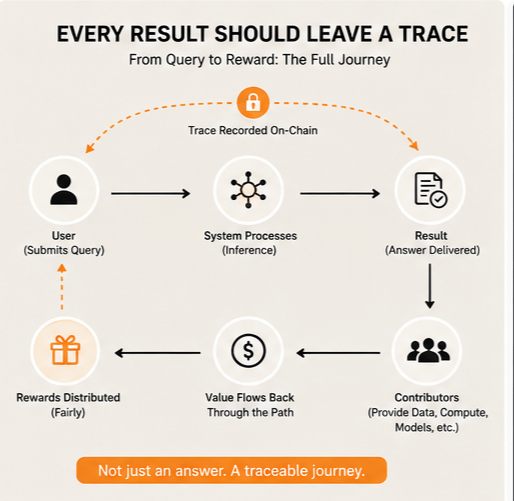
That’s not an easy thing to build. But it’s the kind of detail that decides whether people stick around for the long run.
Seen this way, “stability” stops being a vague promise. It becomes a design choice. Holding onto context of data, of effort, of value means accepting more constraints, more verification, and yes, more friction. But in exchange, the system has a chance to stay consistent when things get real. That’s where Openledger starts to feel intentional. It’s not trying to look perfect in the first cycle it’s trying not to fall apart in the ones that follow.
The market, of course, tends to reward the opposite. Speed, simplicity, short-term efficiency those are easy wins. Fairness and structure usually get postponed. Openledger seems to be resisting that instinct. It treats speed as a tool, not the goal. The real focus appears to be on recognizing contribution and distributing value properly even if that’s less exciting on the surface.
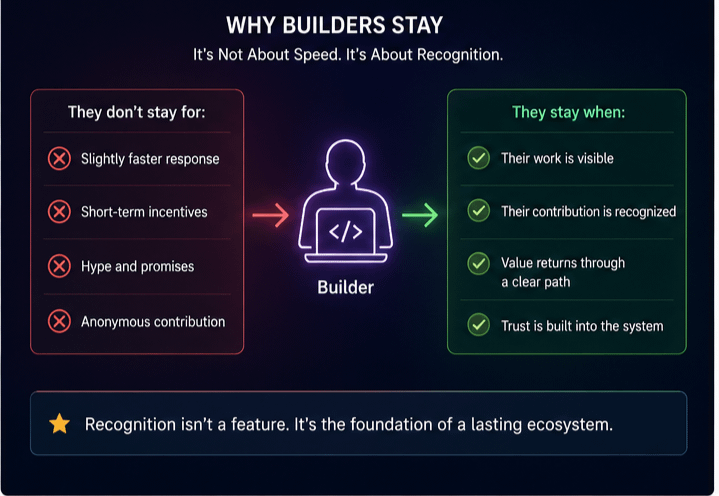
2rAnd ironically, those “less exciting” parts are what determine whether builders stay once the initial hype fades.
Because people who’ve built long enough don’t stay for marginal speed gains. They stay when their work is visible, when it isn’t reduced to anonymous input, when they can trust that their contribution won’t disappear somewhere in the middle. The path through which value returns quiet as it sounds often decides whether an ecosystem lasts.
From that perspective, Openledger feels like it’s trying to get the rules right before chasing scale. And honestly, that earns more respect than polished promises ever could.
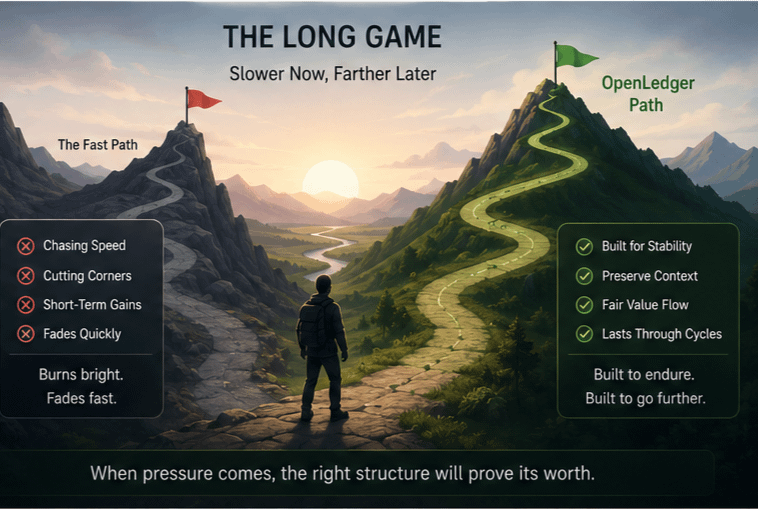
That said, this path isn’t easy. The more context a system tries to preserve, the heavier it becomes. The more precisely it tries to return value, the more coordination and verification it requires. Things get slower, more complex. But maybe that’s the tradeoff if the goal is to survive beyond a single wave of attention.
At some point, a serious system has to accept looking less sleek on the surface so it can be stronger at its core.
After seeing so many projects burn bright and fade just as quickly, it’s hard to stay interested in anything that doesn’t show restraint. Openledger stands out because it seems to understand that durability doesn’t come from smooth performance alone it comes from keeping data tied to its context, effort tied to its origin, and rewards tied to a clear path back.
The real question is what happens when the pressure builds. Whether a system that knows when to slow down can actually go further in the end.
