

OpenLedger is making me think about something I keep coming back to whenever I look at where crypto and AI are Heading.
What are we really building here?
I ask myself that often Because sometimes the speed of this industry makes it hard to pause and think clearly. Every week there is a new protocol, a new infrastructure layer, a new promise that technology is becoming faster, smarter, and more efficient. We keep Celebrating progress, but I wonder if we spend enough time asking who actually benefits from all of it.
For a long time, the Story around AI has felt strangely incomplete to me.
We talk endlessly about models becoming more powerful. We measure speed, benchmark performance, and Compare architectures like we are watching a race. But underneath all of that, there is something much more important that rarely gets attention.
Where does intelligence actually come from?
Not in the abstract Sense, but in the practical sense.
Every AI system is shaped by data. Behind every response, prediction, and decision, there are millions of human Contributions hidden beneath the surface. People write, label, organize, correct, and structure information. Communities generate patterns through behavior. Entire ecosystems create the raw Material that models depend on.
And yet, most of the time, those contributors disappear.
Their work becomes Absorbed into centralized systems that grow more valuable while the people who created the underlying knowledge rarely receive credit, Ownership, or direct reward.
That has always felt strange to me.
Crypto was supposed to challenge systems like this. At its best, it was never just about tokens moving faster. It was about changing how value is created and distributed. It was about building systems where Participation could be visible and ownership could be shared.
But when I look at most AI infrastructure today, I still see old power Structures wearing new clothes.
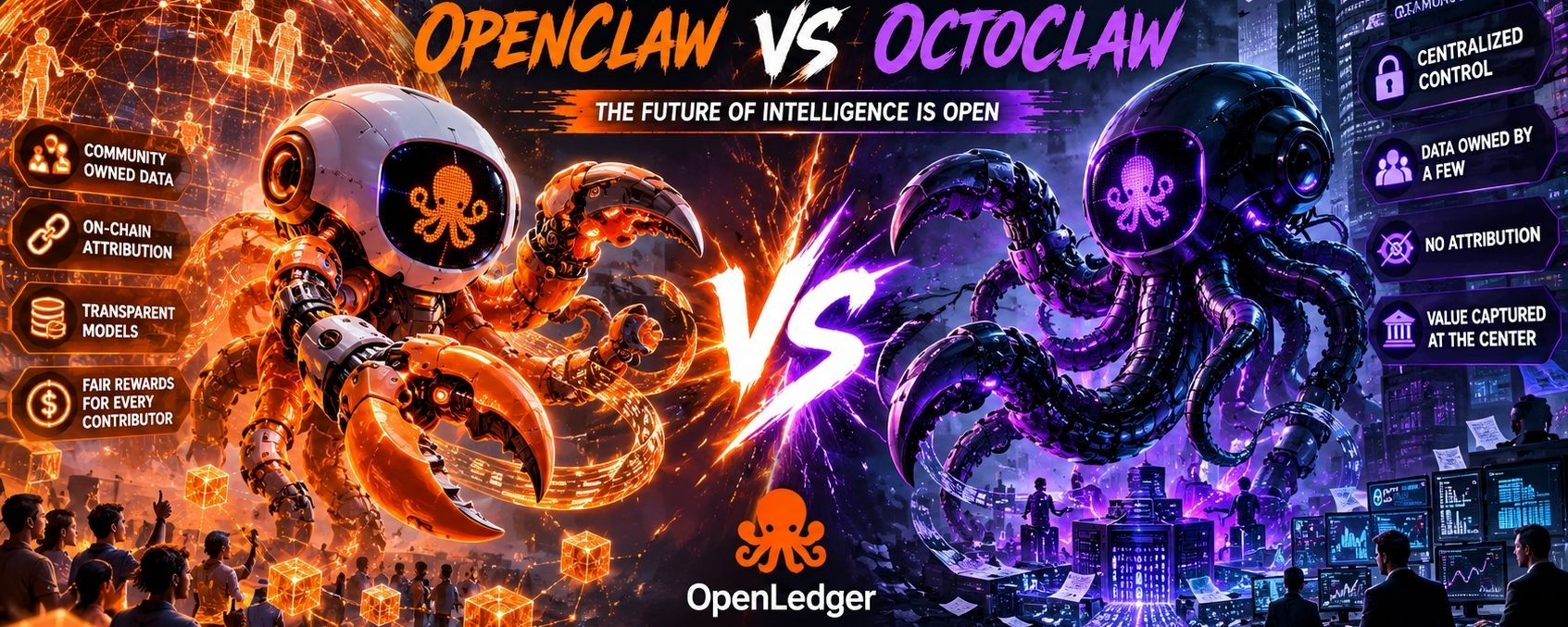
The models may be advanced, but control often stays concentrated. Data flows upward. Value accumulates at the Center. The people feeding the system remain invisible.
That is why OpenLedger caught my attention.
The more I looked into it, the more it felt like an attempt to solve a Problem people have quietly accepted as normal.
The basic idea is simple, even if the mechanics underneath are Complex.
Instead of treating datasets like private fuel for closed systems, OpenLedger treats them as shared digital assets called Datanets. These datasets can be created, improved, and contributed to by Communities. Every contribution is recorded on-chain, which means the system knows exactly who added value and when.
That may sound like a technical detail, but I think it changes something fundamental.
It creates memory.
And memory matters Because without it, attribution disappears.
If intelligence is built on human input, then systems should remember where that input came from. They should recognize it. They should reward it.
OpenLedger extends This idea beyond just storing datasets.
Models can be trained using these community-owned data layers, and every part of the process becomes traceable. Data contributions, model improvements, tuning decisions, and inference usage are linked Transparently through blockchain infrastructure.
What interests me here is not just the technology itself, but the philosophy behind it.
It suggests that AI does not have to be a black box controlled by a few Large actors.
It could become an open economic system where intelligence is not just consumed, but collectively built and fairly compensated.
That feels like a Very different future.
Imagine what happens if this model works at scale.
Instead of AI value flowing mostly toward centralized companies, contributors across the world could participate directly in building specialized intelligence Systems. Researchers, developers, niche communities, and domain experts could help shape models for specific use cases while earning From their contribution over time.
That would change incentives completely.
People would Not just use AI.
They would have a stake in it.
Of course, this is where I become cautious.
Ideas like this sound Powerful in theory, but execution is always harder than vision.
Decentralized systems often struggle with coordination. Incentive design can become messy. On-chain transparency is useful, but it does not automatically solve Adoption challenges or guarantee high-quality participation.
And this is the real test for OpenLedger.
Can it make this system simple enough for real builders to use while Preserving the fairness it promises?
Can attribution remain meaningful when ecosystems Become large and noisy?
Can decentralized intelligence stay efficient enough to compete with highly centralized alternatives?
I do not think these Are small questions.
But I also think asking hard questions is exactly what gives a Project like this weight.
Because if OpenLedger succeeds, it may represent something Bigger than another AI-blockchain experiment.
It could point toward a future where intelligence itself becomes a shared economic layer rather than a privately Captured resource.
And if that becomes Normal, it would reshape more than crypto.
It would reshape How trust works across digital systems.
It would force us to rethink who owns knowledge, who benefits from Collective creation, and whether the systems we build are truly serving the people who power them.
That is why I keep Thinking about this.
Not because it feels exciting in the usual market sense, but because it touches a deeper question about fairness in the Age of machine intelligence.
What are we actually building when we merge AI with blockchain?
Are we creating Systems that distribute value more fairly, or are we simply rebuilding old structures with better interfaces?
And if intelligence Becomes one of the most valuable resources of this century, who should own it?
For me, that is what Makes OpenLedger worth watching.
Not because the Outcome is guaranteed.
But because it is Asking a question this industry can no longer afford to ignore.