
The moment another “AI-powered blockchain” appears, the default reaction now is usually exhaustion rather than excitement. The industry has reached a point where almost every second project claims to be building the future of decentralized intelligence, autonomous agents, or tokenized machine learning. Most of them follow a strangely predictable lifecycle. First comes the narrative wave, then the social farming campaigns, then a flood of speculative attention, followed by token volatility, liquidity extraction, and eventually silence once the incentives dry up. After watching that cycle repeat enough times, skepticism stops being negativity and starts becoming pattern recognition.
That was honestly the first impression OpenLedger gave off as well.
At surface level, it looked like another project trying to merge two of the strongest buzzwords in the market: AI and blockchain. And historically, that combination has often produced more marketing than substance. The crypto industry tends to absorb whatever technological trend is popular at the moment, wrap it in tokenomics, and present it as a revolution before the infrastructure is mature enough to support the promises being made. So the instinctive assumption was simple: this would probably be another ecosystem designed more around speculative participation than genuine utility.
But after spending more time understanding what OpenLedger is actually trying to build, the project starts becoming more interesting in a quieter and more technical way.
What makes OpenLedger stand out isn’t necessarily that it claims to power AI. Almost everyone says that now. The more important detail is that it seems focused on one specific problem most projects barely discuss properly: who deserves value when AI systems generate economic output?
That question sounds simple until you realize how unresolved it really is.
Modern AI models are trained on enormous amounts of data collected from countless sources. Yet once those models become profitable, the people who contributed meaningful data rarely receive anything back. Data becomes invisible after ingestion. The model owner captures the value while contributors disappear into the background. OpenLedger appears to be trying to challenge that structure by creating a system where data, models, and AI agents can all be tracked economically inside a blockchain-based environment.
That changes the conversation slightly.
Instead of simply asking, “How do we tokenize AI?” the project seems to ask, “How do we build an economy around attribution?”
And that distinction matters.
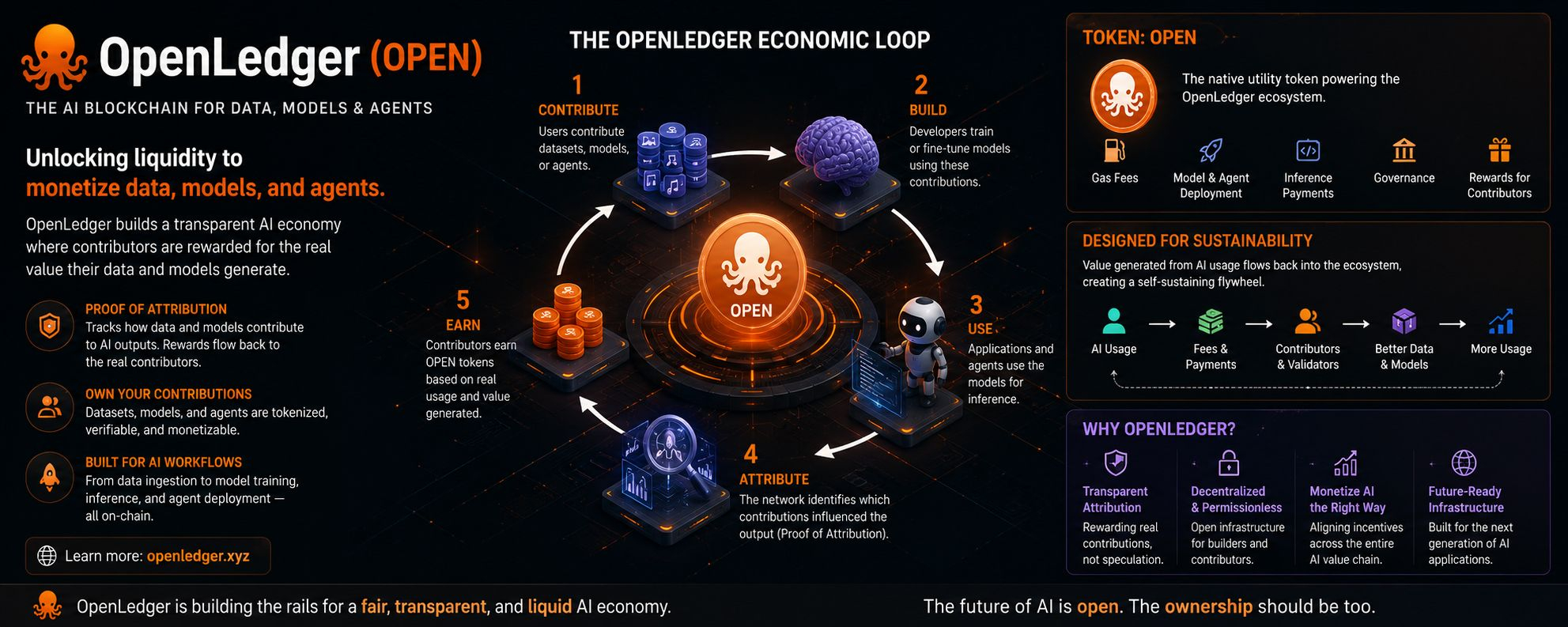
The idea behind the ecosystem is relatively straightforward once stripped of the technical language. Users contribute datasets or models. Developers use those resources to train or run AI systems. Applications generate usage and inference demand. Then the network attempts to identify which contributors actually helped create value and distributes rewards accordingly. In theory, the better or more useful someone’s contribution is, the more economic activity it should generate over time.
At least conceptually, that is far more compelling than the usual engagement farming mechanics most crypto ecosystems rely on.
There is an important psychological difference between rewarding participation and rewarding usefulness. Many blockchain ecosystems accidentally incentivize low-quality behavior because rewards are tied to volume instead of meaningful contribution. Users click buttons, repeat tasks, run scripts, or spam activity simply because emissions are available. The network appears active while very little real value is being created underneath. OpenLedger seems aware of that problem and is attempting to structure incentives around contribution quality rather than simple interaction metrics.
Whether that works in practice is another question entirely.
The most interesting part of the entire project is probably the attribution mechanism itself. OpenLedger talks heavily about proving which datasets influenced model outputs and routing value back toward contributors. If achieved properly, that could create one of the first serious attempts at a transparent AI economy where data ownership and economic participation are connected.
But this is also exactly where skepticism becomes necessary again.
Attribution inside machine learning is extraordinarily difficult. AI models are not clean linear systems where one can easily isolate which specific dataset produced which outcome. Influence becomes blurred across billions of parameters, layered training processes, and complex optimization patterns. So while the idea sounds elegant, implementation could become incredibly messy. There is a meaningful gap between a theoretical attribution framework and a system accurate enough for participants to trust financially.
And trust is everything here.
Because the moment contributors feel rewards are arbitrary or manipulated, the economic model weakens immediately. The entire ecosystem depends on users believing that useful contributions genuinely receive proportional value over time. Without that confidence, the network risks becoming just another speculative environment where the token exists independently from actual utility.
The OPEN token itself initially looks fairly standard. It functions across governance, payments, network activity, deployment, and ecosystem incentives. At first glance, that naturally raises concern because crypto has produced countless “everything tokens” that ultimately lacked meaningful demand beyond speculation. But OpenLedger’s design becomes more understandable once viewed through the lens of AI infrastructure rather than traditional DeFi mechanics.
The project is trying to create a circular economy where AI usage itself generates internal demand. Applications pay for inference. Those payments distribute value across validators, contributors, and model creators. Contributors remain incentivized to improve datasets because useful data theoretically continues generating returns as models gain adoption. Better models then attract additional users and developers, which ideally expands the economic activity feeding back into the network.
At least structurally, that is healthier than ecosystems dependent entirely on new capital entering the market.
Still, the sustainability challenge remains enormous.
A closed-loop economy only works if genuine external demand exists. If real users are not consistently using the models, applications, or agents built inside the ecosystem, then the rewards eventually become circular self-reinforcement rather than productive economic activity. Crypto projects often confuse internal movement with actual demand. Tokens circulate, users farm rewards, dashboards show activity, but little value enters from outside participants who genuinely need the product.
That is probably the biggest unanswered question surrounding OpenLedger.
Will decentralized AI infrastructure become meaningfully useful outside crypto-native speculation?
Because if the answer is yes, OpenLedger could occupy an unusually important position. Data ownership, AI monetization, and transparent attribution are problems likely to become significantly larger over the next decade rather than smaller. AI systems are consuming increasing amounts of public and private data while concentrating value into a small number of companies. There is growing discomfort around that imbalance, and projects attempting to create alternative economic structures may eventually find real relevance.
But timing matters.
Being philosophically correct too early can still look identical to failure.
Another concern is behavioral exploitation. Every incentive system eventually attracts optimization behavior, and AI ecosystems may be particularly vulnerable to that. If contributors discover methods for mass-producing synthetic datasets that appear useful enough to qualify for rewards, the network could quickly become polluted with low-quality information. The challenge for OpenLedger will not simply be rewarding contributors, but continuously filtering signal from noise at scale.
That is much harder than launching a token.
And yet, despite all these uncertainties, the project still feels more thoughtful than most of the AI narratives currently circulating through crypto markets. A large percentage of AI blockchain projects focus almost entirely on speculative abstraction. They talk about autonomous agents, decentralized intelligence, or future machine economies in language so broad that it becomes difficult to identify the actual economic problem being solved. OpenLedger, by comparison, feels more grounded in infrastructure design.
It is less obsessed with sounding futuristic and more focused on building accounting rails for AI-generated value.
That alone makes it worth paying attention to.
Not because success is guaranteed. Far from it. In fact, the technical and economic challenges ahead are probably larger than many supporters fully appreciate. But there is at least a visible attempt to align incentives around something deeper than short-term attention cycles.
And maybe that is why the project leaves a different impression after looking beyond the surface.
It does not feel like a finished ecosystem pretending to have already won. It feels more like an experiment attempting to answer a difficult question before the rest of the industry fully understands how important that question might become.
Can AI become economically transparent instead of extractive?
Can contributors own part of the value they help create?
Can blockchain infrastructure make AI economies more open instead of simply more speculative?
OpenLedger does not yet have definitive answers to those questions. No project really does. But unlike many AI crypto narratives that seem designed primarily for momentum trading, this one appears to be at least wrestling with a real structural issue.
That does not make it a guaranteed success. Execution will matter more than vision. Real adoption will matter more than token design. And user behavior will ultimately determine whether the ecosystem evolves into productive infrastructure or collapses into another reward-farming environment like so many before it.
For now, the most reasonable position is probably cautious curiosity.
Not blind optimism.
Not cynical dismissal either.
Just the recognition that beneath the usual AI-blockchain marketing noise, OpenLedger might actually be attempting to build something more ambitious than another temporary narrative cycle.