
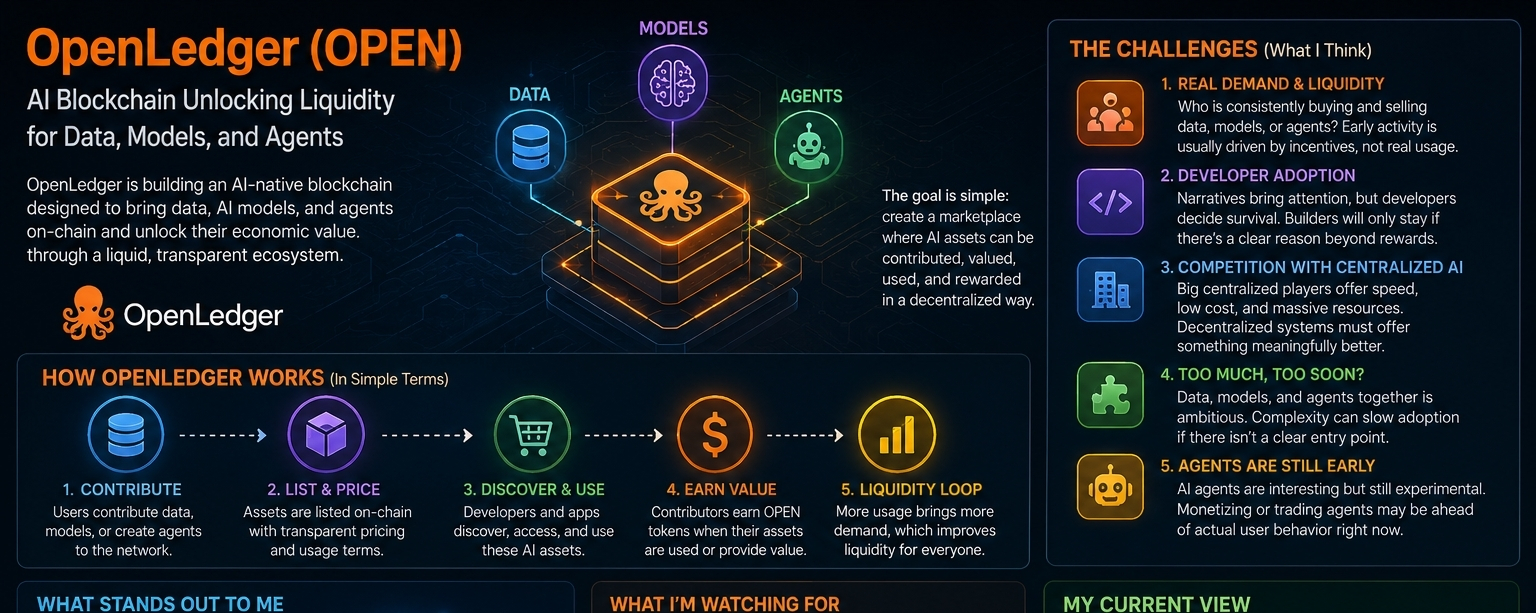
I’ve been looking at OpenLedger (OPEN) and honestly, my first reaction wasn’t excitement or skepticism—it was more like recognition. I’ve seen this general idea before, just repackaged in a slightly newer form that fits the current AI narrative cycle in crypto. Every cycle tends to find its “bridge concept” between blockchain and whatever the dominant tech trend is at the time. Right now, that trend is AI, so naturally we’re seeing attempts to connect blockchains with data, models, and now “agents” in a more direct economic way.
OpenLedger is trying to position itself as an AI blockchain that unlocks liquidity for data, models, and agents. On the surface, that sounds clean. Almost too clean. I’ve noticed that whenever a project bundles multiple complex layers under one economic idea, it usually means the real challenge hasn’t fully revealed itself yet. Because in reality, data, models, and agents don’t behave like simple financial assets. They behave more like infrastructure—messy, contextual, and deeply dependent on where and how they are used.
What immediately stood out to me is the assumption that these AI components can be naturally “monetized” in a decentralized environment. I’ve seen this assumption before in earlier versions of data economy projects. The idea is always compelling in theory: if data has value in AI training, then users should be able to earn from it. If models are useful, they should be tradable. If agents perform tasks, they should generate income streams. But when I step back and think about how people actually behave, the gap becomes obvious. Most users don’t want to think about their data as an asset. Most developers don’t want to deal with fragmented liquidity systems when they’re trying to ship products.
Liquidity is where my mind always goes first in these systems, and not just trading liquidity on exchanges. I’m thinking about real, continuous usage liquidity—the kind that survives after incentives slow down. I’ve seen many ecosystems look active in the beginning simply because token rewards or early campaigns bring participants in. That phase always looks healthy from the outside. But the real question comes later: what happens when participation is no longer subsidized? Does anyone still care enough to keep using the system?
With OpenLedger, I find myself asking that exact question. If data or models are being monetized, who is actually paying for them in a consistent way? Is there a real buyer-seller loop forming, or is it mostly early experimentation supported by narrative momentum? I’ve seen too many “marketplace” style crypto projects struggle at this exact point. Creating a marketplace is easy in theory, but creating balanced, recurring demand on both sides is where most of them fail.
Another thing I keep thinking about is developers. In crypto, developers matter more than narratives in the long run, even if narratives drive the early attention. I’ve watched ecosystems grow rapidly when incentives are strong, only to fade once builders realize they can achieve the same outcome faster on more established stacks. For OpenLedger, the key question is whether developers will actually choose to build here without being pushed by incentives. If they don’t, then the system risks becoming more of a speculative layer than a real infrastructure layer.
The AI blockchain narrative itself has become very crowded. I’ve seen multiple variations of it over the last few years, each trying to solve the same underlying problem: how to decentralize AI infrastructure in a world where centralized systems are already extremely efficient. The reality is that companies operating centralized AI stacks have strong advantages—speed, cost efficiency, integration depth, and access to massive datasets. Decentralized systems don’t just compete on ideology; they have to compete on performance and usability too.
That’s why I find myself somewhat cautious when I see projects that try to cover everything at once—data, models, and agents in a single ecosystem. The ambition is understandable, but in practice, complexity often slows down adoption. It becomes harder to identify what the actual entry point for users or developers is. I’ve seen ecosystems struggle not because the idea was wrong, but because it was too broad too early, without one clear use case anchoring everything else.
The agent narrative is especially interesting right now, but I still consider it early. People are experimenting with AI agents in centralized environments, but most usage still feels exploratory rather than essential. It’s still not something where users depend on agents in a deeply embedded way in their daily workflows. So when I see the idea of monetizing or tokenizing agents, I naturally question how close that is to real demand versus future speculation. Crypto has a history of pricing forward innovation faster than actual adoption curves can follow.
At the same time, I don’t think it’s fair to dismiss OpenLedger or similar projects outright. I’ve also seen early infrastructure ideas that felt abstract or unnecessary at first eventually become important building blocks later on. The problem is that early-stage signals are noisy. Narrative attention, token activity, and community growth don’t always reflect real usage. Sometimes they do, sometimes they don’t. The difficulty is separating temporary excitement from long-term behavioral change.
What I’ve learned from watching similar cycles is that survival usually depends on persistence of usage, not initial design. It’s not about how elegant the system looks at launch, but whether people keep returning to it when there’s no incentive to pull them back. That’s where many projects quietly lose momentum. Not in a dramatic failure, but in a slow fading of engagement once attention shifts elsewhere.
Right now, OpenLedger feels like it is still in the interpretation phase rather than the adoption phase. People are trying to understand what it is and where it fits, rather than actively relying on it as part of their workflow. That’s normal for projects at this stage, especially in a rapidly evolving sector like AI x crypto. But it also means it’s too early to draw strong conclusions about its long-term position.
So when I step back from everything, my view stays intentionally neutral. I’ve seen enough cycles to know that early narratives can either evolve into real infrastructure or dissolve once attention moves on. OpenLedger currently sits somewhere in between those two outcomes. It has a concept that fits the current direction of the industry, but it still needs proof in the form of consistent, organic usage that survives beyond incentives and hype cycles.
For now, it’s something I’m observing rather than labeling. Not something I’m ready to call successful or unsuccessful—just something that needs time, real users, and real behavior before the picture becomes clearer.