
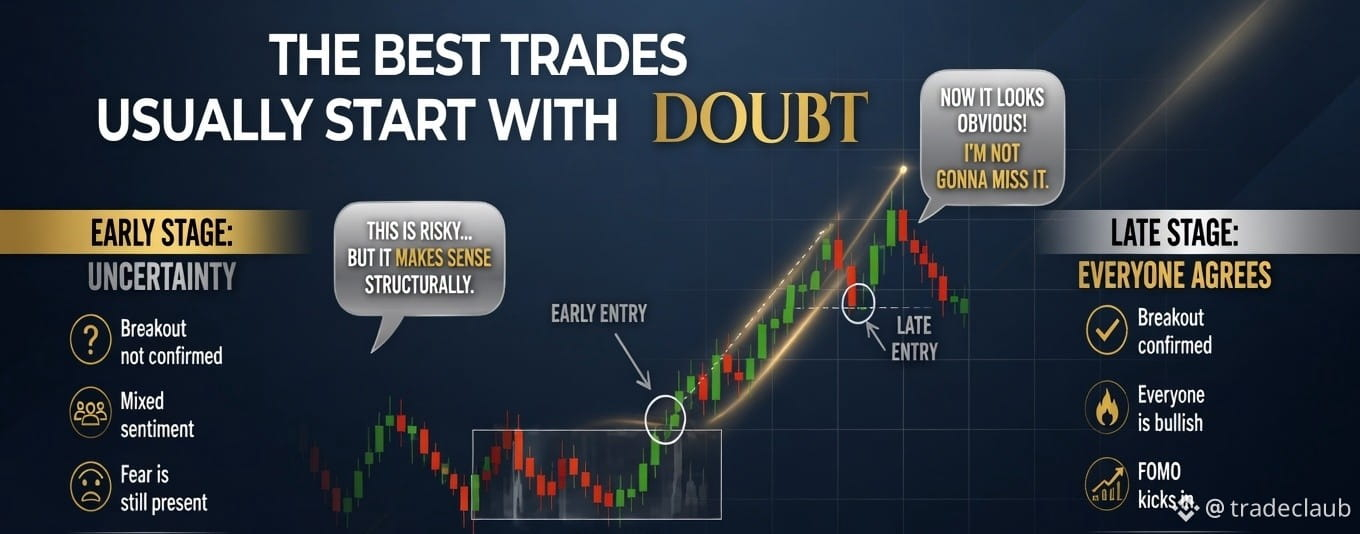
In professional trading, there is a fundamental irony that separates the amateur from the expert:
The most profitable opportunities often feel the most uncomfortable.
While human psychology craves the security of certainty, the financial markets function as a discounting mechanism. By the time a trend is "obvious" to the crowd, the price has already adjusted, effectively stripping the trade of its favorable risk-to-reward asymmetry.
The Anatomy of an Early-Stage Opportunity
True value is found in the "Uncertainty Gap." When a high-probability setup first develops, the market environment is typically defined by:
Structural Ambiguity: Price action is consolidating, and a clear breakout has yet to be validated by the broader market.
Divergent Sentiment: Fear remains a dominant emotion among market participants, and consensus is absent.
Limited "Confirmation": The move lacks the momentum-driven "frenzy" that characterizes late-stage participation.
The Trap of "Comfort"
Most traders instinctually seek confirmation—more candles, higher volume, and undeniable momentum. By waiting for these signals, you are essentially seeking safety.
However, in trading, safety is often a signal of exhaustion. When a chart looks perfect and the narrative is widely accepted, you are likely entering when the "smart money" is already beginning to distribute their positions to the late-coming public.
Principles of Asymmetric Trading
Professional success is not about being "right" more often; it is about managing the relationship between risk and reward. To master this, shift your focus to these three pillars:
Prioritize Asymmetry: Your goal is not to predict the future with 100% accuracy, but to identify setups where the potential downside is strictly defined and mathematically favorable compared to the upside.
Define Your Risk Parameters: Uncertainty is manageable if your exit strategy is pre-defined. Never enter a position without knowing exactly where you are wrong and how much you are willing to lose.
Remove Ego from Execution: Trading is a business, not an opinion poll. If your technical triggers are met, execute the trade. If you find yourself waiting for "more proof" because you are afraid to be wrong, recognize that fear as a signal to review your risk management, not a signal to stay out.
Final Thought
The next time you feel hesitation, ask yourself: Am I feeling this doubt because the trade is structurally flawed, or because it feels uncomfortable to be early?
Stay disciplined, stick to your process, and trade the plan—not the noise.
Disclaimer: This content is for educational purposes only and does not constitute financial advice. Trading involves substantial risk. Always conduct your own research and consult with a professional financial advisor before making investment decisions. $TON $RENDER $NEAR