
Most crypto leaderboard campaigns die the same way. Loud launch. Artificial excitement. Thousands of wallets rushing through meaningless tasks. Then silence. A week later, the rankings stop moving, the community loses interest, and the platform becomes another abandoned corner of the industry.
People inside crypto have seen this pattern too many times to get emotional about it anymore.
That is why [Genius Terminal](https://tradegenius.com/?utm source=chatgpt.com) stands out in a strange way. The project is not really behaving like a short-term campaign machine. It feels like something trying to build routine. Not attention for a weekend attention that repeats every morning.
That difference matters more than the rewards themselves.
The platform calls itself the “first private and final on-chain terminal.” Normally, crypto slogans like that sound inflated immediately. The industry is full of products claiming to be revolutionary while offering slightly cleaner dashboards and another token nobody asked for. But Genius Terminal becomes more interesting once you look at what the product is actually trying to remove.
Not complexity.
Interruption.
That is the real problem most active traders complain about, even if they rarely say it directly.
On-chain trading still feels fragmented in ways normal users have quietly accepted. One app for swaps. Another for perpetuals. Separate bridges. Separate wallets. Endless approvals. Failed transactions during volatility. Portfolio trackers showing wrong balances for hours. People learned how to survive inside broken workflows and started treating that survival as expertise.
Genius Terminal feels built by people who are tired of pretending this is normal.
The platform keeps pushing the same idea throughout its system: one terminal, one balance, multiple markets. Spot trading, perpetuals, yield strategies, pre-launch assets, portfolio management, and cross-chain routing are all supposed to exist inside a single environment instead of across disconnected tools.
The company claims integrations with more than 150 decentralized exchanges across chains like Ethereum, Solana, Base, Arbitrum, Avalanche, Optimism, Polygon, BNB Chain, Hyperliquid, and others. But the bigger point is not the number of integrations. It is the experience they are trying to create.
The terminal wants trading to feel continuous.
No constant switching. No stopping every few minutes to sign another transaction. No breaking momentum while markets move faster than interfaces can react.
That sounds simple until you realize how rare smoothness still is inside crypto.
Most platforms compete by adding features. Genius seems more focused on removing friction. Those are two very different philosophies. Features attract users for a moment. Friction determines whether they return.
That is where the leaderboard campaign becomes more strategic than it first appears.
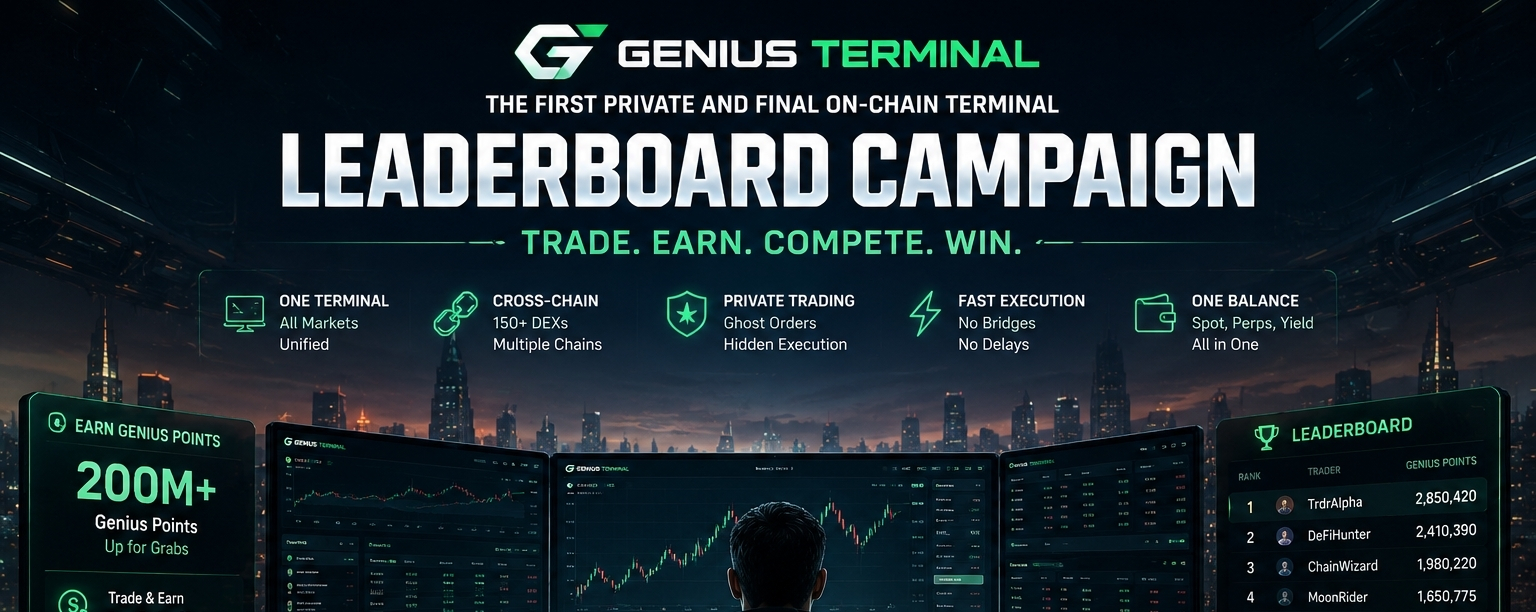
On the surface, it looks familiar. Complete tasks. Earn points. Climb rankings. Unlock rewards. Binance CreatorPad attached a 100,000 GENIUS reward pool to the campaign, which immediately pulled attention toward the platform.
But the rewards are not the interesting part.
The behavior is.
Everything about the campaign pushes users toward repetition. Open the terminal. Trade. Earn Genius Points. Watch rankings move. Come back tomorrow. Repeat the process again.
Over time, repetition stops feeling like participation and starts feeling like habit.
Most crypto projects fail because they only know how to manufacture excitement. They do not know how to become part of daily behavior. Genius Terminal seems obsessed with solving exactly that problem.
Even the account system reflects this thinking. Users create a permanent TraderID attached to leaderboard rankings and activity. That small detail changes the emotional atmosphere of the platform more than people realize.
Anonymous wallets feel disposable.
Named identities feel competitive.
The moment users start recognizing handles on rankings, the platform becomes social without openly behaving like social media. People begin checking positions the same way gamers check ranked ladders. Nobody wants to disappear from visibility pnce they become part of the board.
Crypto has slowly been moving toward this culture for years anyway.
Trading is no longer just financial activity. It became performance. Public wallets became personalities. Screenshots became status symbols. Entire communities now revolve around tracking who entered first, who exited early, and who missed the move completely.
Genius Terminal appears to understand that shift clearly.
Te leaderboard is not simply rewarding activity. It is building identity inside the product itself.
That is important because attention is becoming more valuable than liquidity.
Money moves quickly in crypto. Users move even faster.
A wallet can bring massive volume into a protocol and disappear overnight. But a trader who opens the same terminal every day becomes extremely valuable. Platforms are starting to realize that long-term engagement matters more than temporary spikes.
That probably explains why Genius keeps expanding its vision beyond basic trading tools.
The roadmap stretches into prediction markets, real-world assets, options infrastructure, yield systems, and unified liquidity environments. The ambition is obvious. The project does not want to become another protocol people occasionally visit. It wants to become the place traders stay inside.
Whether that works is another question entirely.
Building a product this ambitious is difficult for obvious reasons. Cross-chain systems sound impressive until volatility hits and execution speed actually matters. Privacy features sound attractive until users demand proof that the mechanics work under pressure. Unified terminals feel efficient until one issue affects multiple systems at once.
Crypto users forgive bold promises during growth phases. They become brutally skeptical afterward.
There is also a deeper issue sitting underneath every leaderboard-based platform.
Gamification changes behavior.
Once rankings become public, users stop thinking only about good trades. They begin thinking about visibility, consistency, volume, and position. Some people will overtrade just to maintain relevance. Some will chase points instead of discipline.
Every modern trading platform now lives inside that tension.
How do you reward participation without quietly encouraging unhealthy behavior?
Nobody has solved that perfectly yet.
Still, Genius Terminal feels more intentional than most projects fighting for attention right now. Not because the marketing is louder. Because the central idea underneath everything feels human.
People are exhausted by fragmented tools.
Exhausted by clunky workflows.
Exhausted by pretending inconvenience equals innovation.
Genius Terminal is making a direct bet that the future of on-chain trading belongs to products that feel less exhausting to live inside.
And honestly, that may matter more than whoever finishes first on the leaderboard.