
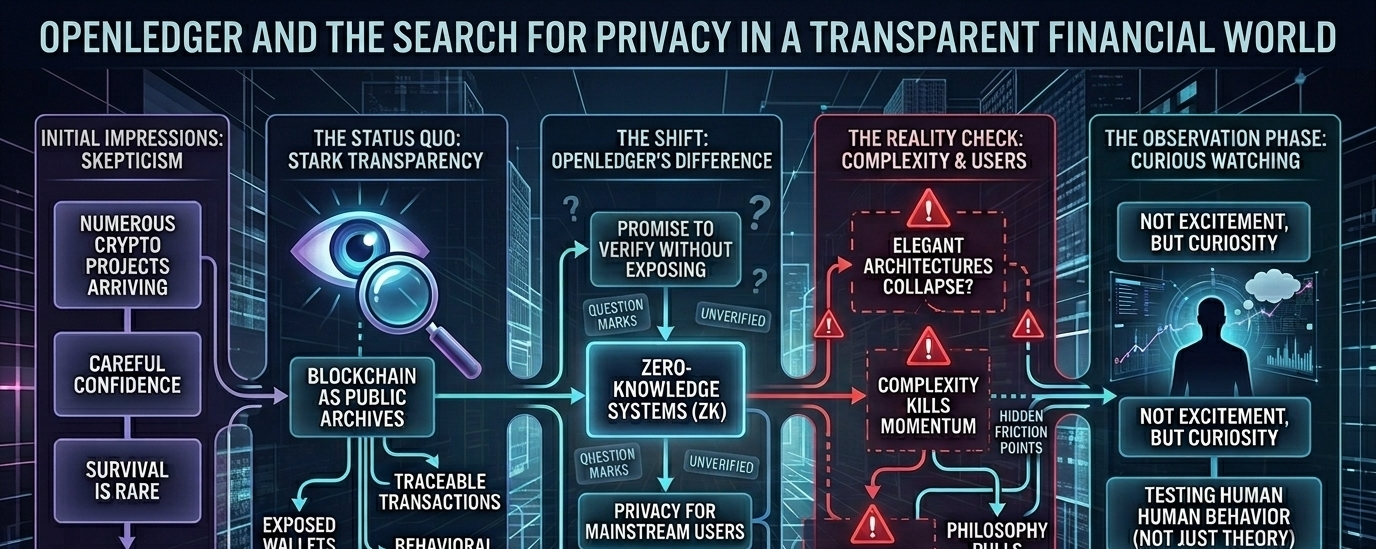
There’s a certain kind of fatigue that settles into people who have spent too many years around crypto. It isn’t hostility exactly. It’s closer to caution shaped by repetition. You watch the same emotional cycle unfold often enough and eventually every new network arrives carrying the shadows of older promises behind it. I find myself approaching projects like with that same quiet hesitation now, not because the ideas are necessarily bad, but because the industry has become very good at describing futures that rarely survive contact with ordinary human behavior.
What makes OpenLedger interesting, at least on the surface, is that it touches a problem the blockchain industry has spent years pretending is not really a problem at all. Most public chains were built around radical transparency. That transparency became part of the ideology. Every wallet visible. Every transaction searchable. Every interaction preserved indefinitely inside systems that celebrate immutability as if permanence itself were inherently virtuous. In the beginning this openness felt revolutionary. It created a sense of trustlessness through exposure. Anyone could verify the ledger. Anyone could inspect movement across the network. In a narrow technical sense, it worked.
But over time the implications became harder to ignore.
The longer blockchain systems exist, the more unusual their assumptions about privacy begin to look. In ordinary life, people do not expose their bank statements to strangers. Businesses do not publish supplier relationships in real time. Professionals do not want every transaction permanently attached to a publicly traceable identity. Even users who claim not to care about privacy often behave differently once financial exposure becomes concrete rather than theoretical. The industry spent years framing transparency as liberation, but eventually transparency starts resembling surveillance when scaled across millions of users.
That contradiction has lingered underneath crypto for a long time. Most networks solved verification by sacrificing discretion entirely. The assumption seemed to be that users would simply adapt to permanent visibility because decentralization mattered more. But I’m no longer convinced that mainstream users will tolerate that tradeoff indefinitely. The crypto space often mistakes ideological enthusiasm for normal human behavior. Early adopters tolerate friction and exposure because they are emotionally invested in the experiment. Ordinary users rarely are.
This is where OpenLedger’s architecture becomes intellectually interesting. The project appears to be trying to carve out a middle space between total transparency and total opacity through the use of zero-knowledge systems. The basic premise behind zero-knowledge proofs has always carried a kind of quiet elegance: proving something is true without revealing the underlying information itself. In theory, that changes the emotional structure of blockchain interaction. Verification no longer requires exposure. Trust no longer depends entirely on visibility.
Conceptually, it’s one of the more important directions crypto has explored in years
And yet this is exactly where my skepticism returns.
Crypto history is filled with projects whose whitepapers sounded more convincing than the products users eventually encountered. Elegant architecture on paper does not automatically translate into systems people actually enjoy using. Some of the most technically sophisticated projects in blockchain history disappeared not because the ideas were wrong, but because complexity accumulated faster than adoption. Interfaces became difficult. Performance degraded under real conditions. Developers lost interest. Users drifted away quietly without making ideological statements about it.
I sometimes think the industry underestimates how fragile attention really is. People talk about infrastructure as though superior design inevitably wins over time, but history suggests otherwise. Better systems often lose to simpler ones. Privacy itself sounds desirable in theory, yet many users consistently trade it away for convenience the moment friction appears. That reality matters more than most crypto communities want to admit.
OpenLedger’s upcoming Phase 1 therefore feels less like a triumph and more like a test of whether this balance between privacy and verification can survive practical usage. The technical ambition deserves some respect because the problem itself is real. Public blockchains have created environments where wallets become behavioral profiles over time. Once identities connect to addresses, the chain effectively becomes a permanent record of financial movement. Analysts, corporations, governments, and surveillance firms increasingly operate inside that visibility layer. It’s difficult to imagine large-scale institutional or mainstream participation remaining comfortable with that forever.
At the same time, privacy systems introduce their own complications. The more sophisticated the cryptography becomes, the harder systems often become to explain, audit, and maintain. Developers may appreciate the engineering, but ordinary users tend to judge systems emotionally rather than academically. They want interactions to feel seamless. They want applications to behave predictably. They rarely care whether something uses advanced zero-knowledge architecture underneath unless the experience becomes noticeably better.
And this is the uncomfortable question surrounding projects like OpenLedger: does the market genuinely demand privacy-centered infrastructure strongly enough to tolerate the additional complexity it may introduce?
Crypto communities frequently assume the answer is yes because privacy sounds philosophically important. But actual usage patterns across the industry tell a less certain story. Many users continue operating on highly transparent systems despite knowing the tradeoffs. Speculation, convenience, liquidity, and network effects often overpower abstract concerns about exposure. People routinely choose environments they claim to dislike if those environments remain easier to use.
I think about this often when new infrastructure projects emerge. There is usually a gap between what users say they value and what their behavior ultimately reinforces. Privacy advocates may see transparent blockchains as structurally flawed, and perhaps they are, but flaws do not automatically prevent adoption. Social networks demonstrated that years ago. People accepted enormous visibility in exchange for participation because the systems were frictionless enough to sustain attention.
So OpenLedger may ultimately face two different challenges at once. The first is technical execution, which is difficult enough on its own. The second is proving that users and developers truly care about privacy strongly enough to reorganize behavior around it. That second challenge is far more unpredictable because it depends less on engineering and more on human incentives.
None of this means the project lacks merit. In fact, I suspect the industry genuinely needs experiments like this now. The longer blockchain technology matures, the stranger its default transparency model begins to appear. There is probably no serious long-term financial future where every participant willingly exposes their economic behavior forever. Some form of selective privacy seems necessary eventually. The logic behind that feels increasingly difficult to dismiss.
But necessity alone does not guarantee survival.
I’ve watched too many technically intelligent projects become trapped between ambition and usability. Some collapsed under their own complexity. Others simply arrived before the market truly cared. A few solved problems users never felt urgently enough to change behavior over. Crypto is filled with systems that made perfect sense architecturally and still disappeared almost without noise.
That is why I find myself watching OpenLedger with interest rather than excitement. Interest feels healthier now. More durable. The project is asking a serious question about blockchain design instead of merely recycling speculative language about scale or speed or throughput. That already separates it from much of the industry noise. But the real pressure begins after the architecture leaves diagrams and enters ordinary use.
Because eventually every blockchain faces the same unforgiving test. Not whether the ideas sound intelligent during early discussion phases, but whether people continue showing up once curiosity fades and daily interaction begins. And I suspect that is the real uncertainty surrounding OpenLedger’s Phase 1. Not whether privacy matters philosophically, but whether users will value it enough to carry the system through the slow, difficult years that determine whether networks become infrastructure or simply another briefly admired experiment.
