
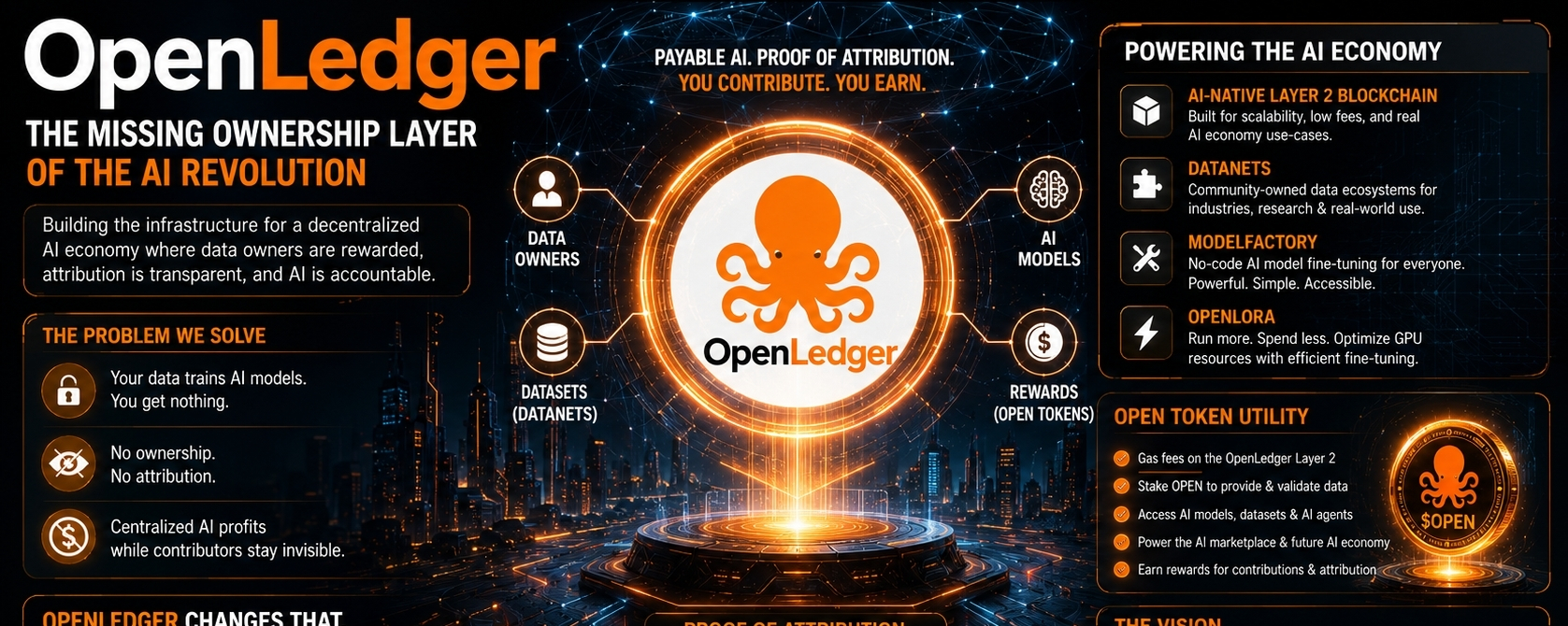
@OpenLedger The artificial intelligence industry is expanding faster than almost anyone predicted. Every week, a new AI model appears, another billion-dollar company enters the race, and more people unknowingly contribute their data to systems they do not control. Behind the excitement surrounding AI tools, there is one uncomfortable reality most people still ignore — the people whose data powers these models rarely receive recognition, ownership, or financial value in return. OpenLedger is trying to challenge that entire structure by building something far more important than another chatbot or image generator. Instead of competing with AI applications directly, it is building the infrastructure layer that could eventually power decentralized artificial intelligence economies.
What makes OpenLedger stand out is the fact that it is not positioning itself as a traditional AI company. It is developing an AI-native Layer 2 blockchain designed specifically for data ownership, AI attribution, and transparent monetization. In simple words, the network wants to create a system where the people contributing useful data are no longer invisible participants. Through its Proof of Attribution mechanism, every dataset uploaded to the ecosystem can be tracked on-chain. If an AI model trains on that data or generates outputs influenced by it, the contributor can automatically receive rewards in the form of OPEN tokens. This concept, which the project describes as “Payable AI,” introduces something the current AI market still lacks — accountability tied directly to value creation.
For years, centralized companies have operated behind closed systems where users unknowingly became the raw material for AI training. OpenLedger approaches this differently by creating community-owned Datanets. These Datanets act like specialized data ecosystems built around particular industries or subjects such as healthcare, legal documents, cybersecurity research, DeFi exploits, analytics, or financial intelligence. Contributors can continuously improve these datasets while maintaining traceable ownership and transparency. That matters because future institutional AI systems will require trusted, verifiable, and auditable sources instead of random unverified internet content. OpenLedger seems to understand that reliable data infrastructure may eventually become more valuable than the models themselves.
The ecosystem becomes even more interesting when looking at its developer tools. Through ModelFactory, users can fine-tune advanced AI models using a no-code environment instead of complicated machine learning workflows. This lowers the barrier for creators, startups, researchers, and independent builders who want custom AI solutions without massive technical teams. Alongside this, OpenLoRA focuses on efficiency by allowing multiple fine-tuned AI models to operate on limited GPU resources at lower computational cost. In a market where infrastructure expenses continue becoming more expensive, reducing GPU dependency could become one of the network’s strongest long-term advantages.
From an investment perspective, the OPEN token also carries actual ecosystem utility rather than existing only for speculation. Every transaction across the Layer 2 network depends on OPEN for gas fees, data providers must stake the token to maintain credibility, and future AI marketplaces inside the ecosystem will require OPEN for accessing, monetizing, and interacting with AI agents and models. This creates several layers of organic demand directly connected to network activity. At the same time, the project’s tokenomics appear relatively balanced compared to many short-term AI narratives currently flooding the market. A large percentage of the supply has been allocated toward community rewards and ecosystem participation, while investor and team allocations follow structured release schedules that reduce immediate sell pressure.
What makes the project even more compelling is its long-term vision. According to its roadmap, OpenLedger is working toward a fully integrated AI economy where autonomous AI agents can eventually perform services, charge fees, distribute earnings, and interact with other agents on-chain without constant human control. If that vision becomes reality, the ecosystem could evolve beyond being a blockchain project and turn into an operational economic layer for decentralized AI systems. In many ways, OpenLedger feels like an attempt to build the decentralized equivalent of Hugging Face, but with blockchain transparency, financial incentives, and ownership integrated directly into its foundation.
As the AI sector continues evolving, the conversation is slowly shifting away from simply building smarter models toward controlling the infrastructure, datasets, and economic systems underneath them. That is exactly where OpenLedger is positioning itself. It sits at the intersection of two of the strongest technological narratives today — artificial intelligence and decentralized finance. While many projects are still chasing short-term hype, OpenLedger appears focused on solving a deeper structural problem that could define the future of AI ownership itself. If the industry eventually moves toward transparent, contributor-owned AI ecosystems, there is a strong possibility that projects like OpenLedger will become far more important than most people currently realize.
