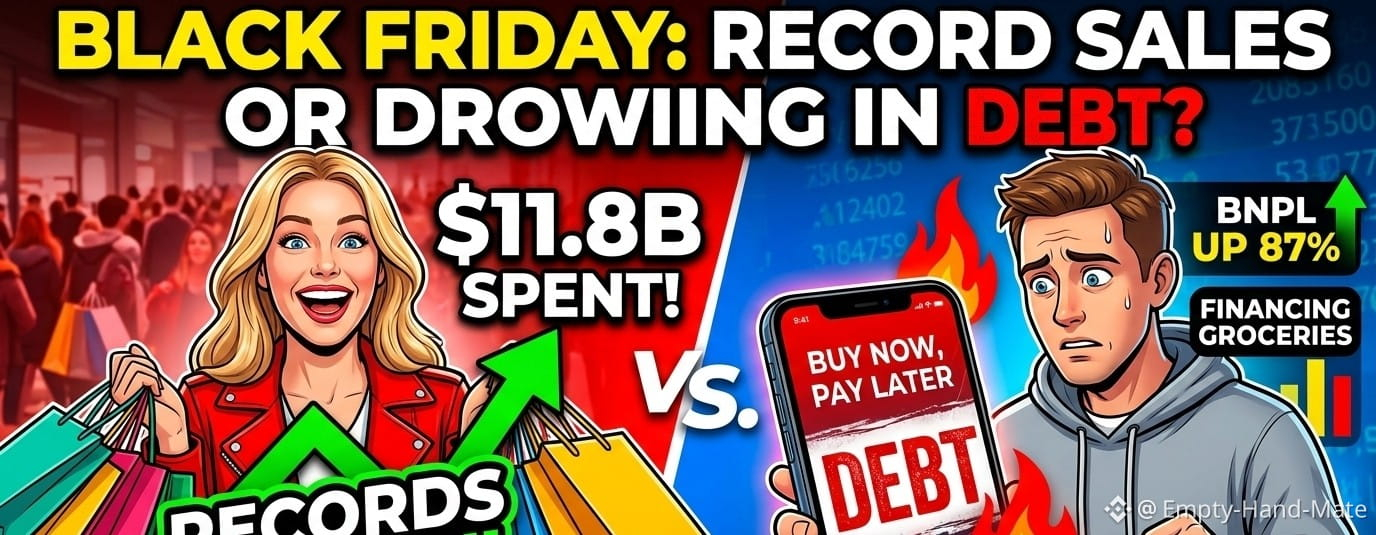
Headlines are screaming about a record-shattering Black Friday, with Americans blowing an estimated $11.8 billion exclusively online. While mainstream media uses this to claim consumer sentiment is booming, the reality under the hood reveals a deeply fragmented, "two-faced" economy.
The truth? The economic boom is highly concentrated:
*The Top 10%:** Wealthy consumers are driving the surge, accounting for nearly half (48%) of all e-commerce sales earlier this year.
*The Squeezed Middle & Lower Class:** For the rest of America, sentiment is at its lowest since 2022. Skyrocketing costs for basics (food, utilities, insurance) paired with shrinking real incomes have left lower-income households feeling like they are in a literal recession.
### The Dangerous Rise of Buy Now, Pay Later (BNPL)
So how is the non-wealthy half still consuming? Debt. Lower-income and younger consumers are relying on financing at an unprecedented rate to keep up:
*BNPL services** saw a 9% spike this Black Friday.
*41% of shoppers** aged 16 to 24 utilized BNPL.
*Younger millennials** boosted their BNPL usage by a massive 87% compared to last year.
Shockingly, *25% of BNPL users** are now financing their daily groceries.
### The Macro Picture: Growth vs. Reality
On paper, the macro data looks incredibly strong. The Atlanta Fed projects Q3 GDP growth near 4%, and the S&P 500 is pushing past 6,750 while gold holds above $4K. Doomsday predictors have been proven wrong, and a December "Santa Claus" stock rally looks highly likely.$BTC
However, this boom is a tale of two entirely different experiences. The lesson for 2026 is clearer than ever: the system favors those who own capital. To outpace inflation and survival-by-credit, you must own assets and ch#BlackFriday2026 #ConsumerDebt #BNPL #Stocks #FinancialFreedom