
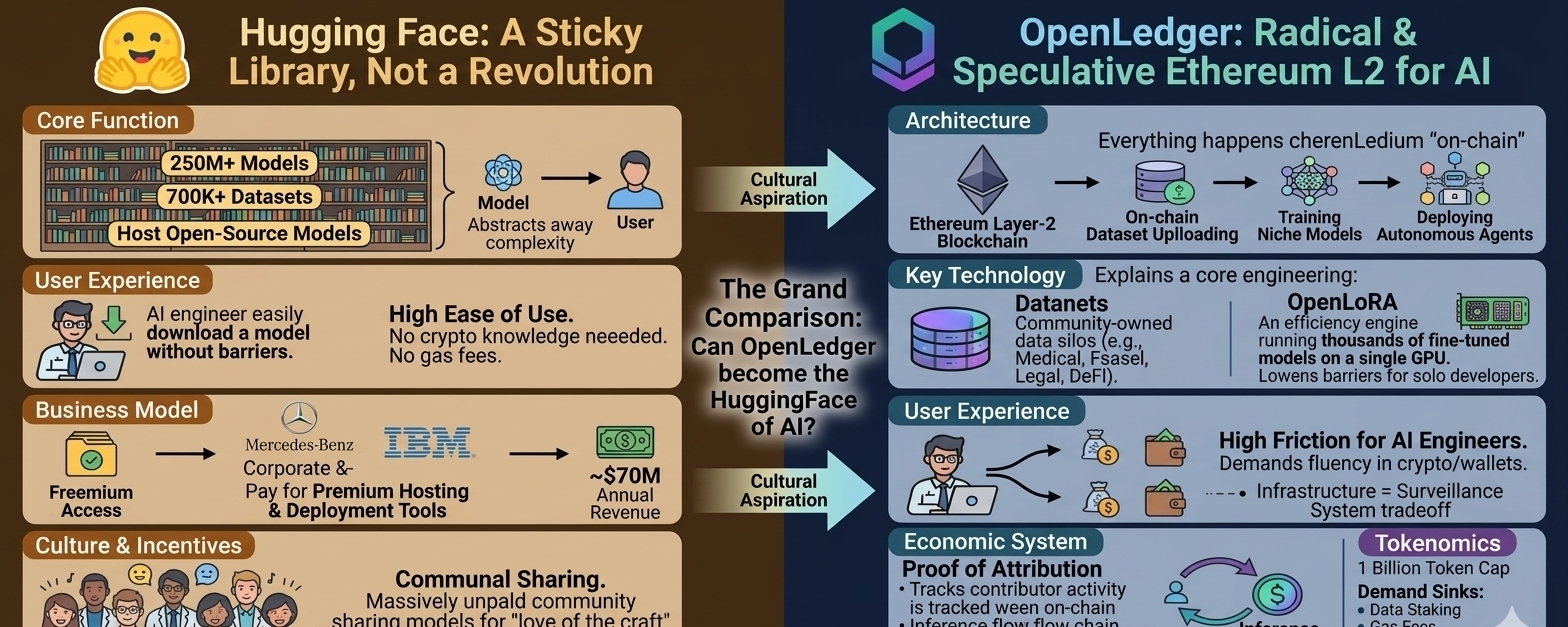
OpenLedger is the latest to carry that torch, and the comparison it invites is grand: can it become the HuggingFace of the AI world? It’s a useful anchor point, but only if you remember what Hugging Face actually is: a library, not a revolution.
Hugging Face, headquartered in New York, has built a remarkably sticky business by hosting open-source models. It is a place you go to download a transformer, fine-tune a BERT variant, or browse one of the more than 250 million publicly available models and 700,000 datasets without ever pulling out a credit card. Its freemium model works. Companies like Mercedes-Benz and IBM pay for premium hosting and deployment tools, generating around $70 million in annual revenue.
OpenLedger offers something different, and more radical, but also more speculative. It is an Ethereum Layer-2 blockchain architected specifically for AI assets. Everything happens on-chain: the uploading of datasets, the training of niche models, the deployment of autonomous agents. The core engineering is built around three components. The first is Datanets, which are essentially community-owned data silos focused on verticals like medical records, legal filings, or DeFi exploits. The third, OpenLoRA, is an efficiency engine capable of running thousands of these fine-tuned models on a single GPU.
This is where the engineering gets interesting. Traditional fine-tuning is computationally expensive; OpenLoRA effectively lowers the barrier to entry for a solo developer or a small research team who can't afford a server farm. The ecosystem is being seeded with real resources. The liquidity is there, at least on paper.
But the comparison to Hugging Face breaks down when you look at the user experience. Hugging Face succeeds because it abstracts away the complexity of the blockchain entirely. You don't need to know what a gas fee is to download a model. OpenLedger, by contrast, demands a fluency in crypto that most AI engineers don't possess. The mechanism for paying data contributors is called Proof of Attribution. It tracks each contribution to a dataset on-chain, and when that dataset is used for inference, a slice of the transaction fee flows back to the contributor in $OPEN tokens. It is a clever accounting system. It solves a real problem—the fact that your daily interactions with chatbots are unpaid labor that trains the models. But it introduces a new friction. To get paid, you need a wallet. To use a model, you need to pay gas fees in a volatile asset. The infrastructure required to track attribution is also a surveillance system, which carries its own privacy tradeoffs.
The team behind OpenLedger seems aware of this tension. The roadmap for 2026 outlines a nine-layer full-stack platform designed to make AI an on-chain asset class. The vision includes an AI marketplace where agents charge fees to other agents and distribute revenue without human intervention. The tokenomics are structured to create demand sinks for $OPEN: data quality staking, gas fees, and marketplace purchases. The total supply is capped at one billion tokens. It is a meticulously engineered economy.
But engineered economies are fragile. The ambition to become the "HuggingFace of AI" is less a technical roadmap and more a cultural aspiration. Hugging Face is a destination because of its massive, unpaid community of contributors who share models for the love of the craft, not because they are chasing token rewards. OpenLedger is betting that financialization will accelerate that collaboration. It might. But in the real world, adding a payment rail to a social network often changes the nature of the contribution, making it transactional rather than communal.
I suspect the real test won't be whether OpenLedger can scale its validator set or lower its gas fees. The test will be whether an AI researcher in a university lab, who doesn't own any cryptocurrency, chooses to upload their dataset to OpenLedger instead of Hugging Face. The data is the fuel. Until that fuel moves, the blockchain is just an empty engine.