
Got caught in a thread yesterday about someone who'd spent three years building a following on a platform, then had their account restricted with no explanation. Big audience, consistent output, gone overnight. Not a new story. Seen it a hundred times. But this one stuck because of how they described it — "I built on rented land."
That phrase was still in my head when I ended up looking more closely at OpenLedger. $OPEN, #OpenLedger. The framing around it kept using this parallel: the internet monetized attention, AI will monetize intelligence. Clean line. Compelling pitch. I've seen it quoted approvingly in a lot of places.
And then I sat with it longer than I usually do.
The parallel sounds like progress. Like a correction. The internet monetized attention, and now something better is coming — a system that monetizes intelligence and actually routes value back to the people who generated it.
But here's the thing that started bothering me: the internet absolutely monetized attention. Massively. Historically. The question is — for whom?
Not for the people providing the attention. For the platforms aggregating it.
Your attention was never the product you sold. It was the inventory someone else sold to advertisers. You got a free service. The monetization happened one layer above you, at scale, without your direct participation in the economics. You were the input. You were not the beneficiary.
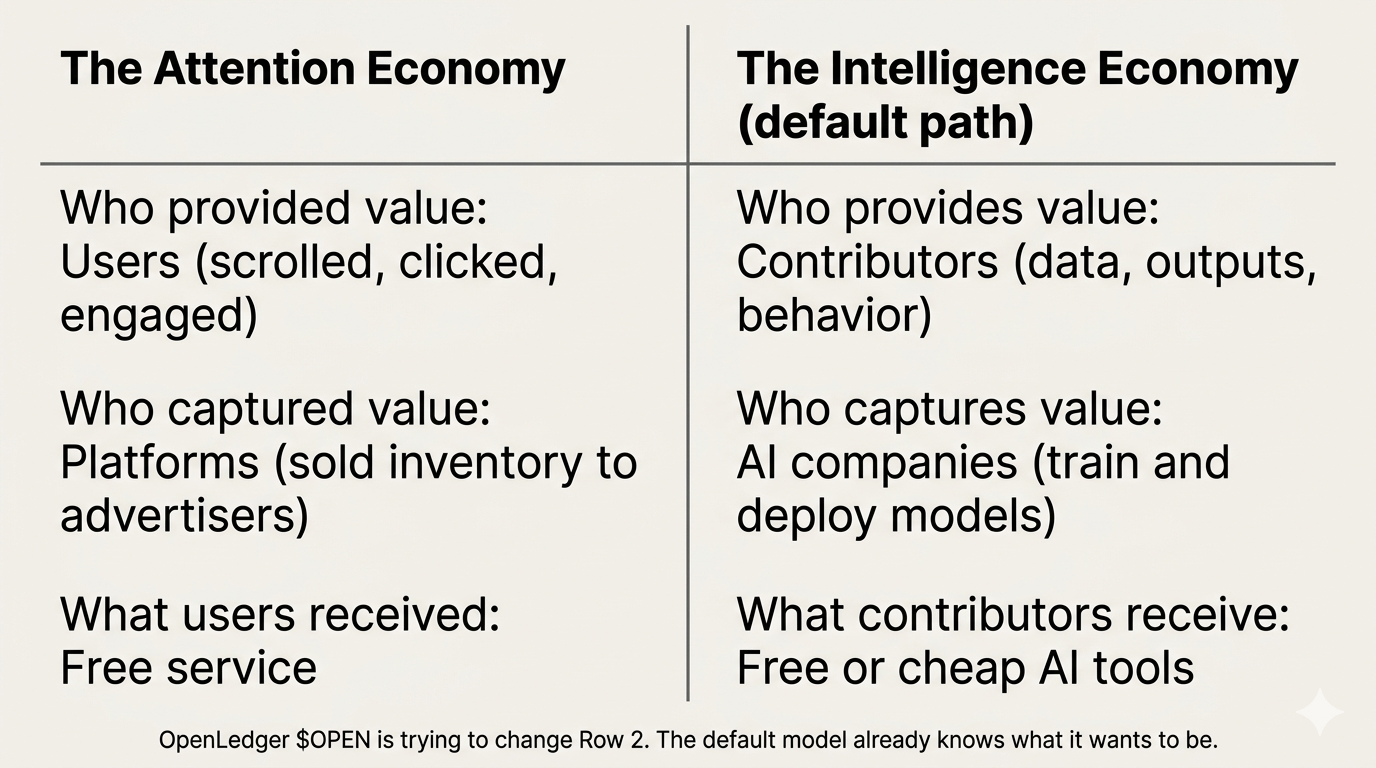
So when the framing is "AI will monetize intelligence" — the question I kept coming back to is: which part of that sentence are most people going to occupy? The intelligence side or the monetization side?
Because if the AI economy follows the attention economy model, the answer is already visible. Your data, your outputs, your behavioral patterns train systems that become valuable. The monetization flows to whoever owns and deploys those systems. You get access to a free or cheap service. The economic logic is identical — just one layer deeper.
I thought OpenLedger was making a creator rights argument. And it is, partly. But actually, what it's trying to do is break the structural parallel before it fully sets. Attribution infrastructure, compensation mechanisms, on-chain records of contribution — these are attempts to build a different economic model before the intelligence economy calcifies into the same shape as the attention economy.
Which matters enormously if it works. And is very hard to execute.
But here's the part I'm genuinely not convinced by.
The attention economy worked because participation was frictionless. You didn't have to do anything to contribute your attention — you just had to be online. The platform captured value from behavior that required no extra steps from you.
An intelligence economy that actually compensates contributors requires active participation. You have to submit data, verify it, tag it, maintain attribution records. That's friction. Real friction. And historically, systems that require active participation from a long tail of contributors end up being used by a small, motivated minority while the rest continue doing the passive thing — which, in this case, means continuing to generate data that gets captured without attribution by whoever built the frictionless interface first.
So the people most likely to benefit from OpenLedger's model are the ones already equipped and motivated to navigate it. Which might be a small and non-representative slice of the contributors the narrative is describing.
There's also something uncomfortable about timing. The attention economy's structure was largely set before most people understood what it was. By the time "you are the product" became common knowledge, the infrastructure was too entrenched to meaningfully challenge. The intelligence economy might follow the same arc — the window where alternative models can actually compete with the default extraction model might be shorter than it looks.
Whether OpenLedger is early enough, and whether the friction problem gets solved, are the two questions I keep returning to.
The "rented land" person from that thread eventually rebuilt on a different platform. Same model. Different landlord.
Market's still doing its slow drift thing. Nothing to act on. Probably the right day to just keep thinking.
@GeniusOfficial #genius $GENIUS