
Most people never think about how a city’s water system works until something breaks. You turn on a tap every day expecting clean water to arrive instantly, but underneath that simple action is an enormous coordination problem. Pipes need maintenance. Reservoirs need monitoring. Engineers need incentives to do their jobs properly. If one part of the system starts cutting corners to save money, the effects may not show immediately, but eventually pressure drops somewhere else, contamination spreads, or entire neighborhoods lose access. Infrastructure only works when incentives, verification, and accountability remain aligned over long periods of time.
That same pattern shows up repeatedly in digital systems, especially in AI. The public conversation around artificial intelligence usually focuses on the visible layer: the chatbot interface, the generated images, the polished demos. But underneath that surface exists another infrastructure layer that is far more complicated and economically fragile. Data has to be collected, cleaned, labeled, and maintained. Models have to be trained and evaluated. Agents need compute resources and coordination frameworks. Somebody has to pay for all of it, and more importantly, somebody has to trust that the system is producing outputs honestly and sustainably.
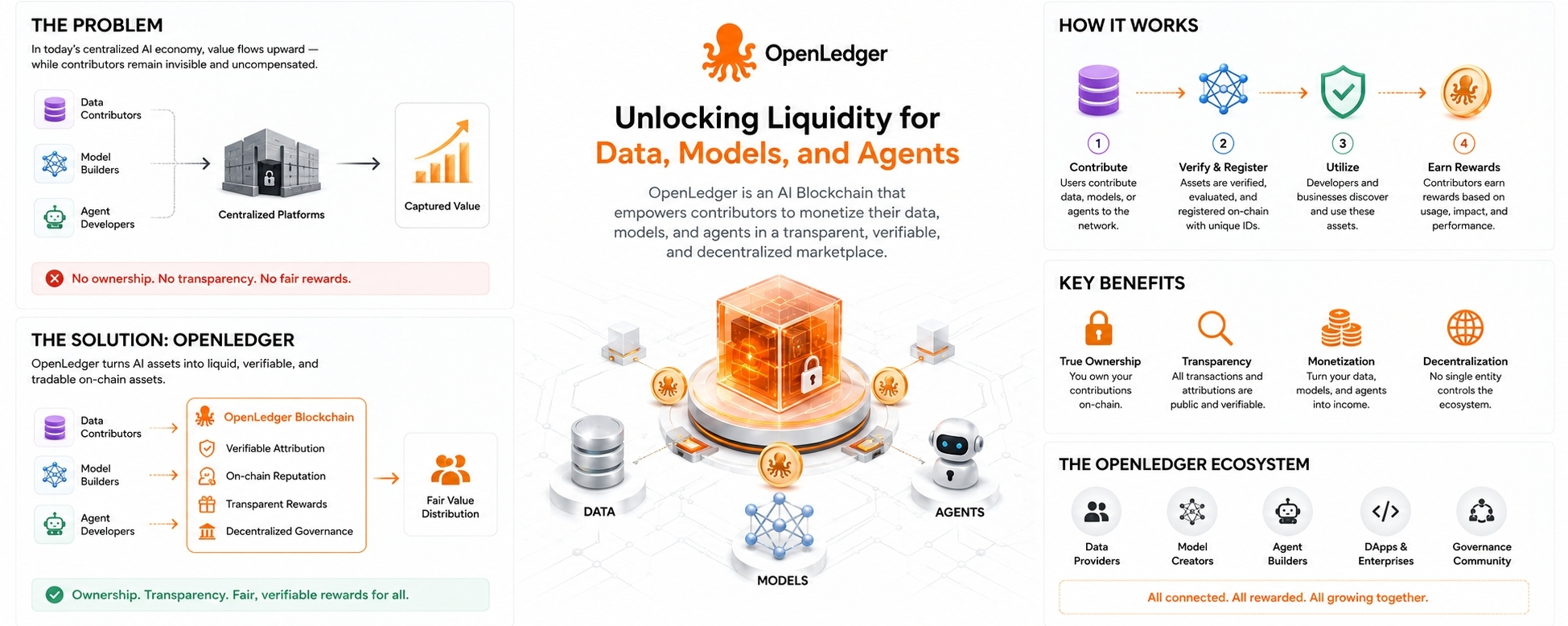
That is the context in which OpenLedger becomes interesting to analyze. The project presents itself as an AI blockchain designed to unlock liquidity around data, models, and agents. At first glance, that description sounds abstract, almost overly broad. Crypto projects often compress complicated operational ideas into a few appealing phrases. But when I looked more carefully at the underlying logic, I realized the core question is actually very practical: can AI infrastructure become economically open in a way that rewards contributors without collapsing into manipulation, centralization, or speculation?
That is a harder problem than it sounds.
Right now, most AI systems operate more like vertically integrated industrial firms than open markets. A handful of companies own the compute, the distribution channels, the datasets, and increasingly the user relationships. Even when outside users contribute value through prompts, behavioral data, fine-tuning, or application building, they rarely retain ownership over the economic upside generated by the system itself. In practice, the structure resembles older infrastructure monopolies more than the decentralized future people often describe.
OpenLedger appears to be attempting a different architecture. Instead of treating AI as a closed product, it frames AI components themselves as economic assets that can be coordinated on-chain. Data providers, model builders, and autonomous agents are positioned less like unpaid participants and more like economic actors inside a network. The important detail here is not the blockchain branding. The important detail is whether the network can create verifiable relationships between contribution and reward.
That distinction matters because AI systems are notoriously difficult to audit. A dataset may claim to be high quality while containing noise or fabricated information. A model may claim certain capabilities that disappear under adversarial testing. Agents may appear productive while internally routing requests inefficiently or even maliciously. In traditional institutions, these risks are managed through contracts, regulation, reputation, and centralized oversight. In decentralized environments, verification becomes far more difficult because there is no single trusted operator responsible for outcomes.
This is where many crypto-AI projects quietly fail. They assume that attaching tokens to participation automatically creates alignment. In reality, financial incentives often amplify bad behavior unless measurement systems are extremely robust. If rewards depend on volume, actors generate spam. If rewards depend on popularity, actors optimize for hype rather than reliability. If rewards depend on unverifiable claims, the system eventually fills with synthetic activity disconnected from real utility.
So the real test for OpenLedger is not whether it can attract attention during favorable market cycles. The real test is whether it can construct mechanisms that survive adversarial pressure over time.
That means the network would need reliable ways to evaluate data quality, measure model performance, track agent behavior, and distribute rewards based on outcomes that can actually be verified. Those sound like technical details, but they are really institutional problems. Large industrial systems succeed because they solve institutional coordination at scale. Ports, railways, insurance networks, and supply chains all depend on measurable accountability. Without that, corruption and inefficiency accumulate quietly until the system becomes unstable.
AI infrastructure faces similar pressures. Imagine a future where autonomous agents are performing financial analysis, customer support, logistics coordination, or research tasks. If those agents are built on unreliable data pipelines or manipulated incentive systems, the consequences become operational rather than theoretical. Businesses do not care whether a system is decentralized in principle. They care whether outputs remain consistent under stress.
That is why adoption matters more than narrative.
A project like OpenLedger ultimately has to prove that participants gain measurable advantages from operating inside its ecosystem instead of using centralized alternatives. Those advantages could include lower costs, better transparency, access to specialized datasets, or new forms of coordination that traditional systems cannot support efficiently. But those outcomes need to emerge from actual usage patterns, not simply token activity.
There is also the question of liquidity itself, which I think is often misunderstood in crypto discussions. Liquidity is not just about trading. In practical economic systems, liquidity refers to the ability to convert effort, assets, or resources into usable economic value without excessive friction. OpenLedger’s thesis appears to be that data, models, and agents are becoming productive digital assets, but existing systems do not compensate contributors efficiently.
Conceptually, that argument makes sense to me. We already live in an economy where user-generated data trains commercial AI systems worth billions of dollars. The imbalance between contribution and ownership is obvious. But translating that observation into a functioning economic network is extremely difficult because digital contributions are easy to fake, duplicate, or manipulate. The internet is full of low-quality abundance. Scarcity and trust are harder to create.
This is why I keep returning to operational reality rather than theory. If OpenLedger can demonstrate measurable throughput, reliable attribution systems, transparent reward structures, and resilient coordination under adversarial conditions, then it may represent something more substantial than another speculative AI narrative. If it cannot, then it risks becoming another layer of financial abstraction detached from meaningful infrastructure.
I also think the broader timing of projects like this is important. AI development is accelerating faster than governance structures around AI ownership. Society has not fully decided who should control training data, who deserves compensation, or how autonomous systems should distribute value. In that uncertainty, experiments like OpenLedger become interesting not because they guarantee success, but because they expose unresolved economic questions that centralized systems often avoid discussing openly.
At the same time, skepticism remains necessary. Blockchain systems frequently underestimate the operational burden required to sustain long-term trust. Real infrastructure is expensive, slow, and maintenance-heavy. Decentralized coordination does not eliminate those realities. In some cases, it intensifies them because responsibility becomes fragmented across many actors with competing incentives.
My own view is cautiously analytical rather than optimistic or dismissive. I think OpenLedger is asking a legitimate question about the future structure of AI economies: who owns the value generated by intelligent systems, and how can that value be distributed transparently across contributors? That is a serious question with real economic implications. But whether the project succeeds will depend far less on branding or market excitement and far more on its ability to build durable verification systems, withstand adversarial behavior, and attract users who care about operational reliability more than speculation.
In the end, I do not see OpenLedger primarily as a token story. I see it as an attempt to redesign the economic plumbing underneath AI itself. And like any infrastructure project, the real judgment will come slowly, through performance under pressure rather than promises made in advance.
