
Better models.
Smarter agents.
More automation.
Faster output.
I will be honest, And after hearing it enough times, it all begins to sound the same.
That is why OpenLedger is more interesting when you do not look at it only as an “AI blockchain.” That label is true enough, but it also feels too broad. It misses the quieter part of the story.
@OpenLedger is really about what happens after AI becomes useful.
Because once AI tools start doing real work, a few questions show up.
Who owns the data behind the work?
Who benefits when a model improves?
How do agents create value that can be tracked?
And how does that value move without being locked inside one platform?
These are not loud questions. But they matter.
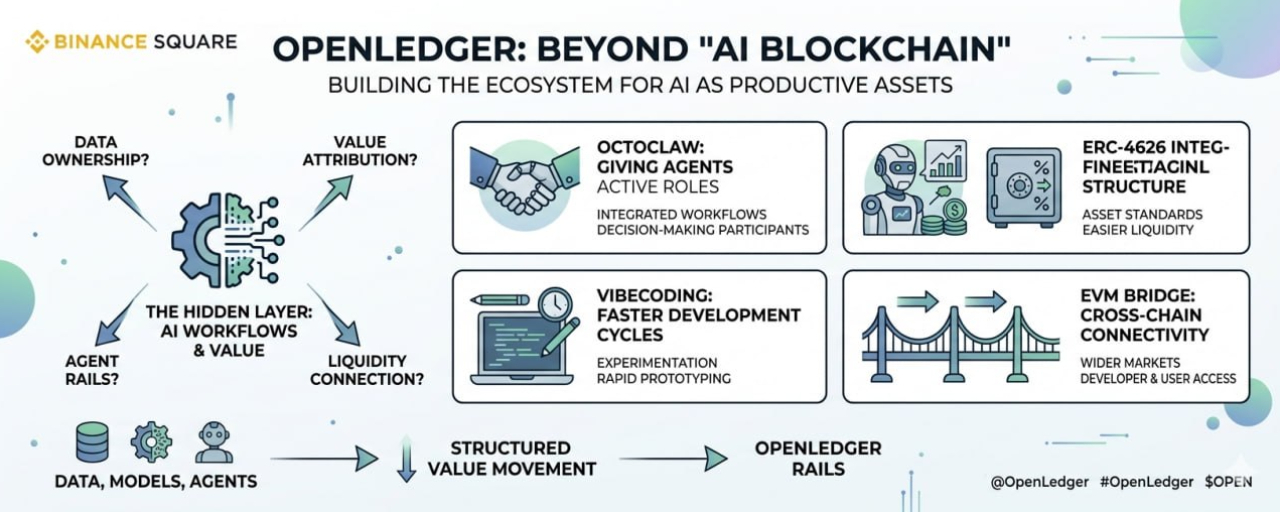
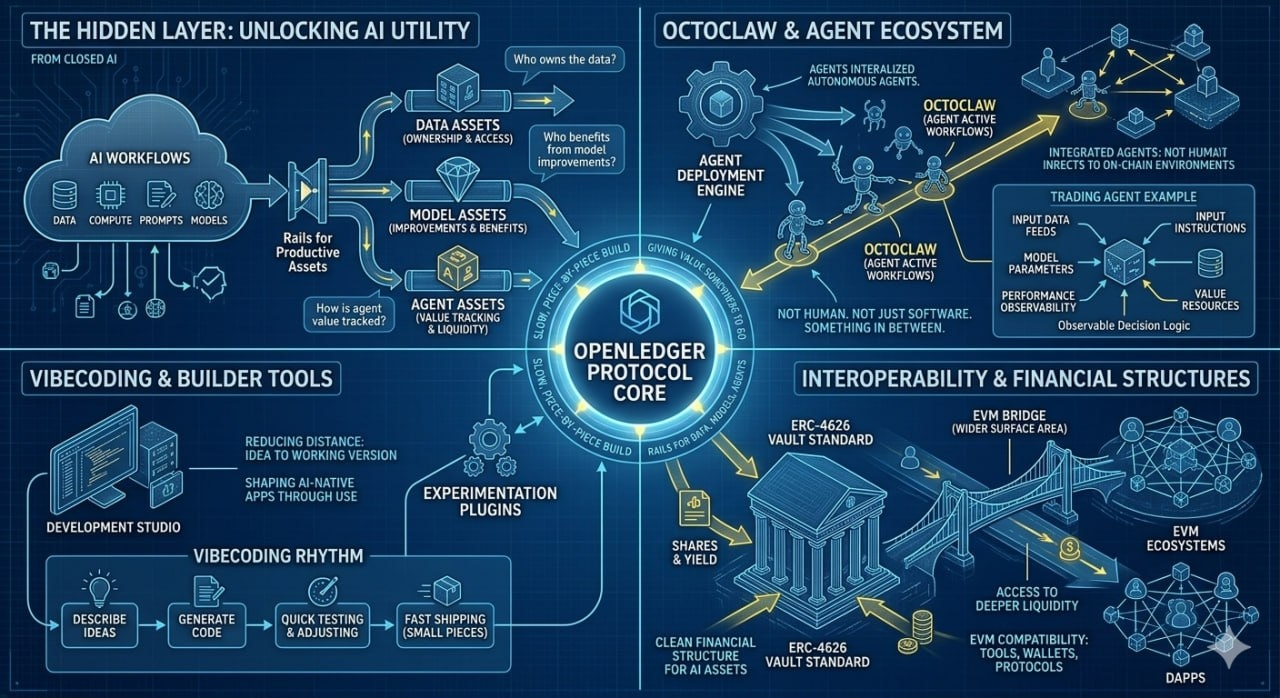
A lot of AI today feels like it lives inside closed rooms. The user gives input. The model gives output. Somewhere in the background, data, compute, prompts, workflows, and agents are doing the real work. But most of that activity is hard to see from the outside.
OpenLedger seems to be trying to make that hidden layer more usable.
Not by turning every piece of AI into a token for no reason. That would be too easy, and honestly, not very interesting.
The better idea is more practical.
If data, models, and agents are becoming productive assets, then they need rails. They need a way to be accessed, valued, reused, and connected to liquidity. Otherwise, they stay useful but trapped.
That is where the recent #OpenLedger updates start to form a clearer picture.
Octoclaw feels like a step toward giving AI agents a more active role inside the ecosystem. Not just agents that answer questions or generate text, but agents that can sit closer to real workflows. Agents that can interact, make decisions, and become part of how users move through on-chain environments.
That shift matters.
Because the agent story in crypto has often been more entertaining than useful. A lot of agent projects create attention, but not much structure. OpenLedger’s approach feels a bit more grounded. The question is not just, “Can an agent do something cool?” The better question is, “Can an agent become part of an economic system where its work has a place?”
That is where things get interesting.
The trading agent is one example of this.
A trading agent is not valuable simply because it trades. Anyone can build a bot. The more important part is what sits around it. What data does it use? What models does it depend on? How are its decisions shaped? Can its performance be observed? Can the value it creates be connected back to the resources that helped produce it?
That is the part most people skip.
AI agents are not magic. They are made from inputs, instructions, models, feedback, and environment. If those pieces remain disconnected, the agent becomes a black box. If they are organized well, the agent starts to look more like a new kind of on-chain participant.
Not human.
Not just software.
Something in between.
OpenLedger seems to be building toward that middle area.
Vibecoding adds another layer to this. $POND
The word itself feels casual, almost unserious. But the behavior behind it is real. Builders are no longer waiting for perfect specs or long development cycles. They are describing ideas, generating code, testing quickly, breaking things, adjusting, and shipping small pieces faster than before.
It changes the rhythm of building.
And for an ecosystem like OpenLedger, that matters because AI-native apps may not be built in the old way. They may emerge from experiments. A small agent. A simple data tool. A trading workflow. A model-connected interface. Something rough at first, then slowly shaped by use.
Vibecoding with OpenLedger could make this kind of building feel more natural.
Not because it removes the hard parts. It does not. But it can reduce the distance between an idea and a working version. And when the underlying ecosystem already thinks in terms of data, agents, and monetization, those experiments can become more than isolated demos.
They can plug into something.
The ERC-4626 integration is important for that reason too.
At first glance, it sounds like a technical detail. A vault standard. Deposits, shares, assets, yield. The kind of thing builders understand but casual users may ignore.
But standards are often what make ecosystems easier to trust.
When assets follow familiar patterns, developers have less guesswork. Liquidity becomes easier to route. Integrations become less fragile. Users do not have to relearn every mechanism from the beginning.
For OpenLedger, ERC-4626 can help give AI-related assets a cleaner financial structure. That could matter if models, datasets, or agent-linked strategies begin to behave more like productive assets over time.
Again, the point is not to force everything into finance.
The point is that useful things eventually need structure around value.
The EVM bridge fits into the same pattern.
OpenLedger cannot grow only by asking people to come into a separate world. That rarely works for long. Builders and liquidity already exist across EVM ecosystems. Tools are familiar there. Wallets are familiar. Protocol behavior is familiar.
A bridge gives OpenLedger more surface area.
It lets assets and users move more easily. It gives developers a reason to test without feeling completely cut off from the rest of crypto. It also makes the AI side of OpenLedger less isolated, which may become important as agents start needing access to wider markets and deeper liquidity.
You can usually tell when an ecosystem is becoming more serious by the type of problems it starts solving.
Early on, the focus is identity. What are we? What category do we belong to?
Later, the focus becomes movement.
How does value move? $WLD
How do builders enter?
How do users interact?
How do agents connect with liquidity?
How does data become more than something stored in the background?
OpenLedger now feels closer to that second stage.
Octoclaw gives the agent side more shape.
The trading agent makes the use case more visible.
Vibecoding makes experimentation feel more open.
ERC-4626 gives liquidity a cleaner standard.
The EVM bridge connects the ecosystem to where a lot of crypto activity already lives.
The angle is not that OpenLedger has everything figured out.
No ecosystem does.
The more honest view is that OpenLedger is working on a problem that will probably become more obvious with time. AI is creating more digital work, more digital decisions, and more digital value. But most of that value still sits in closed systems with unclear ownership and limited liquidity.
OpenLedger is trying to give that value somewhere to go.
Not loudly.
Just piece by piece.
And maybe that is the more useful way to watch it. Not as another big AI narrative, but as a slow attempt to build rails for the things AI leaves behind — data, models, agents, and the value they create while no one is really looking.