

After spending an hour shuttling tokens, tweaking slippage, and juggling yield farms, I realized traditional DeFi felt more like stress management than finance. This led me to view OpenLedger differently: as a platform focused on intent-based coordination and automation. In the following, I’ll explain how OpenLedger’s latest updates (mainnet launch, new tools like OctoClaw agents, partnerships with Trust Wallet and Unstoppable Domains, etc.) turn that stress into a much smoother experience – almost like switching from paper maps to a GPS.
Manual DeFi Feels Like Stress:-
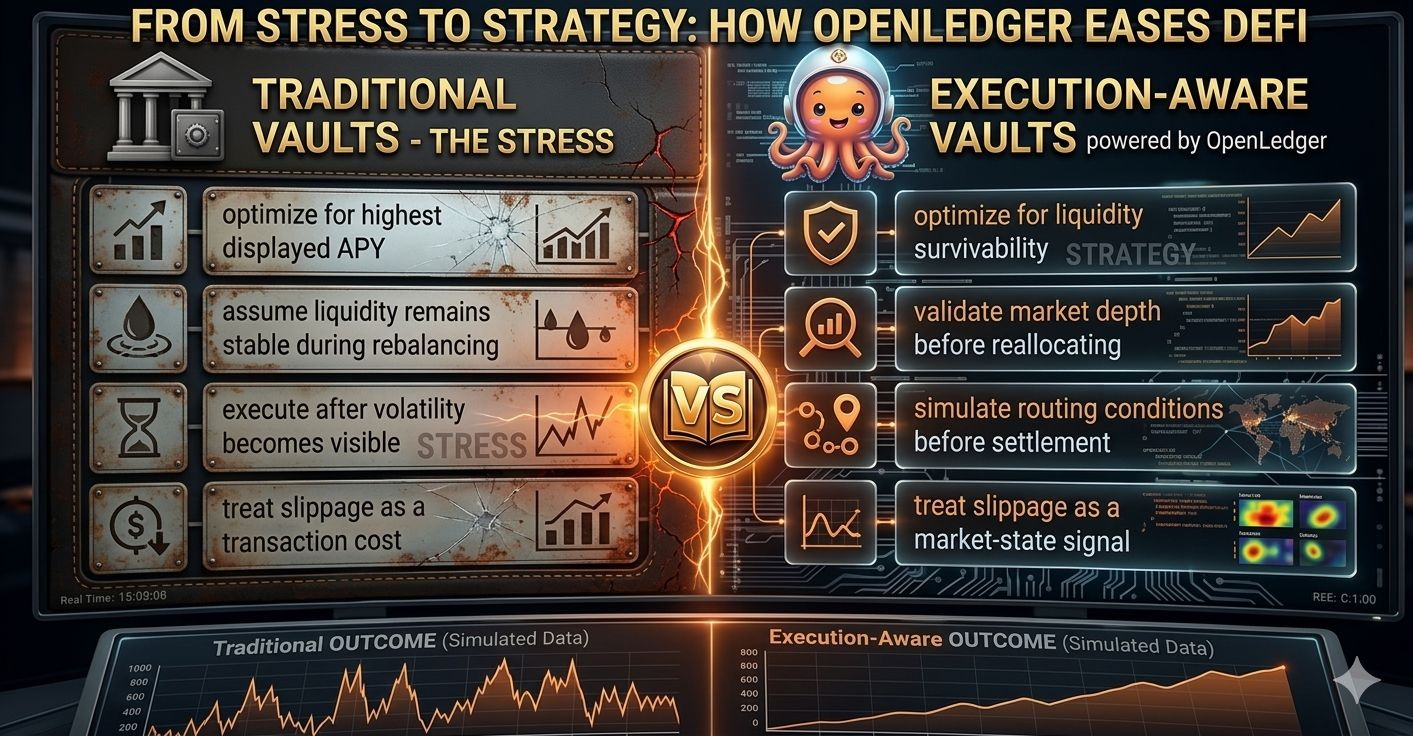
A few days ago I was frantically moving assets between wallets, checking gas prices every minute, adjusting slippage settings, and hopping between farms for the best yields. After an hour of this, I thought, is this really finance or just extreme stress management? (lol). It hit me that most DeFi still forces users to think like operators. I literally had to be glued to my screen, babysitting every trade and gas bump. If anything in the market shifted while I was asleep, I’d be toast. Even seasoned DeFi users burn out doing this, because the whole ecosystem is so fragmented – there are just too many decisions to make all at once.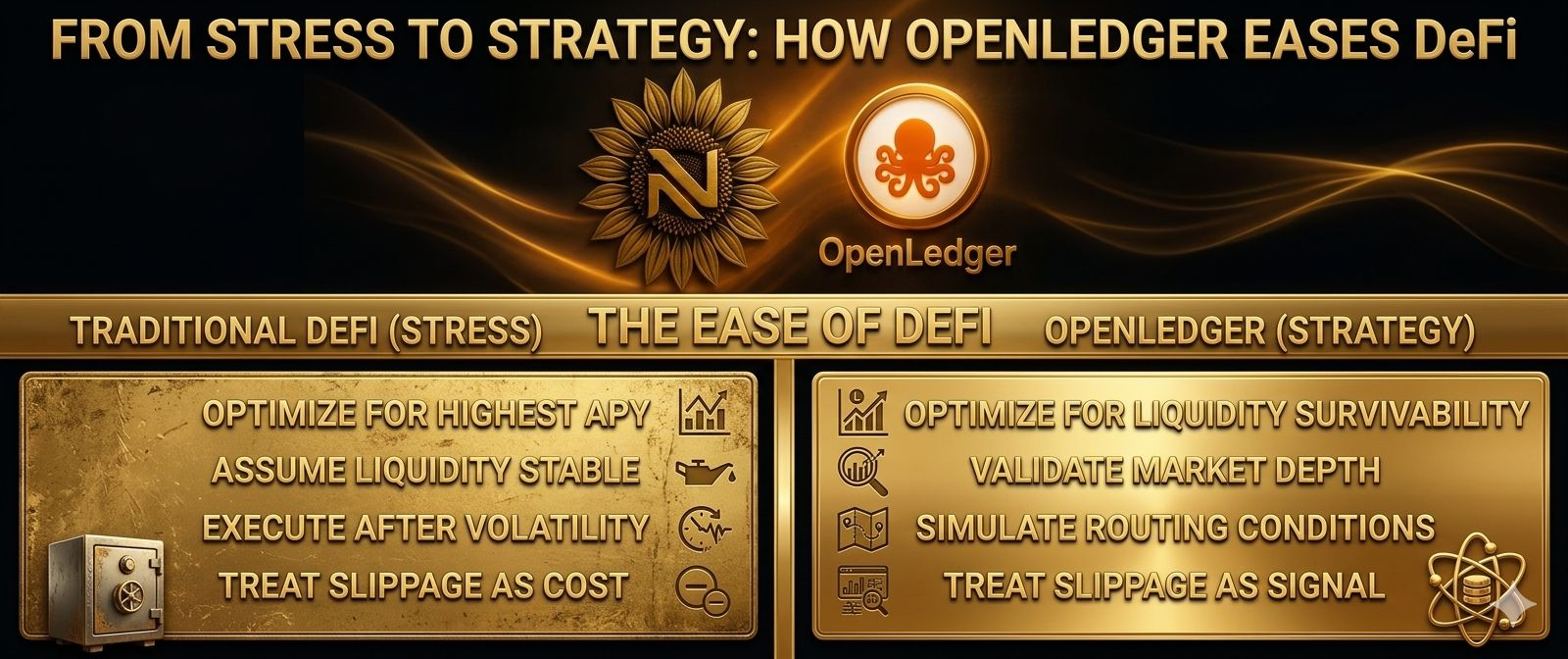
That’s when OpenLedger really caught my attention. It’s moving toward a deeper model: one where I state my intent and the system handles the execution. I don’t have to manually swap each token or decide every gas level. Instead, I can specify a goal – say, “optimize my liquidity and minimize risk” – and intelligent agents coordinate everything. It’s like telling a GPS where to go instead of plotting every turn. Underneath, OpenLedger’s blockchain + AI agent stack figures out the details: pulling live price feeds, routing trades, checking position limits, and settling transactions on-chain. All of these steps remain transparent and verifiable (no secret tricks hiding behind curtains). The only difference I notice is peace of mind: I set my strategy once and the system keeps chugging along, even while I sleep. This kills emotional panic and makes DeFi feel less like a chaotic trading floor.
Importantly, OpenLedger isn’t just gluing together existing tools. Its core architecture is built for this intent-driven approach. The platform’s native ecosystem (now running live mainnet since late 2025) ties AI, data, and smart contracts in a unified way. They launched the $OPEN token and got it listed on major exchanges, and even added Coinbase Custody to securely hold protocol funds. They rolled out OctoClaw, an on-chain AI agent toolkit that lets anyone build and deploy specialized bots in real time. They set up partnerships everywhere: for example, Trust Wallet (with its 200M+ users) is working with OpenLedger to integrate AI-driven wallet features, and Unstoppable Domains teamed up to create the new .openx domain just for on-chain AI identities. Under the hood, OpenLedger is a high-performance Ethereum L2: transactions are fast and gas fees are tiny compared to older chains. This means I can automate many actions without sweating costs. All these updates mean the system can safely monitor and execute across different markets by itself – no more frantic page-refreshing from me.
Shifting From Clicks to Conversations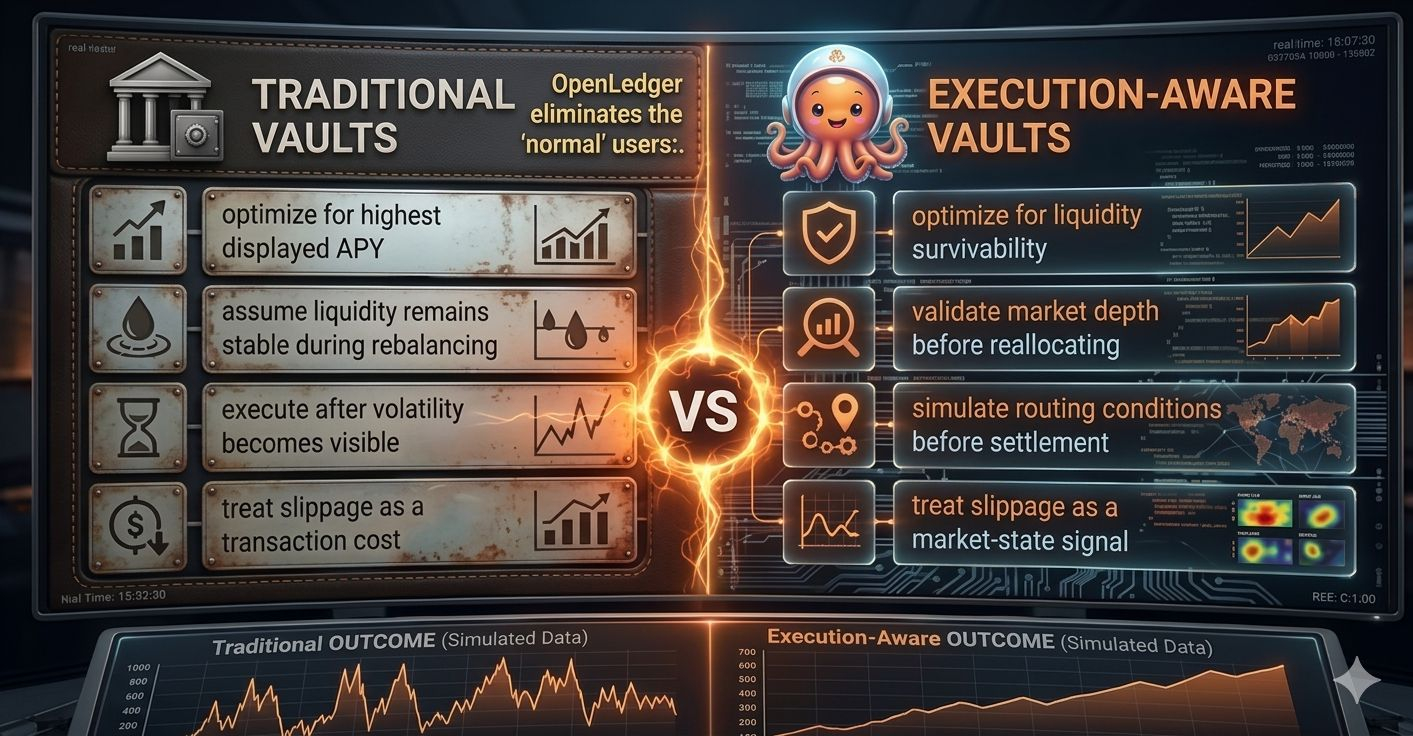
What this all comes down to is a shift in roles. In today’s DeFi world, the “best” user is the one who never blinks: always watching charts, manually executing every order faster than anyone else. OpenLedger flips that on its head. Now, I define the objective and the infrastructure handles the complexity. It reminds me of moving from feature phones to smartphones: once you get used to telling your phone what you want instead of digging through menus, you wouldn’t go back. By replacing most manual steps with AI-driven agents, OpenLedger makes DeFi about strategy rather than sweat. Regular users don’t have to become full-time degens anymore to make meaningful trades – the system’s continuous monitoring and on-chain visibility do the heavy lifting.
The practical result? The whole experience is way less stressful. Risk management is built in at every layer: the agents keep an eye on positions 24/7 and rebalance or alert me proactively. I can verify every action on-chain at any time, so the mystery and fear of “did I get rugged?” mostly disappear. All I really do is set clear intent and stay in control, but without having to click a thousand buttons.
I honestly think this intent-based approach could be one of the biggest changes in DeFi ahead. It’s no secret that crypto currently rewards the fastest, most gluttonous traders who never sleep. But imagine if instead of those people, the winners were simply the systems that remove complexity effortlessly. In that future, decentralized finance might not be about who can react the fastest; it might belong to platforms where intelligent coordination is just invisible infrastructure working quietly.
That’s essentially OpenLedger’s play. In the same way GPS relegated map-makers to history, OpenLedger is quietly showing a future where individual DeFi users don’t have to micromanage every move. They just define their goals, and a background of AI agents and on-chain protocols handles the rest seamlessly. If we get there, “making money in crypto” will feel a lot more like using a smart assistant than like juggling chainsaws at midnight. And that would make DeFi a whole lot less like stress management, and a lot more like what it’s meant to be.
