

Most AI projects today are competing over who can build the smartest chatbot, the fastest model, or the loudest narrative. But the more I study this space, the more I realize the real trillion-dollar question is much simpler:
Who actually owns the intelligence?
Right now, the AI economy feels broken. Massive models are trained on oceans of public and private data, creators rarely get rewarded, attribution disappears into black boxes, and users have no visibility into where intelligence actually came from. AI became one of the most valuable industries in the world while the people feeding it remained invisible.
That’s the exact reason @OpenLedger caught my attention.
While most “AI + crypto” projects focus on hype cycles, OpenLedger is building something far more foundational: a blockchain infrastructure where data, models, AI agents, and contributors can finally become economically traceable. Not just visible payable.
And honestly, that changes the entire conversation.
OpenLedger calls itself “The AI Blockchain,” but after diving deeper into the ecosystem, I think a more accurate description is this:
It’s building the attribution layer for the future AI economy.
That matters more than most people realize.
The core innovation behind OpenLedger is its Proof of Attribution system. Every contribution whether it’s datasets, model improvements, compute resources, or AI agent activity becomes verifiable on-chain. Instead of centralized companies extracting intelligence for free, contributors can actually own and monetize their participation.
That creates what OpenLedger describes as a “Payable AI” economy.
And I think that concept is massively underestimated.
We already saw what happened when the internet enabled creators to monetize content through platforms like YouTube. OpenLedger is attempting a similar shift for AI itself. Imagine specialized Datanets where communities collectively build valuable AI datasets for DeFi behavior, gaming analytics, medical sectors, or localized knowledge and contributors earn whenever those datasets power real applications.
That’s not just another token narrative.
That’s a new economic model for intelligence.
The timing also feels incredibly important. Regulatory pressure around AI transparency, copyright, and data ownership is growing globally. Governments and enterprises are beginning to ask uncomfortable questions about where training data comes from and who deserves compensation.
OpenLedger feels positioned directly at the center of that future conversation.
And unlike many conceptual AI projects, they’ve actually delivered meaningful infrastructure already.
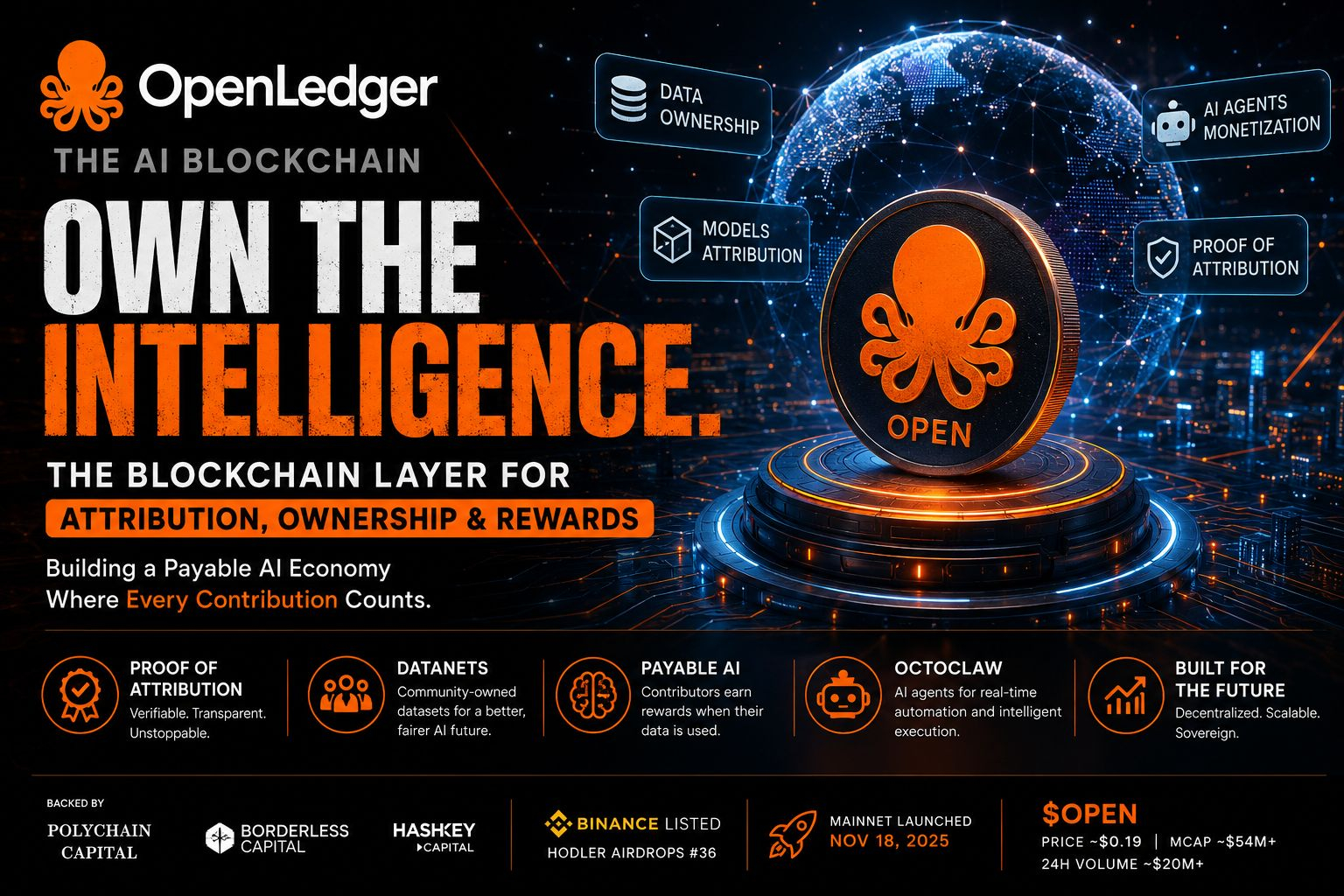
The project raised an $8M seed round backed by serious names like Polychain Capital, Borderless Capital, and HashKey Capital. In my opinion, that backing matters because these firms usually prioritize infrastructure plays with long-term market relevance instead of short-lived hype products.
Then came the major turning point.
In September 2025, Binance listed $OPEN through its HODLer Airdrops program as Project #36. That instantly gave OpenLedger visibility across the broader crypto market. The token launched with strong momentum, trading pairs across OPEN/USDT, OPEN/USDC, OPEN/BNB, OPEN/FDUSD, and OPEN/TRY, while attracting heavy liquidity and community attention.
But listings alone don’t create sustainability.
Mainnet execution does.
On November 18, 2025, OpenLedger officially launched its mainnet, bringing decentralized attribution and automated AI contribution rewards into production. That moment mattered because it shifted OpenLedger from “vision” into real operational infrastructure.
And the ecosystem didn’t stop there.
One of the most interesting launches this year was OctoClaw, a practical AI agent platform focused on workflow automation and multi-LLM orchestration. Instead of vague AI promises, OpenLedger introduced a tool users can actually deploy for execution, automation, and intelligent coordination across systems.
That’s where I think OpenLedger separates itself from many competitors.
It isn’t just selling futuristic language.
It’s building usable AI rails.
The ecosystem expansion has also been strategic. Partnerships with LagrangeDev aim to improve decentralized AI accuracy and launch marketplaces for DeFi and gaming tools. Integration with Kaito helps pull real-time Web3 intelligence into verifiable AI systems while rewarding community engagement through Yapper Arena mechanics. Even collaborations involving Pudgy Penguins showed how OpenLedger can blend AI infrastructure with culture, identity, and interactive digital experiences.
Another underrated factor is community participation.
Over 100,000 contributors have reportedly joined OpenLedger Datanets, while the project maintains one of the more active AI-focused communities across Binance Square and X. The discussion quality around OpenLedger feels noticeably different from standard speculative chatter. A lot of the conversation centers around AI agents, decentralized ownership, inference economics, and infrastructure design instead of pure price obsession.
That’s usually a healthy signal for long-term ecosystems.
From a token perspective, OPEN currently trades around the $0.18–$0.19 range with a market cap above $54M and daily trading volume exceeding $20M. Considering the scale of the AI narrative globally, I personally think the market is still trying to understand what OpenLedger could become if Payable AI evolves into a dominant infrastructure category.
Of course, risks exist.
The AI-crypto sector is highly competitive, token volatility remains significant, and execution on broader marketplace adoption will be critical. Future unlock schedules beginning after September 2026 will also remain an important factor investors monitor carefully.
But stepping back from short-term price action, I think OpenLedger is attempting to solve one of the deepest problems in the modern AI era:
Not how to create intelligence.
But how to fairly value it.
And if the future of AI becomes decentralized, transparent, agent-driven, and economically programmable, then attribution may become more valuable than the models themselves.
That’s why OpenLedger feels important to me.
Not because it’s following the AI narrative.
Because it’s trying to build the ownership system underneath it.
