
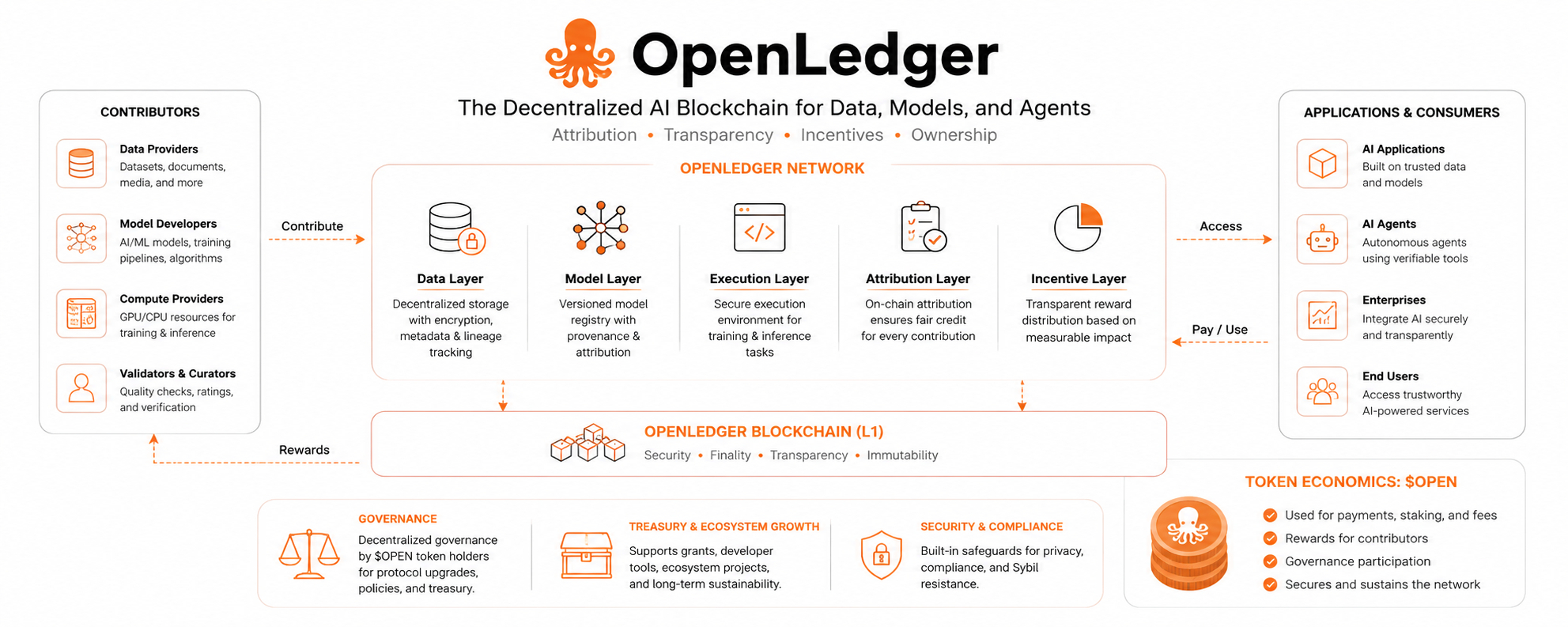

OpenLedger is best understood less as a typical “AI crypto project” and more as an attempt to rethink how AI systems are structured underneath the surface. Instead of focusing only on visible applications like chat tools or agents, it shifts attention toward the hidden layer that actually makes AI possible: data, model training, contribution tracking, and value distribution.
At the core of its idea is a simple but difficult question—who owns and benefits from the systems AI depends on? In most current setups, data is collected from many sources, models are trained in centralized environments, and the value generated often flows back to a small number of controlling platforms. This structure is efficient, but it is also highly concentrated, and users rarely see how their contributions are used or rewarded.
OpenLedger tries to address this by introducing a more transparent coordination layer. The goal is to make participation in AI systems more visible and traceable, so that contributors, developers, and applications can exist in a shared environment where value flow is not completely hidden. In simple terms, it is an attempt to make the “invisible work” behind AI more accountable and structured.
The design challenge here is not small. Systems like this have to balance transparency with performance, and decentralization with efficiency. When more participants join, governance becomes harder, incentives can become uneven, and decision-making can slow down. These are not theoretical problems—they are the real stress points that determine whether such systems can scale in practice.
Another important aspect is how OpenLedger fits into the broader direction of AI development. As AI becomes more deeply integrated into finance, data processing, and digital services, infrastructure ownership becomes more important than individual applications. The way these underlying systems are designed can influence who has control, who gets rewarded, and how trust is established across the network.
At the same time, there is a realistic caution to keep in mind. Many systems that begin with decentralized intentions often face pressure to recentralize as they scale, simply because centralized coordination is often faster and easier under heavy demand. Whether OpenLedger can maintain its intended structure under real-world usage is one of the key long-term questions.
Overall, OpenLedger represents an attempt to rethink AI infrastructure from the ground up, focusing less on hype and more on coordination, accountability, and long-term system design. Its success will depend not just on the idea itself, but on how well it handles complexity, incentives, and scale in practice.