
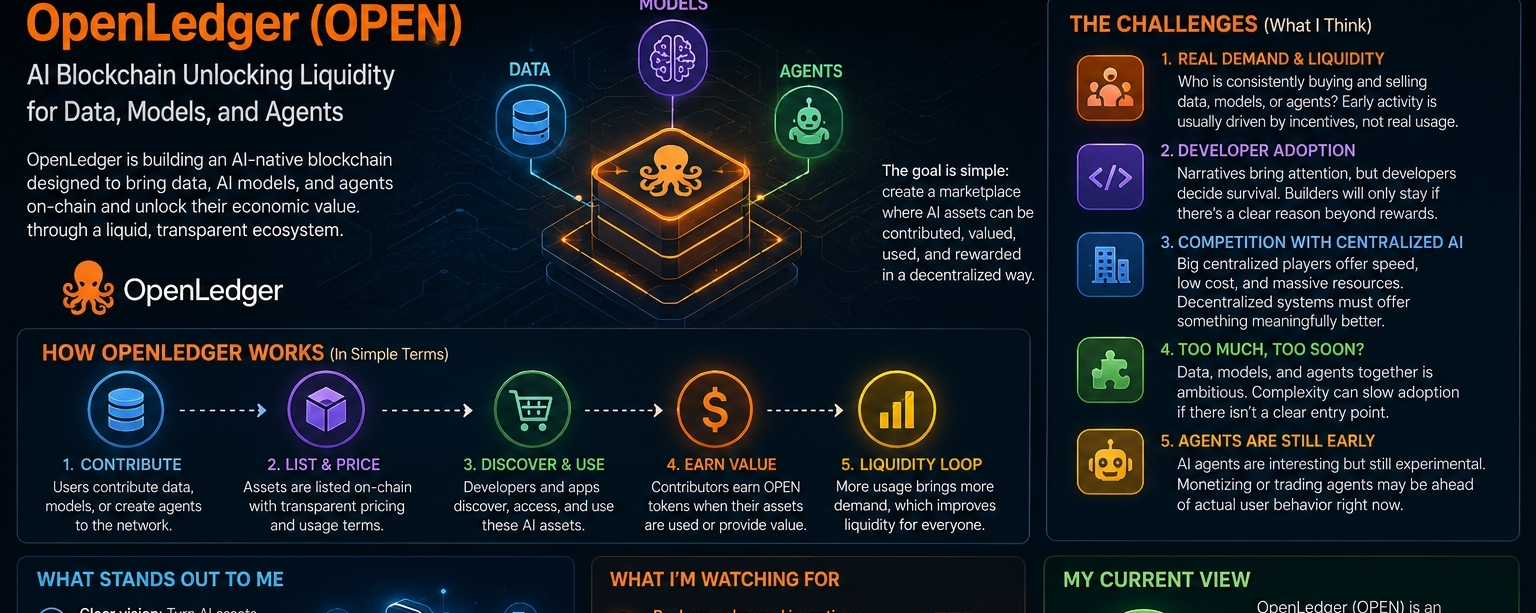
I’ve been seeing a steady rise in projects trying to sit at the intersection of AI and blockchain, and every time something new appears in this category, my reaction is usually the same: I slow down and try to separate narrative from actual demand. With OpenLedger, it feels like another attempt to bring structure to something that is still very fluid in the real world—AI systems, data ownership, and the idea of turning both into something that can be traded or monetized on-chain.
What immediately stands out is the ambition to treat data, models, and agents as economic units. On the surface, it sounds logical. Data has value, AI models produce value, and agents could, in theory, act as automated participants in a digital economy. But I’ve seen enough cycles in crypto to know that what sounds logical in theory often behaves very differently once real users enter the system. The gap between “this can be monetized” and “people actually pay for this repeatedly” is where most of these ideas either break or slowly fade.
I’ve noticed this pattern before in decentralized storage networks, compute marketplaces, and earlier data economy experiments. They all start with a similar promise: unlock dormant value by decentralizing it. But the hard part is never the idea—it’s the liquidity. Not just token liquidity, but real usage liquidity. The kind that comes from developers building actual systems that depend on the infrastructure day after day. Without that, everything tends to remain speculative, even if the technology works perfectly.
With OpenLedger specifically, I keep asking myself where the real entry point is for developers. In most successful ecosystems I’ve observed, adoption doesn’t start with a full vision. It starts with a small, unavoidable use case—something simple enough that people adopt it without thinking too much. If onboarding feels like a shift in behavior rather than an extension of what already exists, adoption usually slows down. That’s something I’ve seen repeat across multiple cycles.
The idea of monetizing AI models and data directly on-chain is interesting, but I’ve also seen how sticky existing AI infrastructure is. Most developers are already building on centralized platforms where everything from compute to distribution is tightly integrated. Asking them to move into a decentralized liquidity layer requires not just ideological appeal but a very clear and immediate advantage. Otherwise, most of them will experiment but not commit.
The “agent economy” narrative adds another layer of uncertainty. I’ve watched early AI agent systems evolve recently, and while they’re impressive in controlled environments, real-world reliability is still inconsistent. Agents can complete tasks, but they struggle with unpredictability, edge cases, and long-running autonomy. If a system depends on agents becoming stable economic participants, then it’s partially built on behavior that is still forming, not established.
At the same time, I don’t ignore these experiments anymore. I’ve seen enough cases where something that looked overly abstract in the beginning later found a very narrow but real use case that gave it life. Not the full vision, not the broad economy it originally described, but a subset that actually made sense in practice. That’s often how infrastructure survives in crypto—not by delivering everything it promises, but by becoming useful in one specific direction that wasn’t fully obvious at launch.
Another thing I keep in mind is attention cycles. In crypto, attention moves faster than utility. Projects can feel very active during the narrative phase, but what really matters is what happens after attention rotates elsewhere. That’s usually when the real signal appears. Builders who stay, usage that continues, and liquidity that doesn’t evaporate—that’s what separates lasting systems from short-lived narratives.
Right now, OpenLedger feels like it’s still in that early observation phase where everything is possible but nothing is proven. I don’t see strong evidence yet of deep developer lock-in or consistent usage loops, but I also don’t see anything that clearly disqualifies it. It sits in that middle space that I’ve learned not to judge too quickly, because that’s often where outcomes are decided quietly over time.
What I’m really watching for is whether it creates something people naturally integrate into their workflow without needing to think about “using a blockchain system.” The more invisible it becomes in practice, the higher the chance it actually sticks. If it stays too dependent on narrative alignment or speculative participation, it will likely follow the same path as many infrastructure-heavy experiments before it.
For now, my stance is simple. I’ve seen enough patterns to avoid rushing into conclusions. It’s something I’m keeping an eye on, not because it stands out as revolutionary right now, but because it sits in a category that has produced both long-term ecosystems and short-lived experiments in the past. The difference usually only becomes clear with time, not with announcements, and definitely not at the start of the cycle.