
I focus less on hype now, mostly because hype doesn’t stay honest for long in this market. It rises fast, talks loudly, then quietly leaves you holding the parts nobody wants to explain anymore. After enough cycles, you stop trusting the noise and start watching what remains when everything cools down.
I’ve been noticing that shift in myself more than anything else. I don’t react the way I used to. I don’t feel pulled into narratives as quickly. I wait. I observe. I try to understand what a project looks like when nobody is trying to perform belief anymore.
That’s where something like OpenLedger enters my attention, not as conviction, but as a question that doesn’t fully settle.
There’s always this gap in crypto between what something says it is and what people actually do with it. Most ideas sound complete in theory. They sound even better when the market is excited. But the real test is always quieter. It shows up later, in behavior, in repetition, in whether anyone still cares when the rewards are no longer loud.
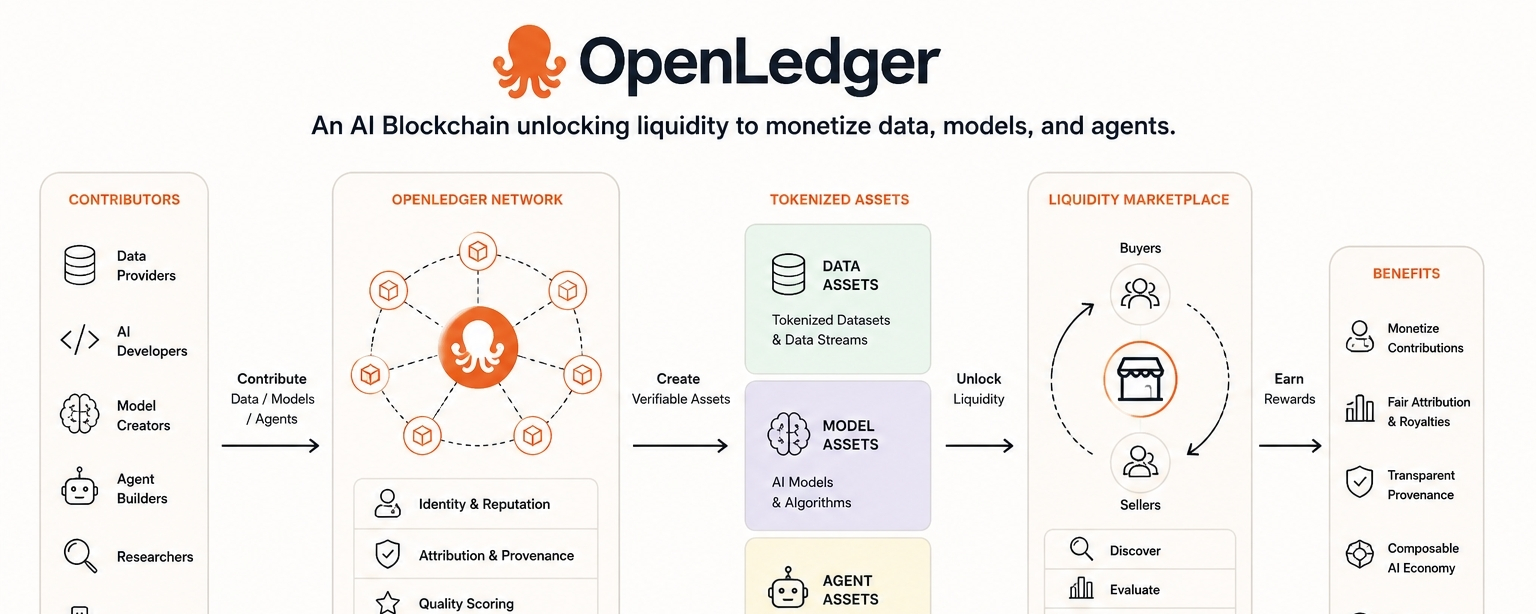
With AI and blockchain mixing together, that gap feels even more visible. Everything is framed around ownership, liquidity, attribution, value flow. Big words that sound clean until you try to imagine real humans interacting with them in a normal way. Because most people aren’t thinking about infrastructure or economic layers when they open an app. They’re just trying to get something done without friction.
And still, I can’t ignore the underlying feeling that something is off in how digital value accumulates today.
People create constantly now without really feeling it belongs to them. A comment, a prompt, a pattern of behavior, a small interaction repeated millions of times across systems that learn from it. It disappears into something larger almost immediately. The contribution is real, but the ownership is blurry. That tension has been building for a while, even if most people don’t name it directly.
OpenLedger sits somewhere in that discomfort. At least in how it presents itself. The idea that data, models, and participation could be made economically visible is interesting, but interest is not the same as belief. I’ve learned to keep those separate.
Because crypto has trained me to be cautious with anything that feels too aligned with a problem statement. Solving a real problem doesn’t automatically mean people will care long enough to sustain it. In fact, the harder part is usually everything after the idea makes sense.
Will people actually use it without incentives pushing them? Will they stay once the novelty fades? Will attribution feel meaningful in a world where convenience always wins a little more?
These questions matter more than any narrative around AI or decentralization.
I’ve seen enough cycles to know that attention is the first thing to leave. Not technology, not vision, but attention. Once attention shifts, everything else becomes heavier. Communities quiet down. Builders either persist or drift. And most users simply move on without explanation.
That’s why I pay attention to atmosphere now. Not announcements, not charts, not the way things are introduced, but the feeling of continuity underneath them. Whether something feels like it is being lived in or just temporarily visited.
OpenLedger, from a distance, still feels undecided to me. Not in a negative way, just unfinished in the way early systems often are. There’s ambition in the framing, but ambition is common. What matters is whether anything about it starts to feel habitual to people who don’t care about narratives at all.
And I think that’s where my skepticism always returns.
Because I’ve seen how quickly ideas dissolve when the emotional energy around them fades. Even good ideas. Especially good ideas that never quite find the right rhythm with actual users.
At the same time, I can’t fully dismiss the direction it’s pointing toward. The question of invisible labor in digital systems is not going away. If anything, it’s becoming more obvious. The more AI grows, the more we notice how much of it is shaped by quiet human input that rarely gets acknowledged in any meaningful way.
There’s a strange imbalance there that keeps bothering me, even when I try not to think about it too much.
Maybe that’s why I keep watching without deciding. Because it feels like something still forming, not something already defined. And crypto has taught me that those are the hardest things to judge correctly.
So I stay in that in-between space for now. Not convinced, not dismissive. Just aware that some ideas don’t reveal what they are in the moment they arrive. They take time, and most of them don’t survive that time.
OpenLedger might become something real in that space, or it might slowly fade into the background like many others before it.
I don’t feel ready to decide, and I’m not sure I need to yet.