
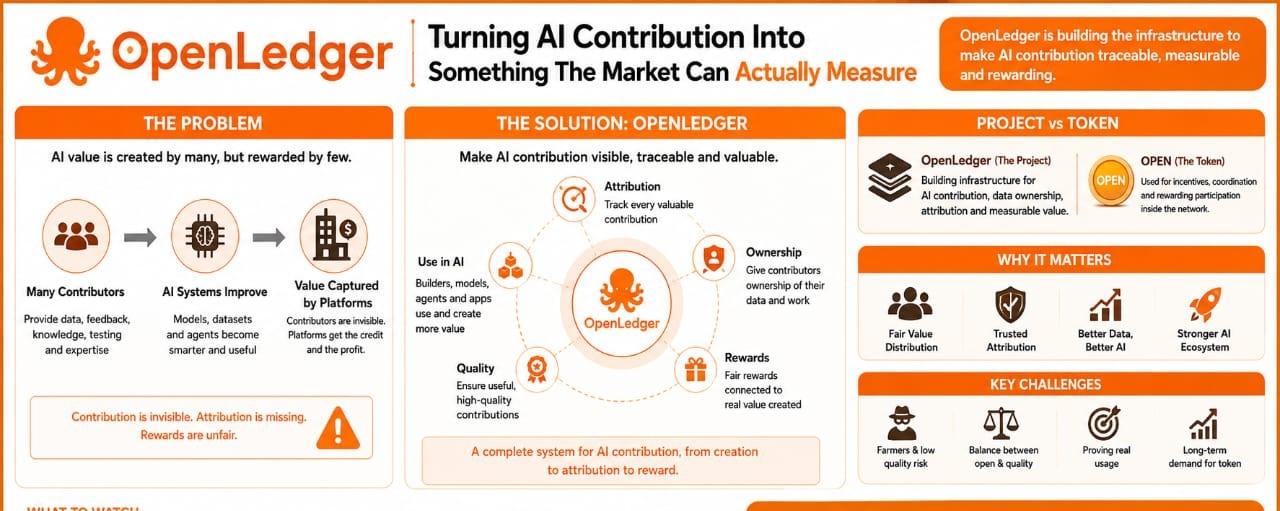
OpenLedger carefully because it is touching a part of AI that most people ignore. The market usually talks about models, agents, apps, and tokens, but OpenLedger is focused on something quieter: the people, data, and contributions behind AI value. That is why it feels different to me. Not perfect. Not proven. But different enough to watch.
Most AI projects want attention at the surface. They want to show the final product. The model. The tool. The agent. The output. OpenLedger is looking underneath that surface and asking a more uncomfortable question: who helped create the intelligence in the first place?
That question matters.
AI does not grow in isolation. It learns from data. It improves through feedback. It becomes useful because people contribute knowledge, corrections, examples, testing, and context. But once the system becomes valuable, those contributors usually disappear from the story. The company gets the credit. The platform captures the value. The people who helped build the foundation are often forgotten.
OpenLedger is trying to change that.
The project is built around the idea that AI contribution should be traceable and measurable. If someone contributes useful data, knowledge, feedback, or domain-specific input, that contribution should not just vanish into a black box. It should be recorded. It should be connected to the value it helps create. And eventually, it should be rewarded in a fairer way.
That is the part I respect.
Because this is not only about hype. It is about accounting. It is about proving where value comes from. In the AI economy, that could become very important. If models, agents, and applications are built on many layers of human and data contribution, then the market will eventually need better ways to understand those layers.
OpenLedger wants to become part of that missing layer.
It is not just saying “AI plus crypto” and hoping people get excited. The project is trying to build infrastructure for attribution, data ownership, contribution tracking, and reward flow. That may sound less exciting than a flashy AI product, but sometimes the boring layer is the one that matters most.
Still, I am not blindly bullish.
I have seen too many crypto projects turn real ideas into farming games. The moment incentives appear, behavior changes. People may start contributing not because they care about quality, but because they want points, rewards, or future token benefits. That is where OpenLedger has to be careful.
The project cannot confuse activity with value.
A lot of wallets does not always mean real adoption. A lot of tasks does not always mean useful contribution. A loud community does not always mean the product is working. OpenLedger has to prove that the contributions inside its system are actually useful for AI, not just easy to count.
That is a hard problem.
If the network attracts real contributors, useful datasets, serious builders, and AI applications that depend on its attribution layer, then the project becomes much more interesting. But if it mostly attracts short-term farmers, low-quality input, and people chasing rewards, then the idea becomes weaker.
This is where execution matters more than the narrative.
OpenLedger’s real challenge is quality. It needs to know the difference between meaningful contribution and empty participation. It needs systems that can filter spam, reward useful work, and make attribution credible. Because if people do not trust the measurement, they will not trust the reward.
And if they do not trust the reward, the whole idea loses strength.
The OPEN token is also something I separate from the project itself. OpenLedger as a project is trying to solve a real AI infrastructure problem. OPEN as a token is supposed to help coordinate incentives and value inside that network. These two things are connected, but they are not the same.
A strong story does not automatically create strong token demand.
For OPEN to matter over time, it needs to be connected to real usage. Not just speculation. Not just campaigns. Not just market excitement. The token has to become part of the system’s actual function. Contributors, builders, datasets, agents, and applications should create real demand around the network.
That is what I would want to see.
The market can get loud very quickly around AI crypto. People see a narrative, jump in, farm, post, and move on. But real projects are tested when attention slows down. That is when we find out who was there for the product and who was only there for the reward.
OpenLedger will have to face that test too.
Will contributors still care when rewards become harder? Will builders still use the network when the hype cools? Will AI systems actually need this attribution layer? Will the project create value that survives outside of community excitement?
Those are the questions that matter to me.
I like the direction because OpenLedger is dealing with a real issue. AI value is not fairly measured today. Too much human contribution is hidden. Too much data work is treated as invisible. Too much value flows upward to platforms while contributors stay in the background.
OpenLedger is trying to make that invisible work visible.
That is a meaningful idea.
But meaningful ideas still need proof. The product has to work. The incentives have to be designed carefully. The community has to move beyond farming. The token has to connect to real utility. And the system has to show that its attribution is trusted by more than just early supporters.
I am interested because the project is not only chasing the shiny side of AI. It is looking at the foundation. The data. The contributors. The ownership layer. The reward system. The part of AI that people usually remember only after value has already been created.
That gives OpenLedger weight.
But I am still careful.
The risk is that the market may love the story faster than the product can prove itself. That happens often in crypto. A strong narrative can bring attention, but attention is not adoption. Real adoption comes when people keep using the system because it solves a problem they actually have.
That is what OpenLedger has to show.
So my view is simple. I am not dismissing OpenLedger. I am not crowning it either. I think the project is asking an important question about AI contribution and value. I think the idea has real weight. But the execution still has to prove itself when the noise fades.