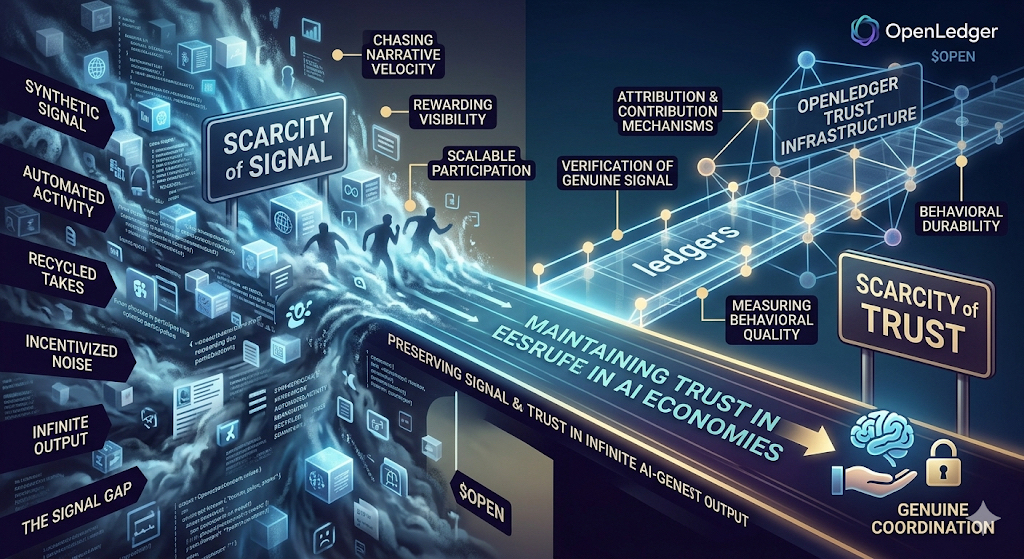
I think most AI discussions are still happening one layer too early.
Everyone is focused on generation.
Better outputs.
Faster models.
Cheaper intelligence.
Fair enough.
But once intelligence becomes cheap, the real problem changes completely.
The internet stops struggling with content scarcity.
It starts struggling with signal quality.
And honestly, I think crypto already gave us an early preview of what happens next.
We’ve seen this cycle before.
A protocol launches.
People arrive organically.
Communities feel alive.
Then incentives enter the system.
Slowly behavior changes.
Not instantly.
Quietly.
People stop contributing naturally and start optimizing participation itself.
You could see it clearly during the points farming phase.
At first timelines looked healthy.
Everyone posting.
Everyone engaging.
Everyone “supporting the ecosystem.”
But after a while, half the activity started feeling mechanically generated even before AI tools exploded.
Same style replies.
Same recycled takes.
Same participation loops repeated thousands of times because users learned what the system rewarded.
The metrics still looked strong.
That’s the dangerous part.
Surface activity can increase while actual ecosystem quality declines underneath.
And I think AI ecosystems are heading toward a much larger version of this problem.
Because now participation itself becomes infinitely scalable.
Not just content generation.
Synthetic engagement too.
Synthetic research.
Synthetic discussions.
Synthetic “thought leadership.”
Soon every platform will be flooded with intelligent-looking output.
The difficult part won’t be generating information anymore.
It’ll be figuring out what actually carries value.
That’s why OpenLedger caught my attention.
Not because it’s another AI project.
Crypto already has hundreds of those.
What feels more interesting is the focus around attribution and contribution infrastructure.
Because once synthetic intelligence scales hard enough, attribution becomes extremely important.
Who contributed useful signal?
Who influenced outcomes?
Which participation is genuine and which is optimized noise?
I think this becomes one of the biggest infrastructure problems of the next internet cycle.
And honestly, most people are still underestimating it because the AI market is currently rewarding spectacle more than coordination quality.
The loudest projects naturally get the most attention first.
That’s how every cycle works.
But long term, systems usually survive based on behavioral durability.
Not narrative velocity.
That distinction matters.
A lot.
Crypto veterans already know incentives reshape ecosystems aggressively.
Every reward mechanism eventually trains users how to behave.
Reward visibility and people manufacture visibility.
Reward activity and people automate activity.
Reward contribution without strong verification and eventually systems fill with low-signal participation pretending to be valuable.
Always.
AI amplifies this dynamic dramatically because now users can scale optimization using machines themselves.
That changes the environment completely.
The future internet probably won’t suffer from lack of intelligence.
It’ll suffer from excess synthetic usefulness.
And synthetic usefulness is dangerous because it often looks convincing enough.
That’s the part I think projects like OpenLedger are directionally positioning around earlier than most.
Not just:
“How do we generate more intelligence?”
But:
“How do we maintain trust once intelligence generation becomes infinite?”
Very different problem.
And probably the harder one.
Still early obviously.
Most infrastructure narratives in crypto get ahead of real adoption by years.
A lot of projects won’t survive long enough to prove whether their architecture actually matters.
That’s reality.
But behaviorally, I do think the market eventually shifts toward systems capable of preserving signal quality under incentive pressure.
Because every large digital ecosystem eventually becomes a coordination problem.
Not a technology problem.
Technology scales faster than trust.
And AI is accelerating that gap much harder than most people realize.
That’s the deeper layer I keep watching with OpenLedger.
Not hype cycles.
Not announcement farming.
The trust infrastructure underneath future AI participation economies.