
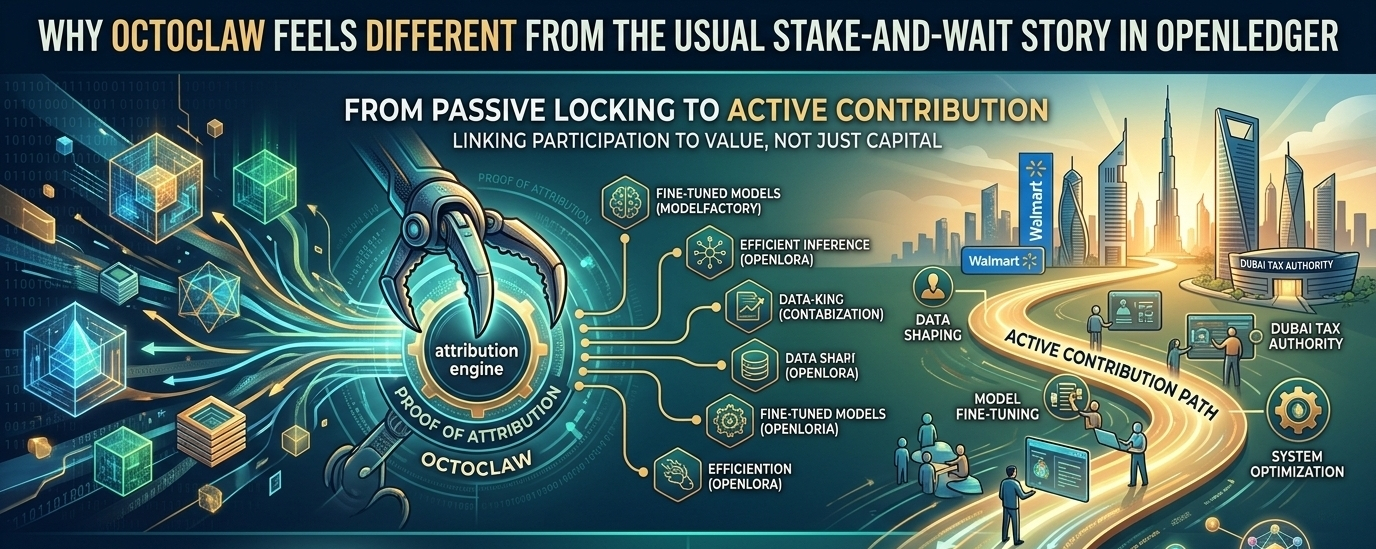
@OpenLedger I’ve spent enough time watching staking ecosystems to notice a pattern that repeats over and over again. A project launches with attractive APR numbers, dashboards fill up, communities get loud for a few weeks, and suddenly everything starts slowing down. The excitement fades, governance participation becomes almost invisible, Discord activity drops, and what once looked like a growing ecosystem starts feeling like a parking lot for idle capital. People lock tokens, wait for rewards, claim them, and repeat the cycle. There is movement on paper, but not much life underneath it. That cycle has become so common that I almost expect it now, which is why OpenLedger caught my attention in a different way when OctoClaw entered the picture on April 17, 2026.
What stood out to me was not another staking interface or another reward mechanic promising bigger numbers. The bigger shift seemed philosophical. OpenLedger appears to be moving away from the idea that users should simply lock assets and wait. Instead, it is trying to connect participation with contribution. OctoClaw introduces an approach where activity itself becomes valuable. Through Proof of Attribution, AI outputs can be linked back to the specific data and contributions that helped create them. That changes the relationship between users and the network. Instead of people sitting on the sidelines hoping rewards continue, contributors can potentially become part of the production layer itself.
The difference may sound subtle, but it changes how a network behaves. Traditional staking often rewards patience. OpenLedger seems to be experimenting with rewarding usefulness. The ecosystem already has a large base of node contributors and multiple AI projects building across the testnet environment. Tools like ModelFactory lower the barrier for users who want to fine-tune models without needing deep technical experience, while OpenLoRA introduces a more efficient way to run large numbers of models through shared infrastructure. Those details matter because they create reasons to stay active beyond token incentives alone.
Of course, no early ecosystem arrives without questions. Mainnet is still fresh, supply dynamics will matter, and systems tied to contribution always face challenges around scale and review complexity. Casual users usually disappear the moment friction starts increasing. But what keeps this interesting is the possibility that OpenLedger is testing a different formula altogether. Enterprise names like Walmart and the Dubai Tax Authority exploring the ecosystem suggest there may already be practical interest forming around the idea. In a market filled with projects competing for locked liquidity, I keep coming back to one thought: networks that reward people for showing up and adding value often feel more sustainable than networks built around simply renting wallets.