
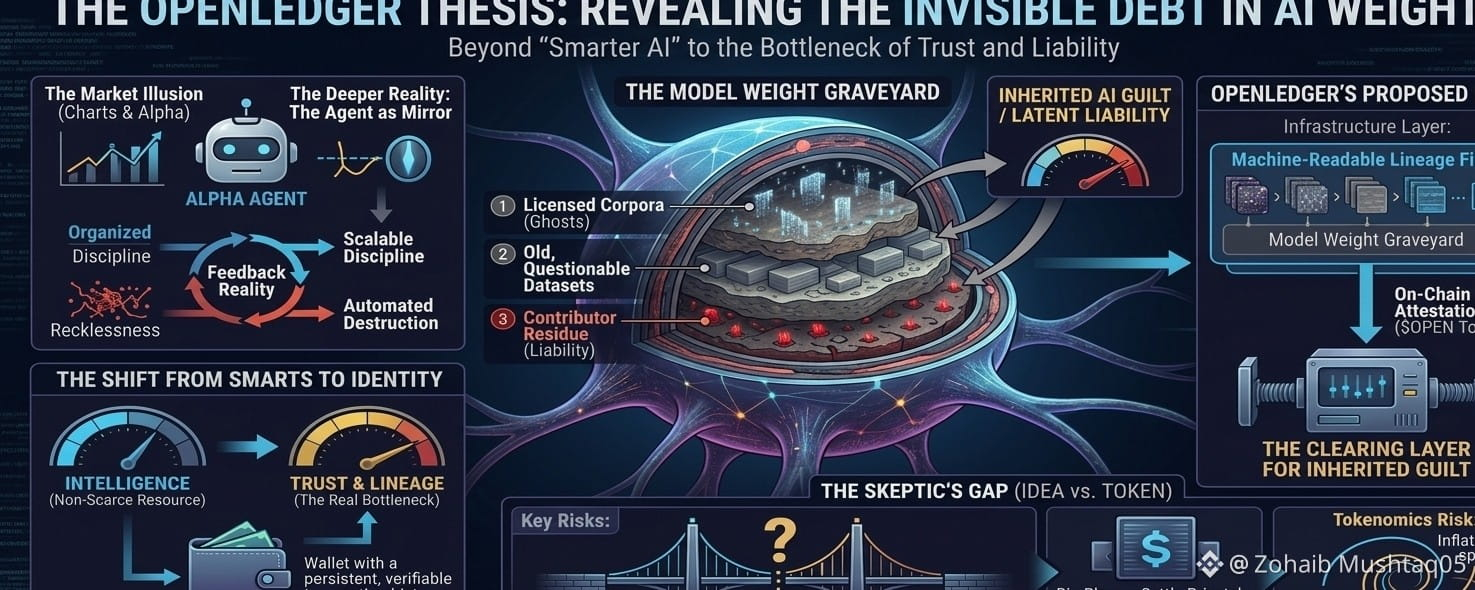
I have been staring at OpenLedger for days not because I think it will make traders rich overnight, but because it stumbled onto a problem almost nobody is pricing right. The market is racing to sell faster models and magical alpha. That works for headlines, but it misses the deeper shift. Once autonomous systems touch real capital, raw intelligence stops being scarce. Trust becomes the bottleneck. People will stop asking how smart an agent is and start asking whether its lineage and the data inside its weights carry latent liability. That is a different infrastructure problem, and it keeps pulling me back.
The OctoClaw piece first flipped the switch. The crowd wants a money printer, but I think it is closer to a mirror. If you are disciplined, it scales your discipline into something relentless. If you are reckless, it automates your destruction. There is no alpha hiding inside the agent, only whatever residue you already carry. Once you see it that way, the question stops being about model quality and starts looking like credit risk. You are evaluating a borrower with a wallet history it cannot fake, which makes persistent identity essential.
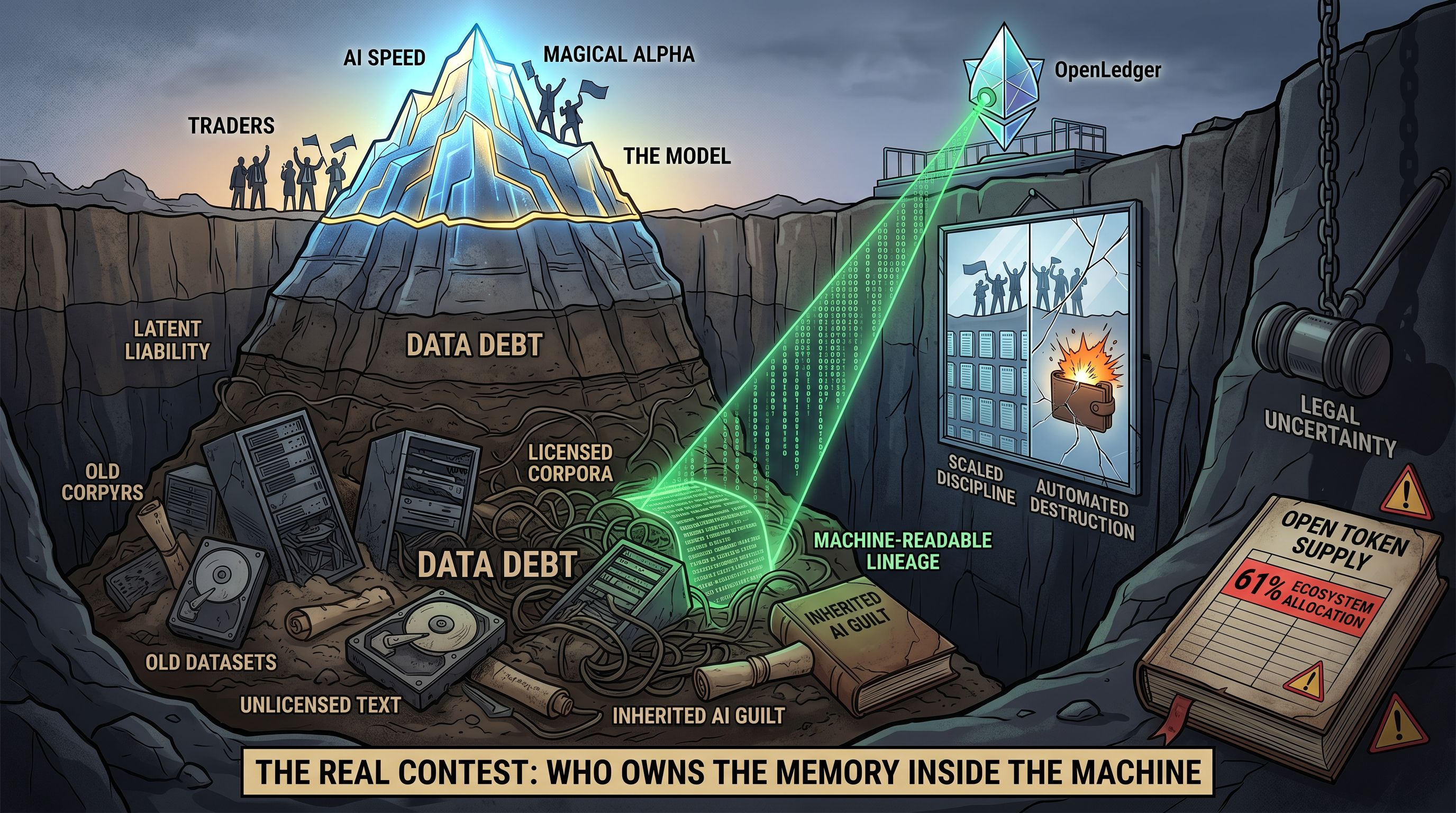
That thinking leads straight to the strangest part of the thesis. Every modern model is a graveyard of old datasets and licensed corpora. The industry ships upgrades like clean replacements, but economically the past does not disappear. It ghosts into the weights. It becomes invisible debt that only surfaces when a regulator or a contributor demands payment. If OpenLedger makes that lineage machine-readable across versions, it is not building a HuggingFace alternative. It is building a clearing layer for inherited AI guilt. As copyright litigation accelerates, that infrastructure could matter more than the models themselves.
I am not blind to the gap between idea and token. Everything I described assumes courts will treat on-chain attestation as legally binding, not convenient metadata. Huge leap. If big players settle attribution privately, OPEN risks becoming a wrapper around other people's legal departments. The supply looks community-friendly, but a sixty-one percent ecosystem allocation can mean inflationary emissions if demand stays thin. Right now the volume feels like narrative rotation, and I have seen too many mainnets launch into thin air to confuse a live network with a living economy.
Where does that leave me? I think OpenLedger is one of the few AI-crypto projects looking at the right problem. Data extraction is real and agent reputation is inevitable. Whether this token captures value depends on whether attribution becomes a legal necessity rather than a buzzword. I am watching, but I will not confuse a brilliant map for territory already conquered. Most people are distracted by charts while the real contest—who owns the memory inside the machine—has barely started.