
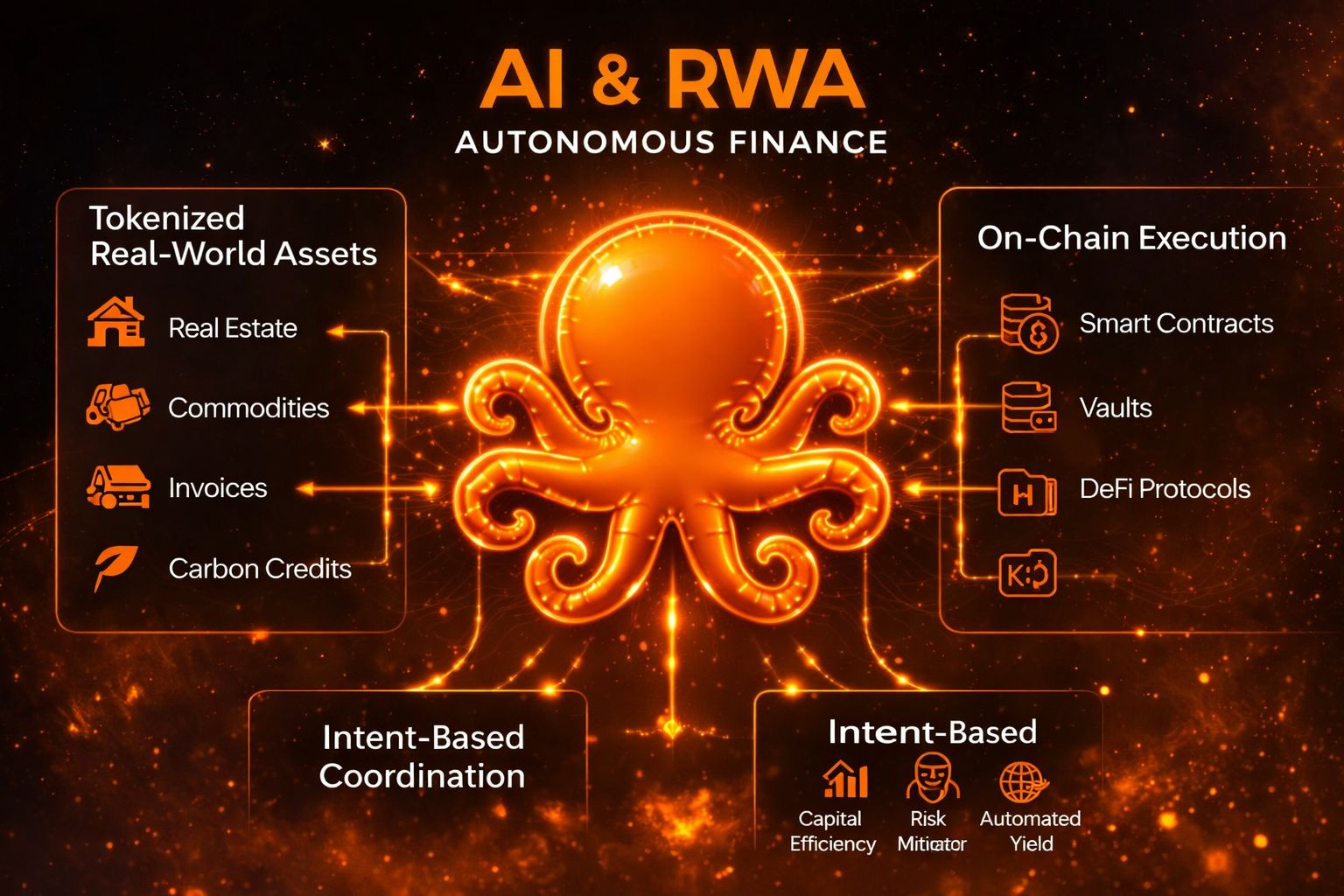
The more I study the intersection between AI and RWAs, the more it feels like the conversation is shifting away from simple “tokenization” toward something much deeper: autonomous financial coordination.
A lot of people understand the first layer already. Real-world assets like treasury bills, commodities, invoices or real estate can now be represented on-chain. That part is becoming easier to grasp.
But the more difficult question is this:
What happens when AI systems begin managing those assets dynamically instead of humans manually coordinating everything?
That’s where @OpenLedger make the discussion interesting to me.
The current DeFi environment is still heavily dependent on human reaction time. Users monitor collateral ratios, adjust leverage, compare yields across protocols, rebalance portfolios and react to liquidation risks manually. Even experienced users struggle because markets move faster than human attention spans.
The emerging idea behind DeFAI changes that structure completely.
Instead of relying on fixed strategies, autonomous systems can continuously monitor:
liquidity depth
Funding rates
Borrow utilization
Yield differentials
Liquidation thresholds
Volatility conditions across multiple protocols
And the important part is that the objective itself changes.
The goal is no longer simply maximizing APY at all costs. It becomes maintaining capital efficiency while reducing unnecessary exposure before risk conditions deteriorate.
That feels like a major conceptual shift.
What also stands out is the role of intent-based architecture. Instead of manually interacting with fragmented DeFi interfaces, users may eventually define desired outcomes while autonomous agents coordinate execution across chains and protocols in the background.
In theory, this could reduce one of the biggest hidden problems in DeFi today: operational complexity.
Another broader explanation:
RWAs bring the assets while AI introduces intelligence, decision-making and execution layers. Once those two systems merge, finance starts becoming not only programmable but increasingly self-executing.
Another important point is accessibility.
TradFi still charges significant AUM fees for strategy management because coordination itself is treated as a premium service. But when on-chain systems and AI agents can automate monitoring, rebalancing and execution continuously, institutional-grade strategy infrastructure slowly becomes open infrastructure instead of gated access.
Of course, a lot of this is still experimental and there are obvious risks around automation, model reliability and execution quality. But structurally, it feels like DeFi is moving from “tools users operate manually” toward “adaptive systems that coordinate themselves in real time.”
That transition may end up being bigger than most people currently realize.