
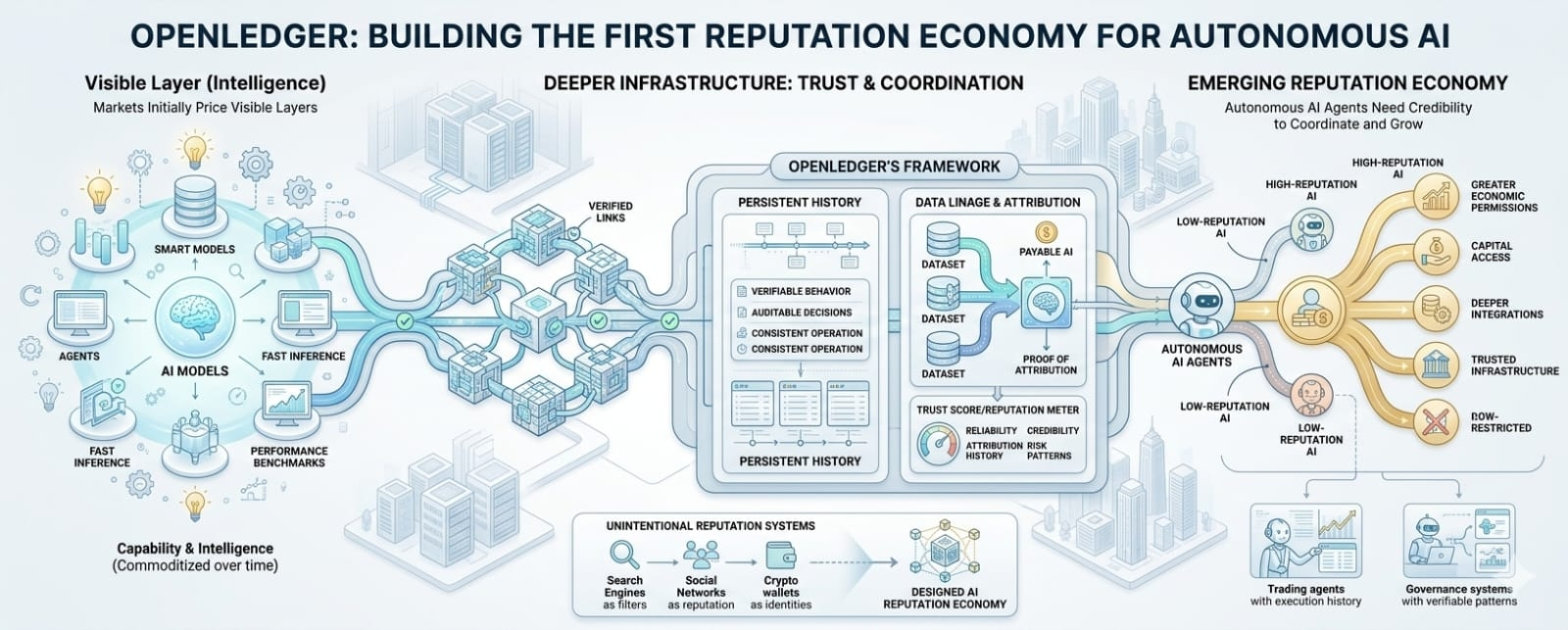
One thing that keeps repeating across every major technology cycle is that markets initially price the visible layer first. People get excited about speed, scale, performance, automation, cleaner interfaces, or whatever looks most impressive in the moment. The deeper infrastructure only becomes obvious later, usually after the technology starts interacting with real economic behavior.
AI feels very similar right now.
Most discussions are still centered around capability. Better models, larger context windows, autonomous agents, faster inference, smarter outputs. The industry is racing toward intelligence itself because intelligence is easy to demonstrate. You can immediately show someone a better answer, a faster response, or a more capable system.
But capability alone rarely becomes the final source of value.
The internet itself became economically important because it developed systems for trust and coordination. Search engines became credibility filters. Social networks became reputation systems. E-commerce platforms became behavioral verification layers. Even crypto, despite beginning as a monetary experiment, slowly transformed into something much bigger than digital money. Wallet behavior, governance activity, liquidity movements, validator participation, transaction history — all of these unintentionally became reputation signals inside transparent networks.
Nobody designed crypto to work that way in the beginning.
It happened because once systems become transparent enough, history starts mattering. And once history matters, reputation naturally emerges.
That is the part of OpenLedger that feels more important than the usual AI infrastructure narrative.
A lot of projects today still approach AI like a pure feature race. Whoever builds the smartest model wins. Whoever creates the most autonomous agents wins. Whoever delivers the fastest execution wins.
But OpenLedger seems to be preparing for something deeper: a world where AI systems themselves eventually need credibility.
That changes the conversation entirely.
Right now most AI systems are still treated like temporary tools. You ask something, receive an output, and move on. But the relationship changes once AI systems begin operating continuously inside economic environments instead of simply assisting humans occasionally.
The moment autonomous systems start: moving assets, executing trades, participating in governance, allocating capital, coordinating liquidity, managing digital infrastructure, or interacting independently across financial systems,
people stop caring only about whether the system is intelligent.
They start caring about whether it is reliable.
And reliability is fundamentally a reputation problem.
Questions suddenly become much more serious: Has this system behaved consistently over time? Can its decisions be audited? What data shaped its reasoning? Who contributed to its intelligence? Does it show manipulative behavior? Can its execution history be verified? Should it be trusted with larger economic permissions?
Those are not performance questions anymore.
They are trust questions.
That is why OpenLedger’s focus on attribution feels more important than people currently realize.
The project talks heavily about “Payable AI,” which at first sounds like another AI monetization narrative. But underneath that idea is something more structurally important: turning intelligence into something traceable and economically attributable.
Its Proof of Attribution framework is designed around tracking how datasets contribute to model outputs and how contributors can be rewarded over time. That may sound technical on the surface, but economically it introduces a very different idea into AI infrastructure.
Persistent history.
Not just outputs. Not just performance benchmarks. History.
And history is where reputation begins.
Most AI systems today function almost like black boxes. Data enters. Outputs emerge. The actual lineage between contribution and intelligence is difficult to verify. OpenLedger is trying to build infrastructure where that lineage becomes visible.
That matters because once AI systems become economically active, opacity becomes a serious limitation.
Financial systems do not scale purely on intelligence. They scale on trust. Banks, credit systems, marketplaces, governance networks — all of them depend on persistent behavioral histories. Markets need ways to measure reliability before granting larger access and coordination power.
AI systems may eventually face the same dynamic.
A trading agent with strong returns is useful. A trading agent with transparent execution history, attributable reasoning patterns, verifiable behavior, and years of consistent operation becomes infrastructure.
That distinction matters a lot.
The really interesting part is that crypto has already shown how transparent systems unintentionally evolve into reputation economies. Wallets became identities without needing names attached to them. Governance participation became a proxy for credibility. Liquidity providers built reputational weight through observable behavior. Entire social structures formed around persistent on-chain activity.
The same thing could eventually happen around autonomous intelligence.
As AI agents become persistent actors inside digital economies, markets may start evaluating them exactly the way they evaluate human participants today: consistency, reliability, historical behavior, risk patterns, execution quality, contribution history, and long-term trustworthiness.
Over time certain systems could accumulate stronger reputational standing than others. Those systems may receive greater economic permissions, larger capital access, deeper integrations, stronger governance influence, or preferred coordination opportunities.
That starts looking less like software infrastructure and more like a reputation economy built around machine behavior itself.
And honestly, that possibility feels much bigger than the current AI narrative most people are focused on.
Because models alone are probably becoming commoditized faster than many expect. Intelligence will continue improving everywhere. Open-source systems are accelerating. Competition is exploding. Performance gaps eventually compress.
But trust does not commoditize as easily.
Persistent credibility compounds slowly over time.
That may end up becoming one of the most valuable layers in the autonomous AI economy.
OpenLedger seems to understand that the future problem may not simply be “how do we build smarter AI?”
The harder problem may become: How do we verify intelligence? How do we attribute it? How do we audit it? How do we measure reliability? How do we coordinate trust around autonomous systems operating independently inside financial networks?
Those are infrastructure questions, not product questions.
And infrastructure built around trust historically becomes far more durable than infrastructure built purely around attention cycles.
That is why OpenLedger stands out differently to me compared to most AI-related crypto projects right now.
It does not just feel like another attempt to build better AI tooling.
It feels closer to preparing for a world where autonomous systems eventually need reputations the same way humans, institutions, and financial entities already do.
If that transition actually happens, then the networks managing credibility around machine intelligence could become far more important than the systems generating the outputs alone.
