
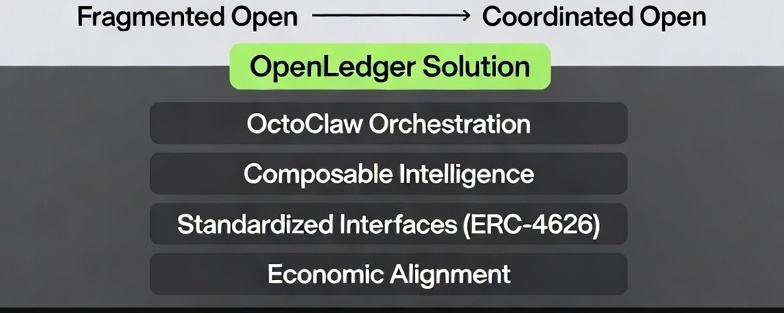


i keep thinking about what registry transparency inside OpenLedger actually does once models stop being isolated systems and start competing inside a shared attribution economy
because transparency sounds universally good at first glance
contributors can verify usage. developers can inspect provenance. attribution histories become visible. reward flows become auditable instead of opaque. all of that feels directionally correct.
but transparency also changes competitive behavior.
especially once the registry becomes detailed enough to expose which DataNets successful models depend on, how often certain datasets appear in inference pathways, and where attribution weight is concentrating across the ecosystem.
that information is economically valuable on its own.
a model builder inspecting registry activity can identify which DataNets are becoming strategically important before the broader ecosystem notices. contributors can optimize toward highly active informational domains. agents like Octoclaw can begin routing toward patterns already reinforced by visible usage momentum.
the registry stops being passive infrastructure and starts behaving like a coordination signal for the entire network.
and coordination signals tend to compress behavior.$OPEN
because once everyone can observe where attribution value is accumulating, systems naturally begin converging toward the same visible hotspots. high-performing DataNets attract more integrations. integrated DataNets generate more attribution flow. more attribution flow reinforces their perceived importance.
visibility becomes self-reinforcing.
which creates a strange paradox.
the transparency layer designed to decentralize trust can unintentionally centralize attention.
and attention matters because OpenLedger’s economy is not only driven by technical correctness. it is driven by where models, agents, and contributors decide to allocate activity over time.
there is also a strategic dimension hiding underneath this.
model builders may eventually become reluctant to expose too much usage detail if registry transparency reveals competitive dependencies too clearly. a successful model’s informational edge could become partially reconstructable simply by studying attribution concentration and DataNet interaction patterns over long periods.
so the system has to balance two opposing forces:#OpenLedger
enough transparency to preserve trust,
but enough opacity to preserve competitive differentiation.
that balance gets harder once EVM-connected ecosystems and agent-driven execution start scaling simultaneously because the amount of observable interaction data grows exponentially.
and i honestly can’t tell yet whether OpenLedger’s registry transparency ultimately strengthens ecosystem coordination in a healthy way… or whether visibility itself gradually becomes a mechanism that concentrates informational power around already dominant DataNets and model pathways over time 🤔