
I’ve been thinking about something that doesn’t sit right with me.
We keep building faster blockchains, better scaling solutions, cheaper transactions… but we rarely stop and ask a more uncomfortable question.
What if the real problem isn’t speed or cost anymore?
What if the problem is that we are still trying to run completely new systems like AI on infrastructure that was never designed for it in the first place?
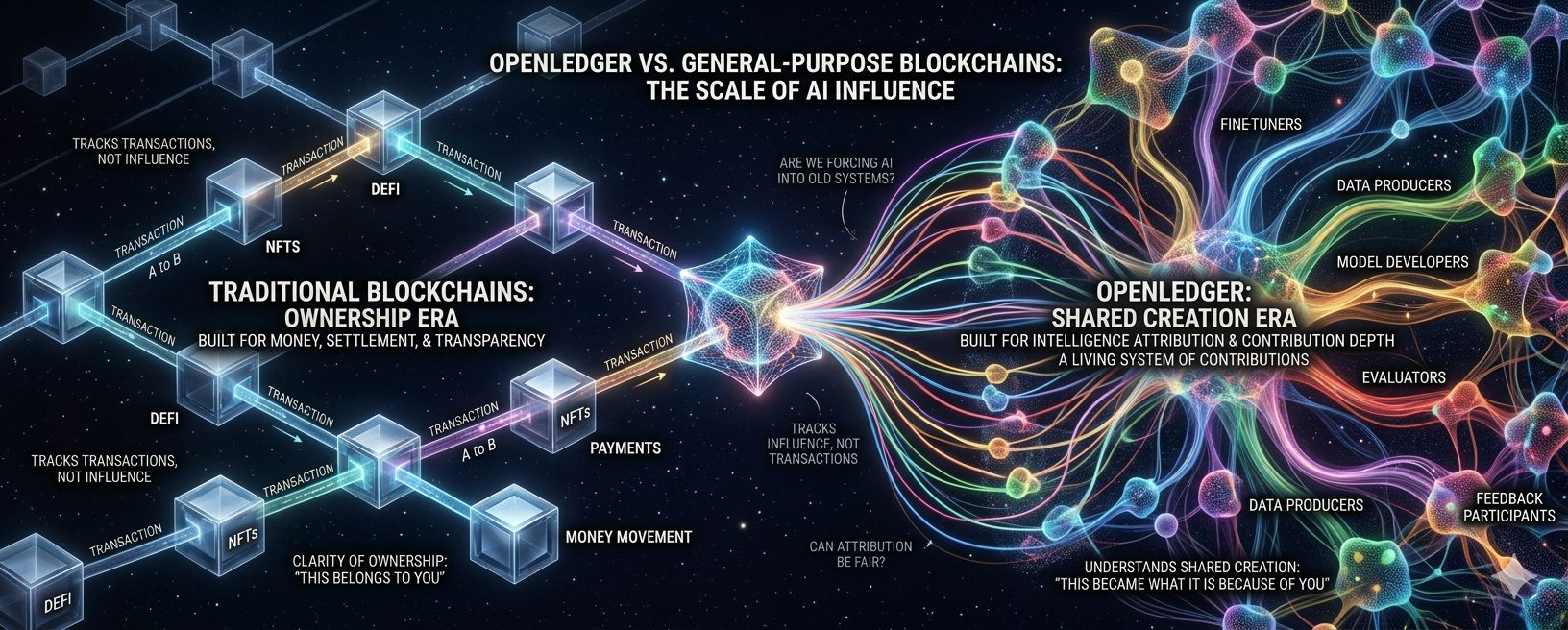
For years, general-purpose blockchains made perfect sense. They were built around money movement, ownership, settlement, and transparency. Send value from A to B. Record it. Verify it. That was the core idea.
And honestly, that design worked incredibly well for DeFi, NFTs, and payments.
But AI doesn’t behave like any of those things.
AI doesn’t just move value. It learns. It evolves. It absorbs influence from thousands of hidden sources and produces something new that can’t be traced back in a simple linear way.
And that’s where things start to break quietly.
Because when I look at current systems, I don’t really see AI ownership in a meaningful sense. I see outputs. I see models. I see datasets. But I don’t see a clear map of contribution.
Who actually shaped the result? Who mattered more? What input changed the behavior in a small but critical way?
Most systems today don’t really answer that. Not in a way that feels fair or measurable.
And maybe that’s the part we’ve been ignoring.
General-purpose blockchains were never designed to solve this. They track transactions, not influence. They record ownership, not contribution depth. They are excellent at saying “this belongs to you,” but not at explaining “this became what it is because of you.”
And AI is exactly that second problem.
It is not a static asset. It is a continuous process of collaboration between data, models, feedback loops, and human input. Everything blends together until individual contribution becomes almost invisible.
That invisibility is starting to matter more than we realize.
Because if you can’t clearly trace contribution, then how do you reward it fairly? And if you can’t reward it fairly, how do you build a long-term AI economy that people actually trust?
This is where #OpenLedger enters the conversation, but not in a loud way.
Not as a replacement for existing chains. Not as a sudden breakthrough. More like a response to a gap that has slowly become impossible to ignore.
The idea behind it feels simple at first: what if AI systems needed their own kind of infrastructure for attribution?
Not just ownership of final outputs, but visibility into how those outputs were shaped.
Instead of treating AI as a single event, OpenLedger frames it more like a living system of contributions. Data providers, model developers, fine-tuners, evaluators, and even feedback participants all become part of a connected chain of influence.
And the important shift here is not technical complexity. It’s the way value is defined.
Because in this model, value is not just “who owns the model,” but “whose input actually changed the model’s behavior.”
That sounds clean in theory, but I keep thinking about how difficult it must be in practice.
AI systems don’t work like spreadsheets. Influence is not cleanly separable. One dataset might slightly shape behavior in ways that only appear much later. One feedback loop might correct something small that completely changes output quality over time.
So attribution becomes less about perfect precision and more about structured approximation. A system that tries to say: this mattered, this mattered more, and this mattered less.
Not perfect truth, but a usable version of fairness.
And that’s where things get interesting, but also uncertain.
Because once you start measuring contribution at that level, the system itself becomes heavier. More complex. More debatable. Every reward becomes a question of interpretation.
Still, I can’t ignore the direction this points toward.
We are slowly moving from blockchains as financial infrastructure to something broader, something closer to coordination layers for intelligence itself.
And general-purpose chains, for all their success, were never really designed for that shift. They assume clarity of ownership. AI introduces ambiguity of influence.
That mismatch is the real tension.
If systems like @OpenLedger or similar ideas become more widely adopted, I think the biggest change won’t just be technical. It will be behavioral.
Data sharing might become more intentional if people believe their contribution can be tracked. Model development might shift toward collaborative ecosystems instead of isolated competition. Even AI training might start to feel less like extraction and more like participation.
But I also stay cautious here.
Because attribution at scale is not just a technical problem. It is a governance problem. A philosophical problem. And maybe even a political one.
Who decides what level of contribution is “enough” to deserve reward? And what happens when the system gets it slightly wrong, which it inevitably will?
These are not small details. They define trust.
Still, the direction feels hard to dismiss.
General-purpose blockchains gave us digital ownership. But AI might require something more subtle: a way to understand shared creation.
And maybe that is the real shift we are standing in front of, without fully realizing it yet.
So I keep coming back to a few questions.
Are we trying to force AI into systems that were never meant to measure intelligence contribution?
Can attribution ever be fair enough to support real economic value, or will it always stay an approximation we learn to accept?
And if intelligence itself becomes collaborative, then who should actually own the outcome?
My takeaway is not that one system replaces another.
It’s that we might be entering a phase where ownership alone is no longer enough to describe what is happening inside AI systems. And once that realization becomes common, everything built on top of it will start to change quietly, but fundamentally.
