
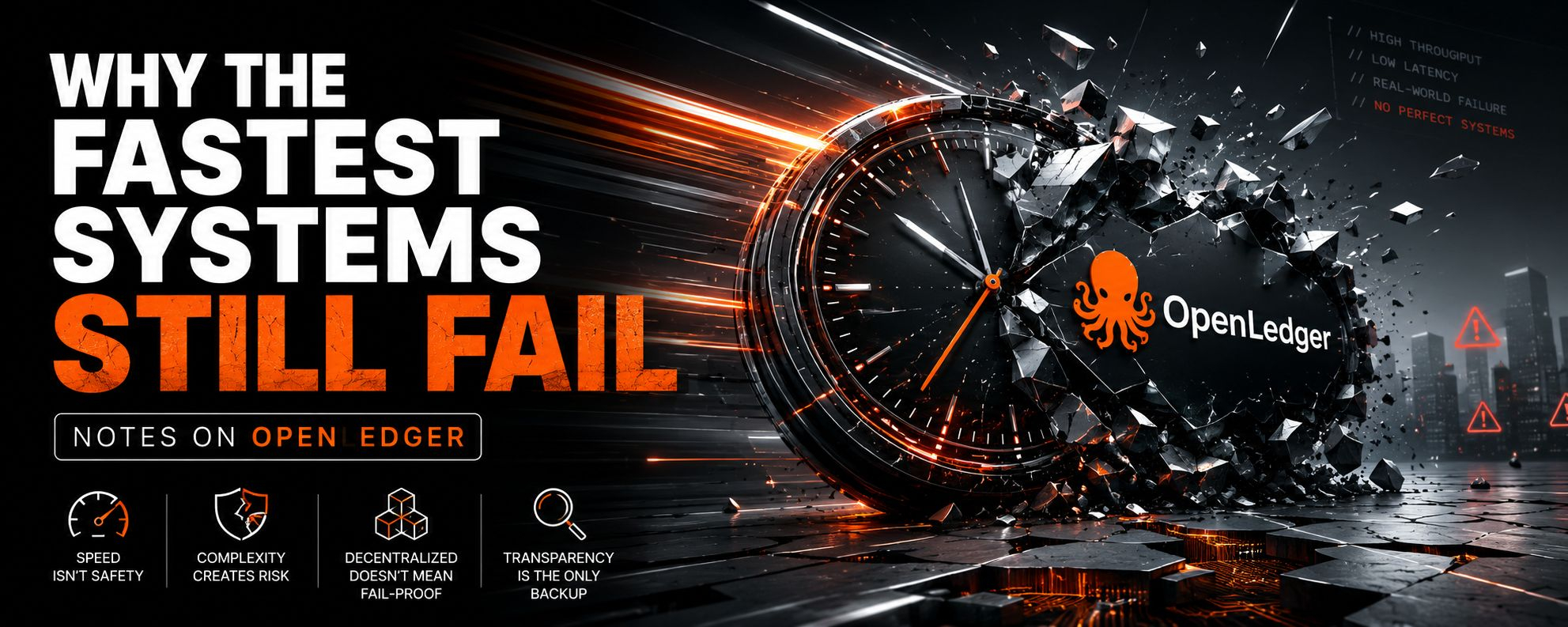

I keep noticing that most infrastructure conversations become strangely theatrical the moment throughput enters the room. Numbers start replacing judgment. TPS charts appear in slide decks like military decorations. Entire systems are framed as victories because they move faster than the systems before them. But in every environment I have watched closely trading firms, operational custody teams, internal risk reviews the catastrophic moments almost never began with latency.
They began with permissions.
A key approved too broadly. A signing flow nobody challenged because it had become routine. A wallet session left open longer than intended because convenience quietly outranked discipline. By the time the incident bridge opens and the first 2 a.m. alerts start arriving, nobody is asking whether the chain processed transactions fast enough. The only question that matters is who had authority, for how long, and why nobody constrained it earlier.
That distinction is partly why OpenLedger keeps holding my attention.
Technically, it is an SVM-based high-performance Layer 1 designed around AI-era liquidity: data, models, and agents treated as economic participants rather than passive assets. The performance layer matters, obviously. Execution speed matters. Parallelization matters. But I do not think the deeper design question is about acceleration anymore. I think it is about containment.
Most systems fail because authority expands faster than supervision.
The uncomfortable truth is that operational risk compounds invisibly. It accumulates in approval flows, delegated access, bridge assumptions, forgotten sessions, and human fatigue. A blockchain can settle in milliseconds and still remain structurally fragile if every interaction demands unrestricted wallet exposure. In practice, the attack surface grows faster than the throughput chart.
That is where OpenLedger Sessions begins to feel less like a feature and more like institutional maturity.
I keep returning to the idea of enforced, time-bound, scope-bound delegation. Not trust as a vague social promise, but trust reduced into measurable operational limits. A session can perform exactly what it was permitted to perform, for exactly the period it was allowed to exist, and nothing beyond that boundary. The significance of this becomes clearer during real operational stress. Teams stop debating abstract decentralization philosophy and start asking painfully practical questions: Who can revoke this? How quickly? What survives key compromise? What permissions persist after fatigue sets in?
“Scoped delegation + fewer signatures is the next wave of on-chain UX.”
That sentence sounds almost understated until you spend enough time around audit environments. Excessive signing is not always security. Sometimes it is just accumulated friction disguised as discipline. People adapt to repetitive approval flows by becoming less attentive to them. The human layer degrades first. Eventually, signatures become ceremonial rather than intentional.
OpenLedger appears to understand that the future of security is not endless prompts asking users to approve everything manually. The future is narrower authority surfaces with explicit expiration. Sessions that die automatically. Delegation that cannot silently widen itself over time. Permissions designed like temporary corridors instead of permanent ownership.
That feels considerably closer to how mature systems behave.
I also think the architectural layering matters more than most marketing language admits. OpenLedger’s modular execution approach sitting above a more conservative settlement layer reflects a reality large financial systems learned decades ago: experimentation and finality should not operate at the same emotional temperature. Fast execution environments are valuable precisely because they absorb operational complexity away from the slower layer responsible for durable settlement guarantees.
The separation creates psychological discipline inside the infrastructure itself.
People often misunderstand modularity as fragmentation. In reality, it is frequently a containment strategy. A system capable of isolating execution risk from settlement certainty is usually more resilient than one pretending every layer should optimize for the same objective simultaneously.
Even EVM compatibility, in this context, feels less ideological than practical. I do not see it as a grand philosophical statement. I see it as tooling friction reduction. Existing developer behaviors matter. Existing operational familiarity matters. Migration costs matter. Mature infrastructure tends to minimize unnecessary cognitive strain wherever possible.
The native token appears in this structure less as speculation fuel and more as security fuel. Staking, at least conceptually, stops being passive yield theater and starts resembling operational responsibility. Security only becomes meaningful when participants are economically tied to the consequences of system behavior.
And still, none of this eliminates the oldest problem in crypto infrastructure.
Bridges remain uncomfortable.
Every cross-chain design eventually encounters the same brutal reality: the moment assets leave one trust domain and enter another, assumptions multiply. External validators, multisig arrangements, relayers, oracle dependencies each additional layer quietly introduces another place where confidence can fracture. I keep thinking about how often the industry discusses bridges as if they are permanent infrastructure achievements instead of temporary negotiations with complexity.
“Trust doesn’t degrade politely it snaps.”
That is the part many systems still underestimate. Failure rarely arrives gradually enough for public relations teams to soften it. One compromised key. One delegated permission nobody revoked. One overlooked approval path during a weekend deployment. Then suddenly the architecture that looked elegant in documentation becomes a live incident report.
Which is why I no longer believe the defining question for a ledger is how fast it can say “yes.”
I think the defining question is whether it can refuse safely, predictably, and without hesitation.
Because a fast ledger that cannot constrain authority simply accelerates exposure. A fast ledger with guardrails does something more valuable. It prevents the kind of failure everybody eventually claims was obvious in retrospect.
And increasingly, I think that difference is the entire point.
