
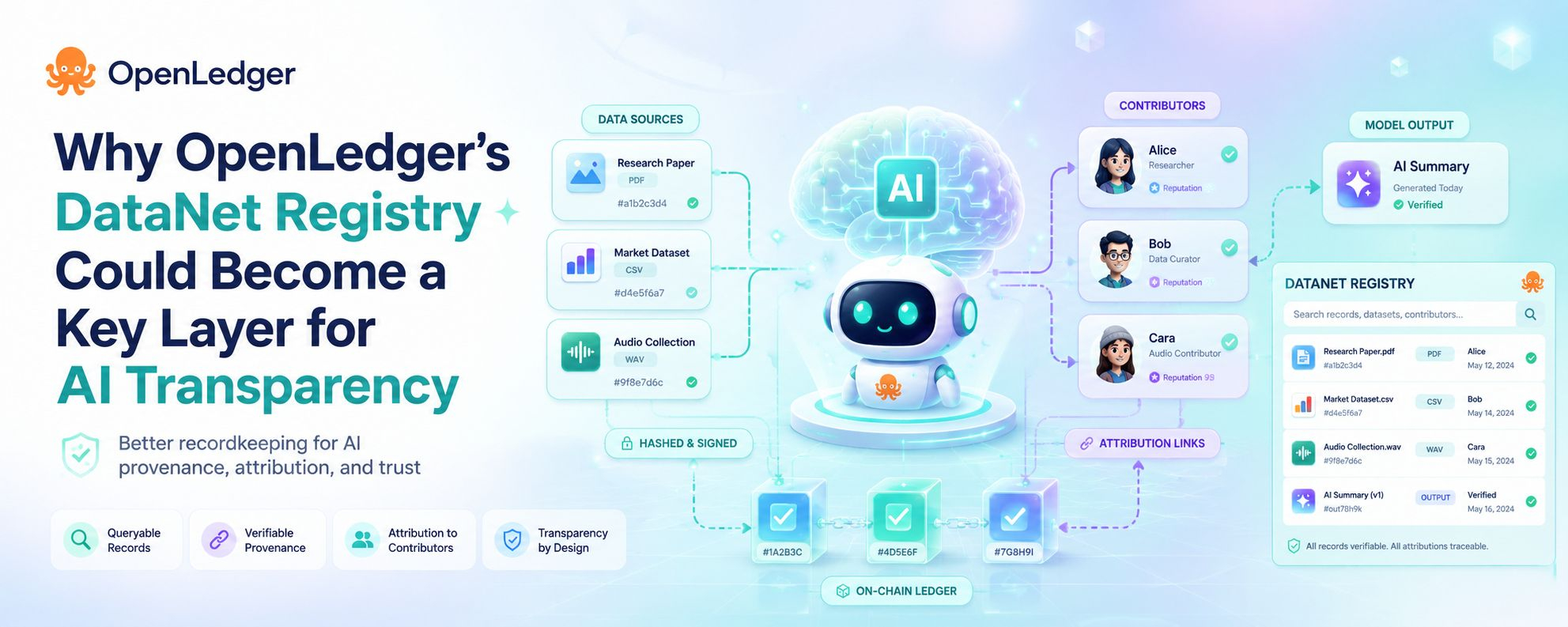

I keep coming back to a small discomfort around AI: not that it answers, but that it answers without showing its receipts.
The polished response arrives first. Smooth paragraph, confident tone, maybe a citation if the product is generous. But underneath that answer is a crowded room nobody sees clearly. A dataset from one place. A cleaned file from another. A human correction. A scraped paragraph. A specialist note. A community contribution. Somewhere in that pile, intelligence begins to look natural, and the people or sources behind it become strangely weightless.
That is why OpenLedger’s DataNet Registry is interesting to me. Not because a registry sounds exciting. It does not. The word itself feels administrative, almost boring. But maybe that is the point. AI transparency may not arrive as a dramatic reveal. It may arrive as better recordkeeping.
OpenLedger describes DataNets as decentralized data networks that aggregate, validate, and distribute domain-specific datasets for AI model training, with verifiable attribution built into the contribution layer. Its Proof of Attribution paper goes further: all DataNets are indexed in a global DataNet Registry that tracks dataset identifiers, contributor records, usage logs, and attribution records, and the registry is described as public and queryable.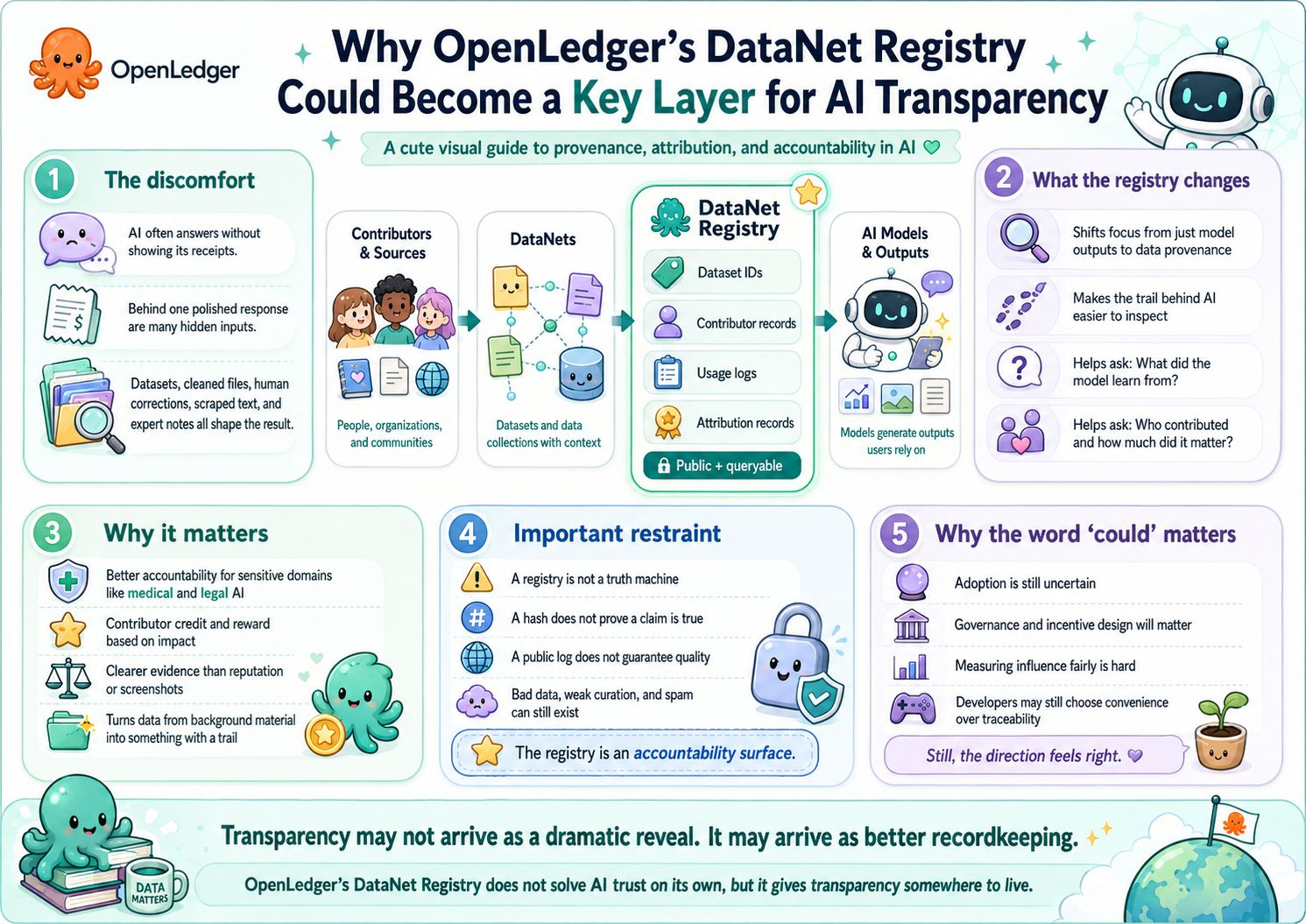
That changes the shape of the problem.
Most AI systems ask us to trust the final model as if the final model is the whole story. But the model is only the visible surface. The deeper question is provenance. What did it learn from? Who contributed? Was the data licensed? Was it curated or dumped? Did one dataset influence a model heavily, or did it barely matter? Without answers to those questions, “transparency” becomes a soft word people use when they mean visibility after the fact.
A registry does not make AI honest by itself. That would be too easy. A hash does not prove a claim is true. A contribution record does not guarantee quality. A public log can still contain bad assumptions, weak data, lazy curation, or cleverly disguised spam. This is where I think the idea has to be treated with restraint. The DataNet Registry is not a truth machine. It is closer to an accountability surface.
And accountability surfaces matter.
If a model trained on a medical DataNet gives a strange answer, the useful question is not only “Was the answer wrong?” It is also “Which sources shaped that answer?” If a legal assistant leans toward one interpretation, I want to know whether its training material came from strong domain-specific data or from a thin, noisy pile wearing professional clothes. If a contributor claims their data helped a model, there needs to be something more solid than reputation or screenshots. OpenLedger’s Proof of Attribution framework says data contributions are linked to model outputs and recorded so contributors can receive credit and rewards based on impact.
That is the quiet importance of the registry. It turns data from background material into something with a trail.
I also like that the title says “could become,” not “will become.” That word matters. “Could” leaves room for reality. For adoption problems. For governance fights. For the difficulty of measuring influence fairly. For the possibility that developers may prefer convenience over traceability until regulation, user pressure, or economic incentives force the issue.
Still, the direction feels right. AI is moving into domains where vague trust is not enough. We are going to need systems that do more than say, “This model is powerful.” We will need systems that can answer, “Powerful because of what?”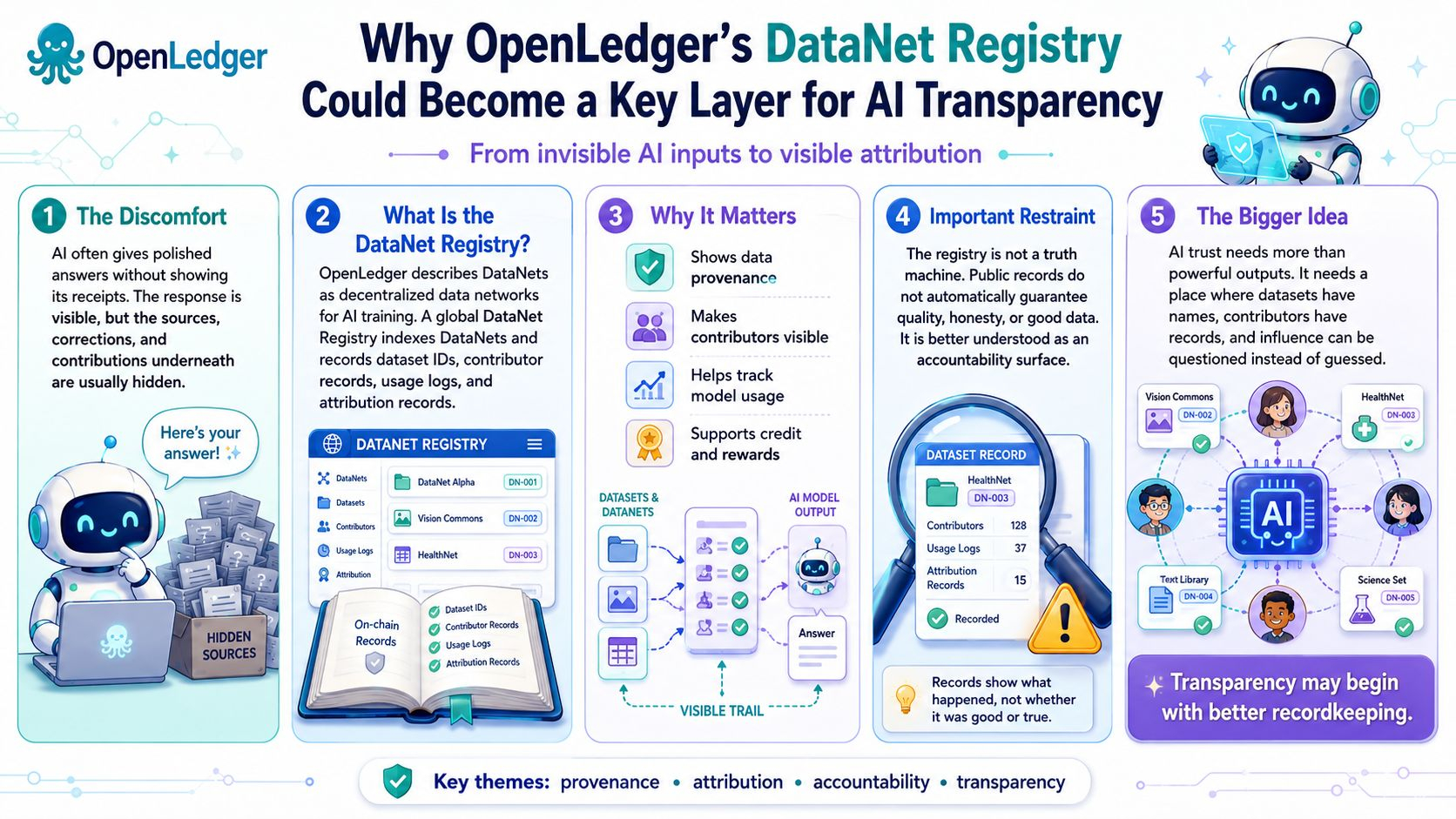
Maybe OpenLedger’s DataNet Registry becomes important not because it makes AI transparent in one clean motion, but because it gives transparency somewhere to live. A place where datasets have names, contributors have records, model usage leaves marks, and influence can be questioned instead of guessed.
That does not solve the whole AI trust problem.
But it does reject one broken default: the idea that intelligence can be built from invisible inputs forever, and nobody should ask to see the trail.