

I was scrolling through a late-night developer thread a few days ago and noticed something interesting. People weren’t debating whether AI networks need tokens anymore. That argument feels mostly settled. The real discussion now is about whether the token actually sits inside the system in a meaningful way or just floats above it as a speculative layer. That difference matters more than most traders realize, and it’s exactly where the OPEN token starts to get interesting.
OPEN sits at the center of the @OpenLedger ecosystem with a total supply capped at 1,000,000,000 tokens. On paper, that number sounds large because crypto investors have been trained to react emotionally to supply counts. But supply without context tells you almost nothing. A billion-token network supporting AI infrastructure behaves very differently from a meme coin printing billions for pure circulation. What matters is how many economic functions pull demand toward the token at the same time.
OPEN is trying to anchor itself to four separate behaviors underneath the network. Transaction fees, attribution rewards, governance, and service payments. Most projects stop at one or two. Understanding that helps explain why the design feels more like infrastructure economics than traditional crypto marketing.
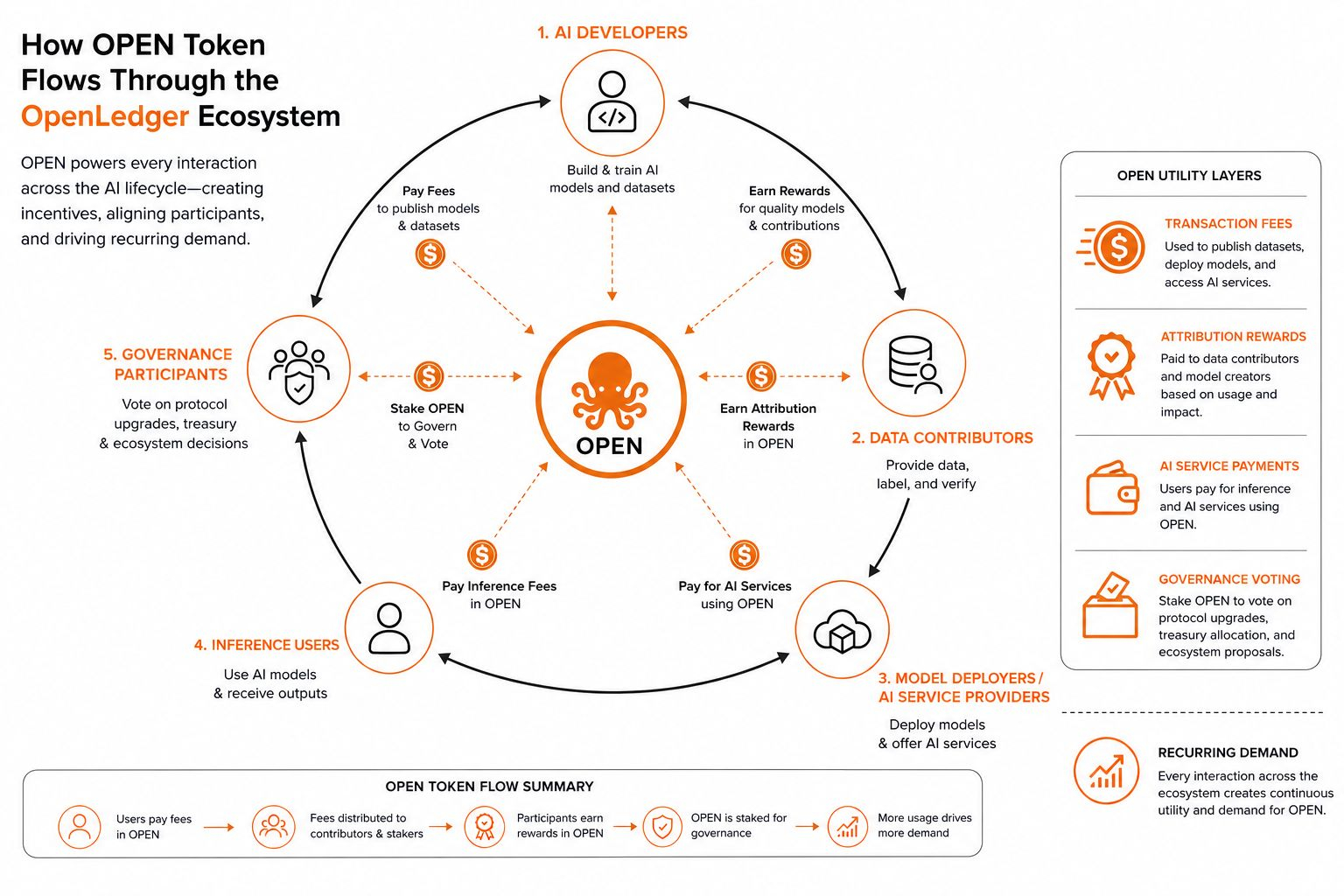
The transaction fee layer is the easiest part to grasp. Every time someone deploys an AI model, runs inference, or executes activity on the network, OPEN is used to cover the computational cost. Surface level, that sounds similar to gas on Ethereum. Underneath, though, the economics are slightly different because AI workloads behave differently from normal blockchain transactions. AI inference can become extremely repetitive and resource-heavy. One active application could trigger thousands of model requests in a short period. That creates steady transactional demand instead of purely speculative bursts.
You can already see the broader market moving toward this structure. NVIDIA crossed a market value above $3 trillion earlier this year because investors realized computation itself became the scarce asset underneath AI growth. OPEN appears to be positioning its token around that same idea. Not around hype alone, but around usage tied to compute demand.
Then there’s attribution rewards, which quietly may be the most important piece of the whole system.
AI has a data problem nobody fully solved yet. Models need enormous datasets, but contributors rarely get compensated fairly once their information enters the machine. OpenLedger is trying to attach measurable value back to contributors using OPEN rewards. In simple terms, if your data or model contribution improves the network, the token becomes the payment rail recognizing that value.
That changes the texture of participation. Instead of users simply paying fees, contributors become economic stakeholders. I think that’s why some developers have started paying closer attention recently. The current AI economy heavily concentrates rewards around a few centralized companies. Attribution systems attempt to spread some of that value outward again.
Of course, there’s risk underneath this model too. Measuring contribution quality in AI systems is incredibly difficult. Low-quality data flooding networks for token rewards remains a real concern across decentralized AI projects. If incentives aren’t calibrated carefully, token emissions can quietly dilute meaningful contributions. Early signs suggest the industry understands this issue better now than it did two years ago, but execution remains to be seen.
Governance is another layer people usually ignore until it suddenly matters. OPEN token holders can vote on network upgrades and funding allocations for AI initiatives. Most governance systems in crypto struggle because participation rates stay low. But AI networks may evolve differently because decisions around model standards, dataset approvals, and infrastructure funding directly affect developers building on top of the system.
I noticed this shift during recent conversations around open-source AI regulation. Developers increasingly want influence over how networks evolve instead of depending entirely on centralized platforms. Governance tokens begin acting less like political theater and more like operational coordination.
Meanwhile, service payments create another economic loop. OPEN is also used for specialized AI training and inference requests. That sounds technical until you translate it into something familiar. Imagine a startup needing a customized language model for legal document analysis. Instead of building infrastructure from scratch, they pay through the OpenLedger ecosystem using OPEN tokens. The token becomes tied to actual service demand, not just exchange speculation.
That distinction feels important right now because the market is changing how it prices crypto narratives. In 2021, almost any AI-related token could rally on branding alone. In 2026, traders are asking harder questions. Where does value accumulate? Who actually needs the token? What activity creates recurring demand underneath price action?
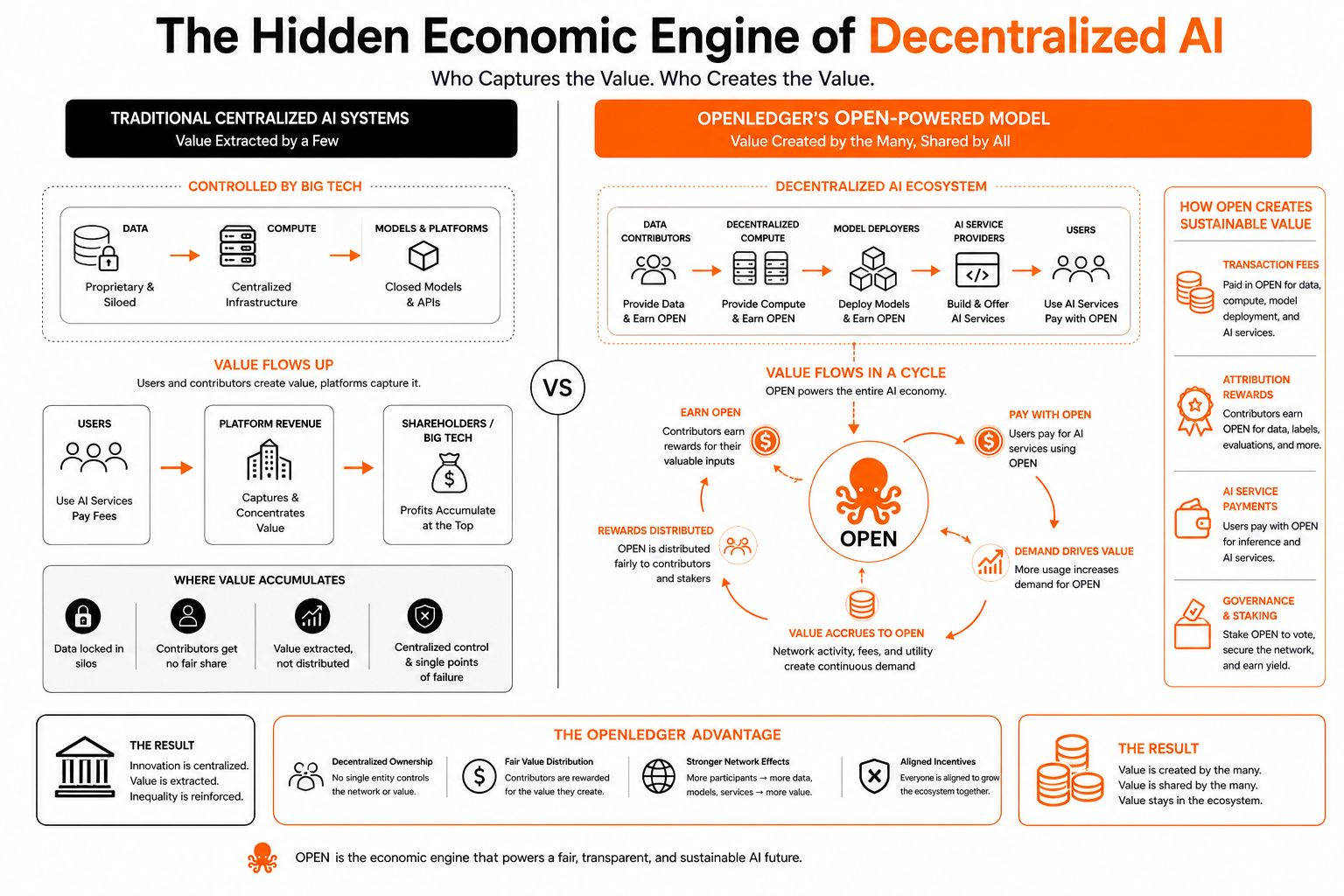
OPEN’s structure suggests an attempt to answer those questions directly.
If this model holds, the bigger pattern becomes hard to ignore. AI networks are slowly merging compute markets, data ownership, and digital coordination into one economic layer. Tokens increasingly look less like abstract assets and more like operating fuel for machine-driven systems.
And that may end up being the quiet shift underneath this entire cycle. The next generation of crypto winners probably won’t be the loudest networks. They’ll be the ones people keep using without thinking about the token at all, even while the token quietly powers everything underneath.
