I’ve been spending time digging through OpenLedger lately, mostly because I wanted to understand whether this whole “AI blockchain” narrative actually means anything structural or if it’s just another layer of branding wrapped around automation. And honestly? I think most people are still looking at this completely wrong.
Everybody keeps talking about AI like the entire future depends on faster outputs.
Faster agents.
Better predictions.
Cleaner execution.
More autonomous systems.
Cool. Sure.
But here’s the thing nobody really talks about enough.
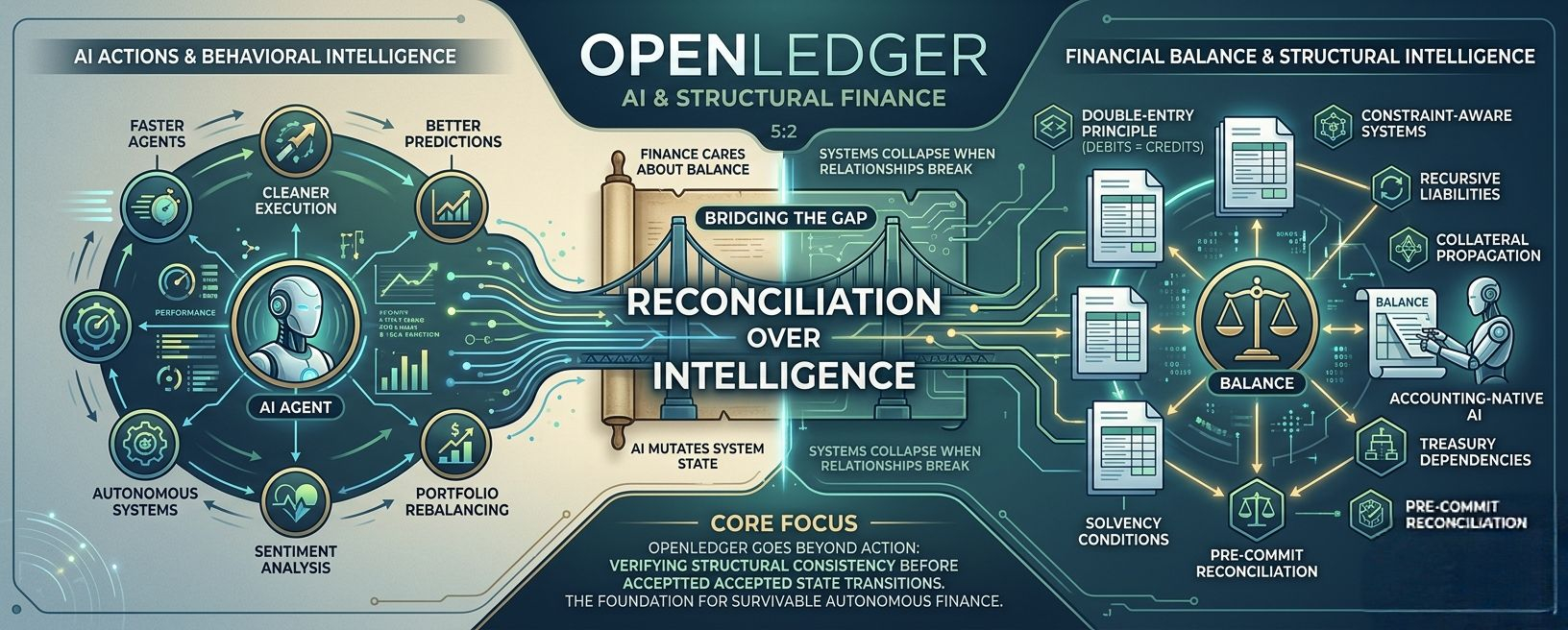
Finance doesn’t actually care about actions as much as people think it does.
Finance cares about balance.
That’s the real system underneath everything.
And once you see that, a lot of current AI infrastructure suddenly starts looking… incomplete.
I’ll be honest, I used to think double-entry accounting was mostly boring operational machinery. The kind of thing auditors care about. Compliance teams. Accountants with spreadsheets nobody wants to open voluntarily.
I was wrong.
Completely wrong, actually.
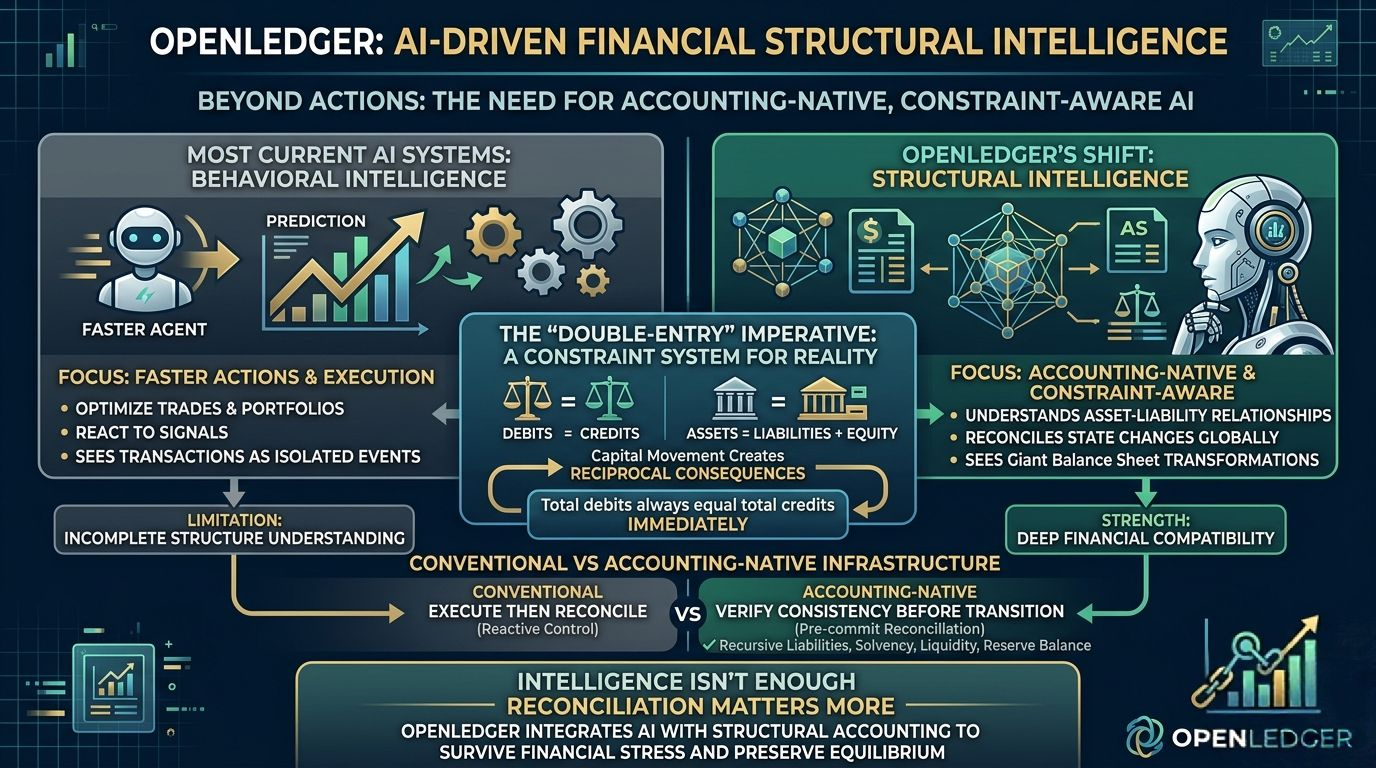
Double-entry accounting isn’t just recordkeeping. It’s basically a constraint system for reality. That’s what clicked for me while tracing how capital actually moves through modern crypto infrastructure.
Every state change has to reconcile somewhere else.
Always.
You can’t create movement without creating consequence.
That’s why I think OpenLedger gets interesting in a way most AI projects don’t.
A lot of AI agents today only understand action-level intelligence. They know how to react to signals. They optimize execution paths. They rebalance portfolios. They scrape sentiment. They trigger trades faster than humans.
But finance is bigger than actions.
Way bigger.
Actions are just the visible surface layer.
Underneath that surface, financial systems run on relationships between assets, liabilities, collateral dependencies, liquidity exposure, reserve assumptions, treasury obligations, and solvency conditions. That’s the actual machinery.
And honestly, most AI agents today don’t understand that machinery at all.
They understand motion.
Not structure.
There’s a huge difference.
I’ve seen this before with a lot of “autonomous finance” narratives. Systems look brilliant during expansion cycles because everything works when liquidity flows easily and nobody checks structural pressure points too carefully.
Then stress hits.
Suddenly nobody understands where liabilities actually sit anymore.
That’s where things get messy fast.
Because every financial system, whether people realize it or not, operates around a core invariant:
Total debits always equal total credits.
Period.
Not eventually.
Not approximately.
Immediately.
That rule matters way more once AI systems start controlling actual capital flows instead of just recommending actions from the sidelines.
Because now the AI isn’t just analyzing the system.
It’s mutating the system.
And the second an AI mutates state conditions — collateral positions, liquidity exposure, treasury allocations, leverage relationships — you’re no longer dealing with a prediction problem.
You’re dealing with a consistency problem.
That distinction changes everything.
Most current crypto infrastructure still treats transactions like isolated events.
Wallet A sends funds.
Vault B receives collateral.
Protocol C issues yield exposure.
Simple story.
Except it’s not actually true.
Nothing moves independently inside financial systems.
That’s the part people miss.
Let’s say someone deposits stablecoins into a vault. That vault routes liquidity into a lending pool. Then another layer creates derivative exposure against that collateral. Then treasury systems recycle the resulting liquidity somewhere else downstream.
Most AI models interpret that sequence as separate actions.
But structurally? It’s one giant balance-sheet transformation happening across interconnected states simultaneously.
The original stablecoin changes character entirely during that process.
Part becomes collateral backing.
Part becomes somebody else’s liability.
Part becomes future redemption exposure.
Part becomes leveraged dependency sitting somewhere downstream waiting for stress conditions to expose it.
Nothing exists in isolation anymore.
And honestly, this is exactly why I think AI systems trained purely on behavioral outputs eventually hit a wall in finance.
Because financial systems don’t just care whether actions execute correctly.
They care whether the entire structure remains internally coherent afterward.
Big difference.
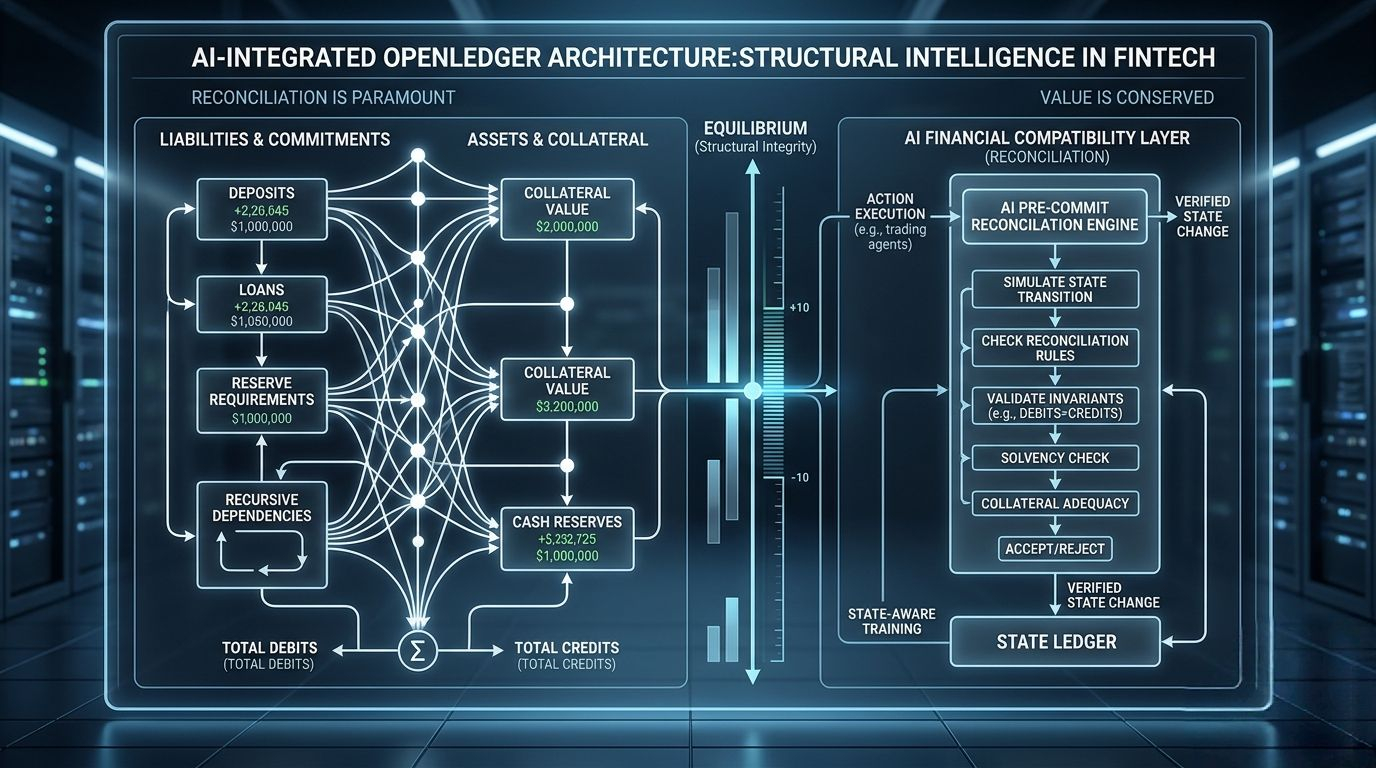
This is where OpenLedger starts feeling less like a transaction network and more like a structural accounting environment.
And that’s where things get interesting.
Because if you really think this through, the future AI layer inside finance can’t behave like a detached automation engine floating above the ledger anymore.
It has to become constraint-aware.
The AI has to understand:
- recursive liabilities
- collateral propagation
- liquidity coupling
- solvency pressure
- reserve deterioration
- treasury dependencies
- balance-sheet fragility
Those aren’t trading concepts.
They’re accounting concepts.
People underestimate that shift massively.
Most AI systems today optimize for output efficiency. Faster execution. Better prediction accuracy. Lower latency. More automation.
But finance doesn’t collapse because execution was slow.
Finance collapses because balance relationships break.
That’s the real danger.
And honestly, I think this is why pre-commit reconciliation layers matter so much moving forward.
Most systems today basically execute first and reconcile later. They rely on monitoring systems, liquidation engines, audits, emergency controls, governance intervention… all reactive stuff.
But accounting-native systems flip that model entirely.
They verify structural consistency before accepting the state transition.
Meaning the system checks whether:
- assets still reconcile
- liabilities remain attributable
- reserves stay internally balanced
- solvency assumptions still hold
- accounting symmetry remains intact
before the transition finalizes.
Not after.
That’s a huge conceptual shift for AI infrastructure.
Because now intelligence alone isn’t enough.
The AI has to remain financially compatible with the ledger itself.
And honestly? I think this becomes one of the biggest dividing lines in the next generation of AI-financial systems.
Some systems will focus on behavioral intelligence.
Others will focus on structural intelligence.
The first category produces smarter automation.
The second category produces systems that can actually survive real financial stress.
There’s a reason double-entry accounting survived for centuries. People treat it like old administrative machinery, but it survived because it mirrors conservation logic almost perfectly.
Value can’t appear without consequence.
Risk never disappears. It moves.
Liabilities don’t evaporate. They transfer somewhere else.
Every financial state mutation creates reciprocal pressure inside the system whether people notice it immediately or not.
That’s reality.
And I think that’s the bigger implication behind OpenLedger that people still aren’t fully talking about.
The important question isn’t:
“Can AI execute finance autonomously?”
Honestly, that part is becoming trivial.
The harder question is:
“Can AI preserve structural equilibrium while operating inside autonomous financial systems?”
Because eventually every serious AI-financial architecture hits the same wall.
Intelligence matters.
But reconciliation matters more.