
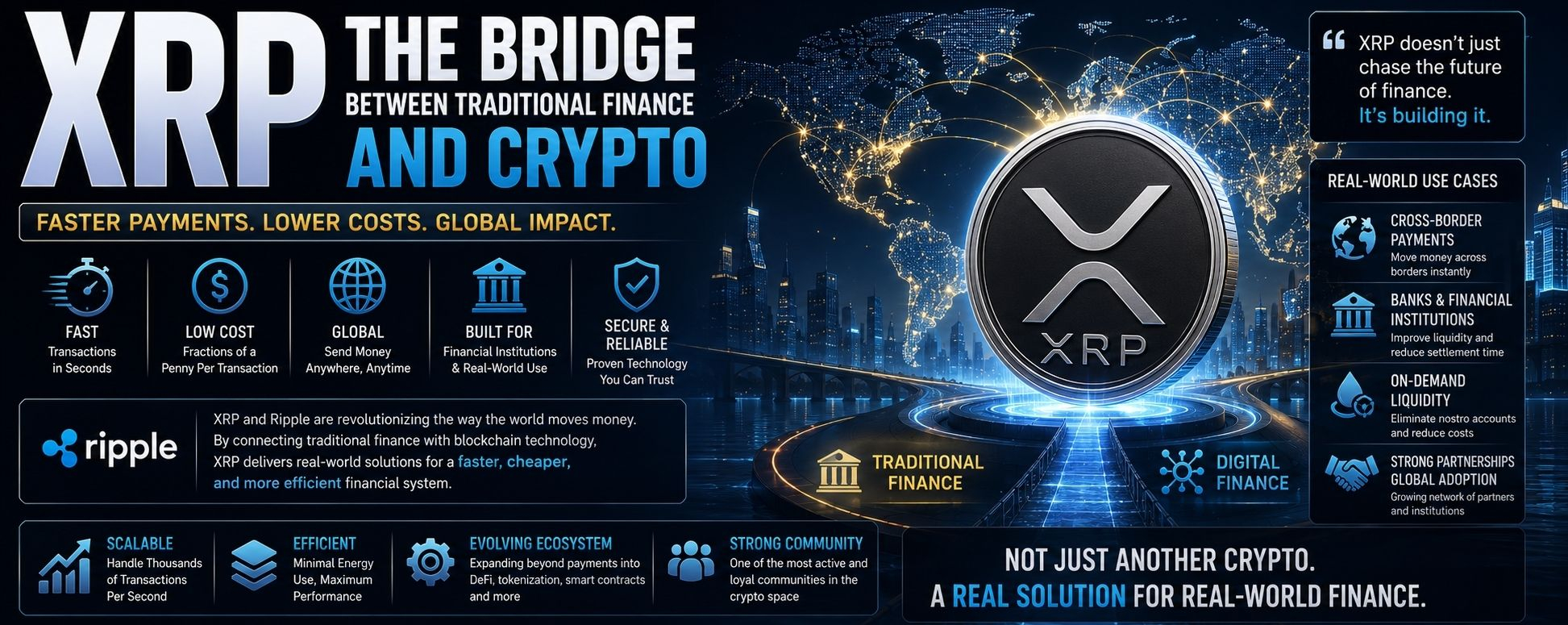
For years, the crypto industry has focused heavily on decentralization, speculation, and digital assets. But while many projects compete for attention, $XRP has continued building around one of the biggest real-world opportunities in finance: global payments.
Created by Ripple, XRP was designed to solve a major problem that still exists in traditional banking systems — slow and expensive international money transfers. Even in 2026, cross-border payments through conventional financial networks can take several days to settle, often involving high fees and multiple intermediaries. XRP aims to simplify that process by enabling near-instant global transactions with significantly lower costs.
What makes $XRP different from many cryptocurrencies is its strong focus on utility rather than hype. Instead of positioning itself purely as a decentralized experiment, the XRP ecosystem has concentrated on building infrastructure that financial institutions and payment providers can actually use in the real world.
One of XRP’s biggest strengths is transaction efficiency. The XRP Ledger is capable of processing transactions within seconds while maintaining extremely low fees. This combination of speed and scalability has helped XRP remain relevant despite increasing competition across the blockchain industry.
Another important factor is Ripple’s long-term vision for financial connectivity. The company has continued expanding partnerships and payment solutions aimed at improving liquidity movement across borders. Rather than replacing banks entirely, XRP often positions itself as technology that can modernize existing financial systems and reduce settlement friction.
The $XRP Ledger is also evolving beyond payments. Developers are increasingly exploring tokenization, smart contract functionality, decentralized finance, and institutional blockchain applications within the ecosystem. This suggests XRP is gradually expanding from a payment-focused asset into a broader financial infrastructure network.
Despite regulatory challenges over the years, XRP has maintained one of the strongest global communities in crypto. Many investors continue viewing it as a long-term infrastructure play rather than just another speculative token cycle.
If blockchain technology eventually becomes deeply integrated into global finance, XRP could end up playing a much larger role than many people originally expected. Instead of competing to become just another cryptocurrency, it may become one of the key bridges connecting traditional banking systems with the future of digital finance.