
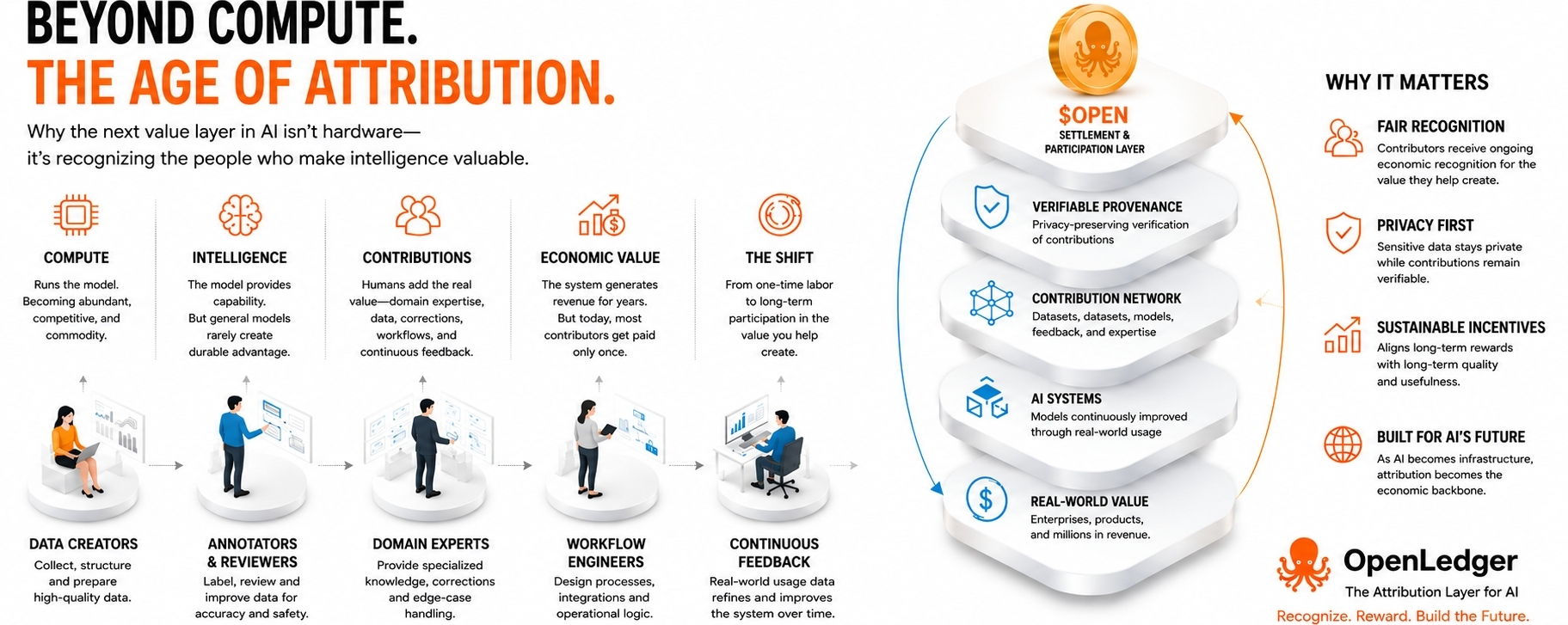
The Most Misunderstood Layer of AI Isn't Compute. It's Ownership.
Everyone talks about artificial intelligence as if the future will be won by whoever controls the most compute.
The conversation is almost always the same.
More GPUs.
Cheaper inference.
Bigger models.
Faster training.
Larger clusters.
Every investment narrative eventually circles back to hardware because hardware is easy to understand. It is tangible. You can count it. You can measure it. You can assign a cost to it.
And because it is visible, markets naturally become obsessed with it.
But history has a habit of punishing industries that mistake visibility for value.
Railroads weren't the most valuable part of industrialization.
Oil wells weren't the most valuable part of globalization.
Servers weren't the most valuable part of the internet.
Infrastructure matters.
But infrastructure rarely captures all the value it creates.
Sometimes it captures surprisingly little.
And I increasingly believe artificial intelligence is heading toward a similar realization.
Because while everyone is debating how intelligence is produced, very few people are asking a more important question:
Who owns the value created after intelligence exists?
That question may end up defining the next decade of AI.
Not model architecture.
Not benchmark scores.
Not token speeds.
Ownership.
Or more specifically:
Attribution.
The Hidden Workforce Behind Every Useful AI System
There is a popular story people tell about AI.
A company acquires a model.
The model becomes intelligent.
The company deploys it.
Revenue follows.
Simple.
Neat.
Clean.
The problem is that reality looks nothing like that.
The truth is that most commercially successful AI systems spend very little time being "finished."
Instead, they enter a constant process of refinement.
Correction.
Adjustment.
Adaptation.
Improvement.
The model that enters production is rarely the model that creates long-term value.
The model that creates long-term value is the one that survives contact with reality.
And reality is messy.
Reality contains edge cases.
Reality contains contradictions.
Reality contains unusual customer behavior.
Reality contains regulations.
Reality contains unexpected workflows.
Reality contains thousands of situations that were never represented in benchmark datasets.
This is where the real work begins.
Not inside the GPU cluster.
Inside the feedback loop.
Healthcare professionals correcting medical outputs.
Legal reviewers identifying subtle mistakes.
Fraud specialists labeling suspicious behavior.
Support teams flagging recurring failures.
Operations managers teaching systems how organizations actually function.
Engineers creating workflow-specific improvements.
Subject matter experts continuously refining behavior.
These people rarely appear in AI marketing materials.
Yet without them, most specialized AI systems would remain expensive demos rather than profitable products.
The uncomfortable truth is that the smartest AI systems in the world often become commercially valuable because humans spend enormous amounts of time making them less wrong.
And that contribution is where a fascinating economic question begins to emerge.
Why Does AI Compensation Still Look Like Contract Labor?
Imagine two scenarios.
In the first scenario, a musician writes part of a song.
That song becomes a global success.
Years later, the musician continues receiving compensation because their contribution remains embedded inside the asset generating value.
Nobody finds this strange.
The relationship between contribution and participation is widely accepted.
Now imagine a different scenario.
A domain expert helps improve an enterprise AI model.
Their corrections significantly enhance performance.
The system becomes a critical product.
It generates millions of dollars over several years.
The contributor receives payment once.
The relationship ends forever.
No matter how much value continues to be produced, their economic participation is over.
That arrangement feels normal today.
But should it?
The more AI behaves like a continuously productive asset, the stranger this structure begins to look.
We are applying industrial-era compensation logic to systems that increasingly resemble digital capital.
The mismatch becomes difficult to ignore.
Particularly when the largest improvements often come from specialized knowledge rather than raw computation.
The Real Scarcity May Not Be Intelligence
Most crypto-AI projects focus on compute.
That makes sense.
Compute is measurable.
It can be bought.
It can be sold.
It can be coordinated through markets.
It can be tokenized.
It fits neatly into existing economic frameworks.
But what happens if compute follows the path of most technologies?
What happens if it becomes increasingly abundant?
What happens if competition compresses margins?
What happens if hardware becomes a commodity rather than a moat?
History suggests this is not an unreasonable possibility.
When a resource becomes abundant, value often migrates elsewhere.
The scarce layer changes.
The profitable layer changes.
The strategic layer changes.
And in AI, that layer may not be compute.
It may be attribution.
Not intelligence itself.
Not ownership of models.
Not ownership of servers.
Ownership of contribution.
Ownership of improvement.
Ownership of value creation.
The ability to answer a deceptively simple question:
Who actually helped make this system useful?
That question sounds philosophical.
Until revenue enters the conversation.
Then it becomes economic.
Very quickly.
The Attribution Problem Nobody Has Solved
Let's imagine an enterprise AI assistant.
At first glance, it appears simple.
But underneath the surface, hundreds or thousands of contributors may have influenced its performance.
Training datasets.
Domain experts.
Workflow engineers.
Human reviewers.
Continuous feedback systems.
Specialized annotators.
Production corrections.
Industry-specific refinements.
Some contributions may improve accuracy by 10%.
Others by 0.1%.
Some fixes become important every day.
Others matter only during rare edge cases.
Some contributions become more valuable over time.
Others become obsolete.
How do you measure that?
How do you determine who deserves recognition?
How do you calculate economic participation?
The challenge is enormous.
Because intelligence is not built in a straight line.
It is built through overlapping layers of contribution.
A single output may be influenced by thousands of prior inputs.
Traditional ownership frameworks struggle to describe that complexity.
And yet complexity does not eliminate value.
It merely makes value harder to track.
Why OpenLedger's Thesis Feels Different
This is where OpenLedger becomes interesting.
Not because it promises magical attribution.
Not because it claims perfect economic fairness.
And not because it introduces another speculative token narrative.
What makes the idea interesting is that it begins from a different assumption.
Instead of asking:
"How do we make AI cheaper?"
It asks:
"How do we measure who contributed to AI value creation?"
That is a fundamentally different question.
And potentially a much bigger one.
OpenLedger's broader vision around verifiable datanets, contribution provenance, and transparent participation mechanisms points toward an economy where contribution itself becomes a measurable asset.
The goal is not perfect attribution.
Perfect attribution may be impossible.
The goal is credible attribution.
That distinction matters.
Markets do not require perfection.
Markets require trust.
People settle billions of dollars in transactions every day using systems that are imperfect but sufficiently reliable.
The same principle may apply here.
If contributors can be identified with reasonable credibility, entirely new economic structures become possible.
From Labor Markets to Participation Markets
The biggest implication may not be technical.
It may be economic.
Today, AI contributors largely operate inside labor markets.
You contribute.
You get paid.
You leave.
The transaction ends.
But attribution infrastructure introduces another possibility.
Participation markets.
A world where contributors remain economically connected to the systems they help improve.
Not because they own the company.
Not because they own the model.
But because they contributed measurable value.
That sounds subtle.
It is not.
It fundamentally changes incentives.
Instead of compensation being tied solely to effort, compensation becomes partially tied to outcomes.
The relationship between contributors and AI systems becomes ongoing rather than temporary.
And suddenly the economic architecture of intelligence begins to resemble something entirely different from traditional software.
The Challenges Are Enormous
Of course, this vision is far from guaranteed.
In fact, the obstacles are significant.
Finance departments dislike uncertainty.
Lawyers dislike ambiguity.
Accountants dislike open-ended obligations.
Regulators dislike structures that blur the line between ownership, participation, and entitlement.
Every organization prefers simplicity.
A one-time payment is simple.
A long-term participation framework is not.
Then there is privacy.
Some of the most valuable AI improvements originate from highly sensitive environments.
Medical systems.
Corporate workflows.
Customer interactions.
Compliance databases.
Internal communications.
Attribution cannot come at the expense of confidentiality.
Any viable solution must verify contribution without exposing underlying information.
That is one of the hardest technical problems in the entire AI stack.
And even if privacy is solved, incentives create another challenge.
The moment rewards become visible, people optimize for rewards.
Metrics get gamed.
Systems get farmed.
Low-quality contributions flood the network.
Reputation manipulation appears.
Every crypto veteran has seen this movie before.
Without robust filtering mechanisms, attribution systems can become extraction systems.
The risk is real.
And it cannot be ignored.
The Bigger Shift Nobody Is Pricing In
Despite these challenges, I suspect the market is underestimating something important.
We may be witnessing the early stages of a transition from an ownership economy to a contribution economy.
For decades, digital systems primarily rewarded owners.
Owners of platforms.
Owners of networks.
Owners of infrastructure.
Owners of intellectual property.
AI introduces a new possibility.
One where contributors become increasingly visible.
Increasingly measurable.
Increasingly important.
Because intelligence does not emerge from models alone.
It emerges from ecosystems.
And ecosystems create value through participation.
If that participation becomes economically recognizable, entirely new markets become possible.
Not markets for compute.
Not markets for tokens.
Not even markets for intelligence.
Markets for contribution itself.
And that may ultimately become one of the most valuable layers in the entire AI economy.
Because the future of AI may not belong to those who simply own the intelligence.
It may belong to those who build the systems that decide who gets recognized when that intelligence starts making money.
That is a much larger opportunity than most people realize.
And if it unfolds the way some believe it might, attribution won't be a feature of the AI economy.
It will become one of its foundational pillars.