
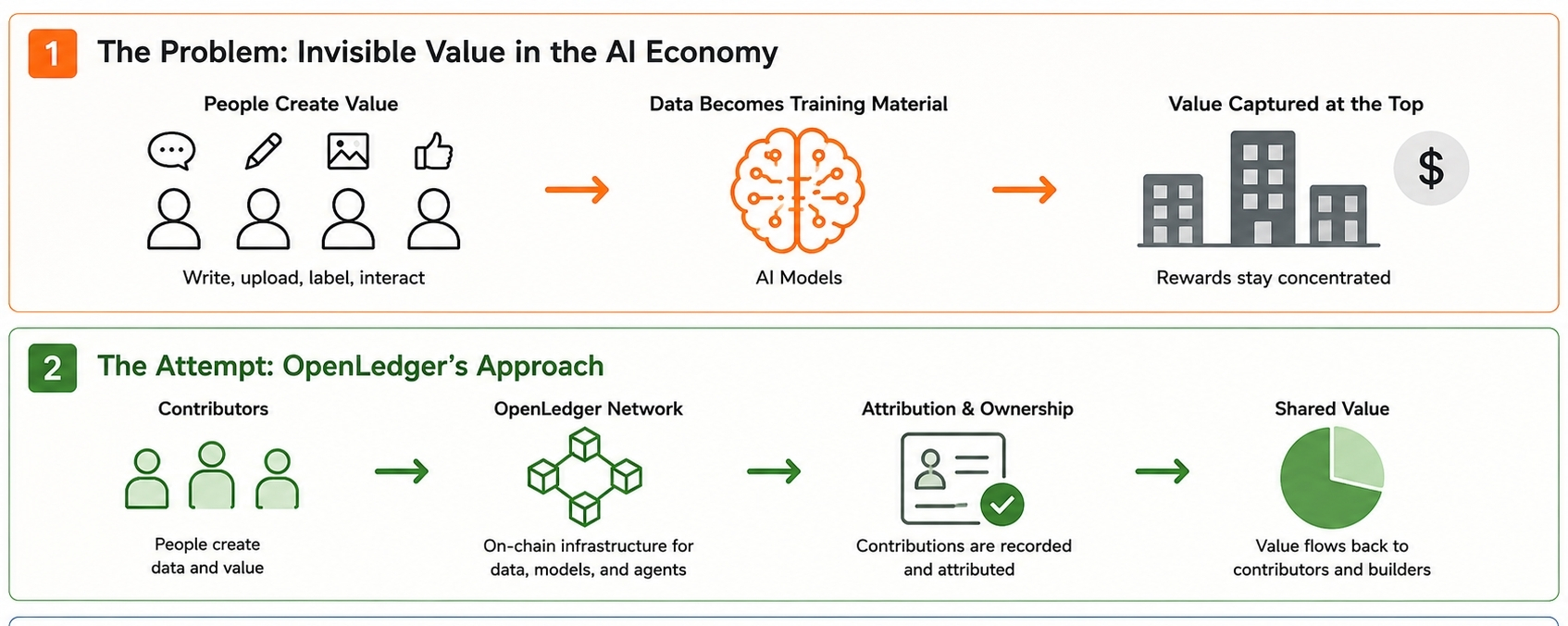

I think one of the biggest problems in crypto is that the industry keeps creating movement without creating real meaning. Every cycle arrives with a new promise. DeFi was supposed to rebuild finance. NFTs were supposed to give creators ownership. Now AI and blockchain are being pushed together as the next major shift. The language changes, but the pattern often feels the same.
A lot of activity. Very little clarity.
That is why projects like catch my attention, even if I do not fully trust them yet. Not because I think they have already solved something important, but because they are at least pointing toward a real issue that most people still avoid talking about.
AI systems today are built on massive amounts of hidden labor. People create the data. People write, upload, label, respond, and interact online every day. That information becomes training material for models, but the value rarely flows back to the people who helped create it. Most of the rewards stay concentrated at the platform level.
I keep coming back to that imbalance.
Crypto has always claimed it could fix ownership and distribution problems, but honestly, I have seen this before. The industry is very good at turning serious ideas into financial narratives long before the systems actually prove they work. Something gets tokenized, liquidity appears, and suddenly speculation becomes more important than usefulness.
That is where my hesitation around OpenLedger starts.
The idea sounds reasonable on paper. A blockchain focused on data, AI models, and agents. A system where contributors could potentially own part of the value they help create. That is interesting to me because the underlying problem is real. If AI becomes part of everyday infrastructure, then questions around attribution and ownership will matter a lot.
Who benefits from the intelligence economy?
Who gets rewarded when models improve?
Who disappears in the background while someone else captures the value?
These questions matter more to me than price charts or hype cycles.
What interests me is not the branding around AI. Every project uses AI language now. That part does not impress me anymore. What matters is whether a system can create long-term incentives that actually make sense once the excitement fades.
And that is difficult.
The more I sit with crypto projects tied to AI, the more I notice how quickly the conversation moves toward liquidity instead of usefulness. Markets appear before products mature. Participation becomes financialized almost immediately. Everyone talks about ecosystems, but very few talk honestly about sustainability.
From my view, this is where appearance and reality usually separate.
A network can look active while producing very little real value. A project can trend online while depending entirely on speculation underneath. Crypto has always had a talent for making unfinished systems look complete through marketing and momentum.
That does not mean every idea is meaningless. But it does mean I have learned to slow down before believing the narrative.
I respect the attempt more than I trust the outcome.
Still, I think OpenLedger is interesting because it sits close to a real unresolved problem. AI is becoming more powerful, but the economic structure around it still feels incomplete. The internet already runs on invisible contribution, and AI is accelerating that pattern. People create value constantly without ownership, without attribution, and often without even realizing it.
Maybe systems like OpenLedger are trying to address that imbalance. Maybe they are early experiments in figuring out how data and intelligence could become shared economic layers instead of centralized assets controlled by a few large companies.
Or maybe it becomes another cycle where the narrative grows faster than the actual utility.
I honestly do not know yet.
And I think that uncertainty is important to admit. Crypto discussions often become too confident too quickly. Everything is either called revolutionary or dismissed immediately. But most technologies take years before their real shape becomes clear.
So I pay attention carefully. Quietly.
Not because I am convinced, but because I think the questions behind projects like this are becoming harder to ignore. Ownership, contribution, data, coordination, invisible labor — these are real tensions inside the future AI economy.
Whether crypto can solve them is another question entirely.