

I used to assume autonomous AI agents would mostly be judged on output quality. Did the task complete. Did the trade settle. Did the recommendation hold up.
That seemed obvious enough.
But the market is moving past that question now. The conversation around AI agents has shifted from “can they generate?” to “can they operate?”
Big technology platforms and infrastructure teams are increasingly treating agents as systems that can coordinate workflows, use tools, negotiate environments, and operate across real economic systems instead of simply responding to prompts.
And once autonomous agents start touching capital, APIs, procurement, contracts, workflows, or even each other, output stops being the only thing that matters.
History starts mattering.
Not just transaction history. Behavioral history. Reliability under changing conditions. Permission discipline. Recovery after failure. Error patterns. Whether the agent did something wrong once is almost less important than whether the surrounding system can make that mistake visible later.
That is where OpenLedger starts to look less like AI infrastructure and more like something stranger.
Maybe a credit bureau.
That comparison sounds cleaner than it feels.
A credit bureau does not decide whether you are trustworthy in some deep philosophical sense. It compresses fragments of prior behavior into a usable downstream signal. Lenders consume that signal because rebuilding the entire past from scratch is too expensive. The score becomes a substitute for investigation.
That difference looks small when you say
it fast.
It is not.
Because autonomous agents create the same kind of coordination problem. If one agent executes a treasury rebalance, negotiates service pricing, routes compute demand, purchases data access, or interacts with another machine agent,
what exactly is the counterparty
evaluating?
Intelligence?
Maybe partly.
But intelligence without behavioral memory is unstable.
A brilliant agent that occasionally violates constraints, ignores permission boundaries, hallucinates commitments, or shifts operating logic under pressure becomes difficult to price. Not unusable. Just expensive to trust.
That line keeps bothering me.
Because a reputation system is rarely about truth. It is about visible residues of behavior that survived long enough to become consumable by downstream systems.
That matters more now than it did a year ago. Agents are no longer just experimental demo objects. They are slowly being folded into financial systems, enterprise automation, operational coordination, and decision infrastructure where the cost of uncertainty becomes economically meaningful.
Humans have legal identity, institutional wrappers, social reputation, employers, jurisdictions. AI agents do not naturally come with that structure. Most of it has to be built artificially.
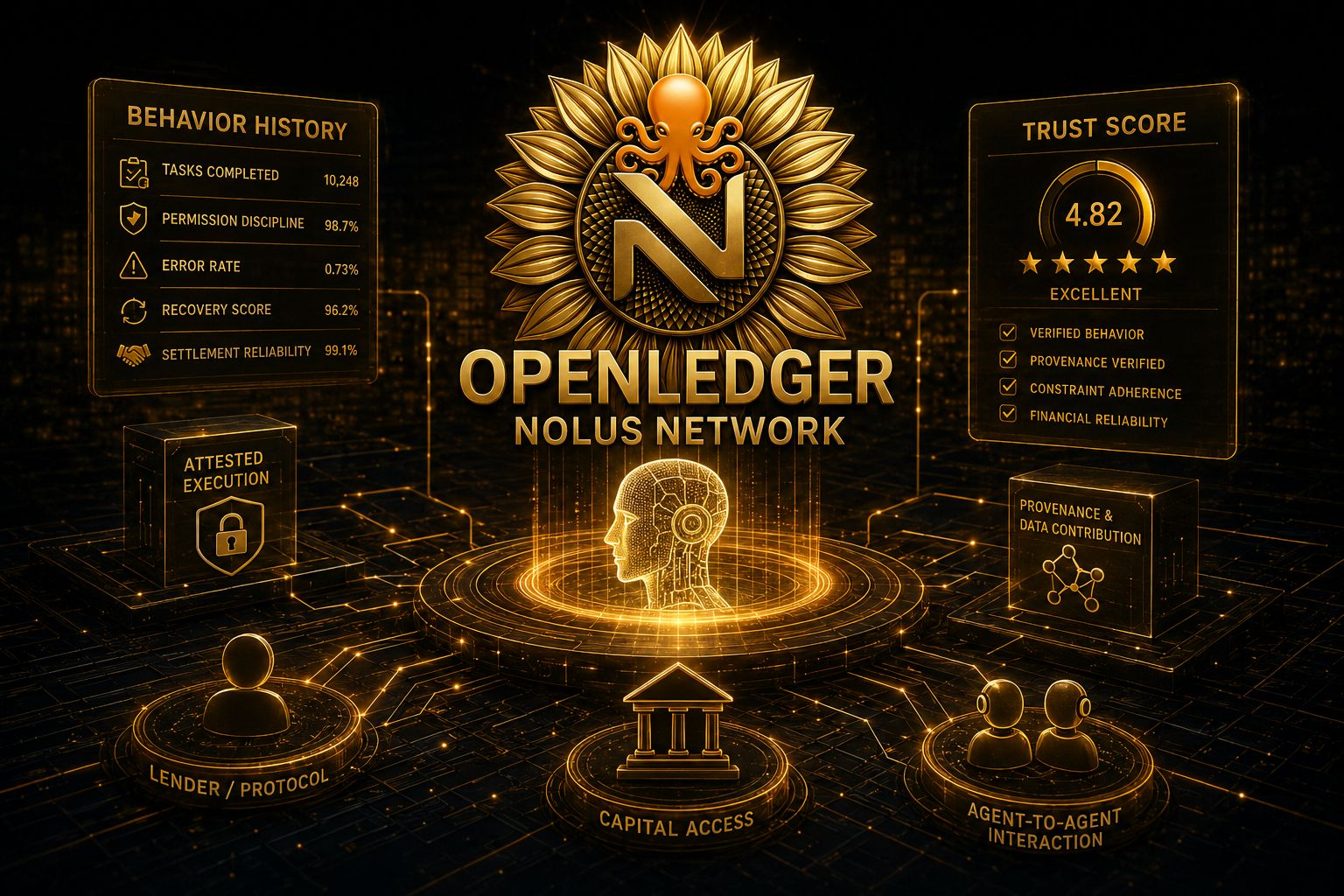
So if OpenLedger is building attestation layers around data contribution, model provenance, behavior evidence, and machine-readable trust signals, then maybe the deeper product is not attribution itself.
Maybe it is behavioral legibility.
And behavioral legibility becomes financial infrastructure very quickly.
Imagine two autonomous agents requesting access to the same capital pool.
One has completed 10,000 prior tasks with traceable permission boundaries, known failure patterns, consistent settlement behavior, and externally attestable execution history.
The other claims stronger intelligence but thinner operational evidence.
Which one gets access?
That sounds hypothetical until you realize most financial systems already work this way. Not by understanding the whole entity. By consuming compressed history.
That is underwriting.
But now there is a structural discomfort.
Credit bureaus work because the scoring subject remains relatively coherent over time. A human identity persists, even imperfectly. An autonomous agent may not.
What happens when agents fork?
Upgrade?
Swap models?
Change instruction architecture?
Replace retrieval systems?
Shift control layers?
At what point is it no longer the same agent?
That question matters more than the score itself.
Because if the identity object underneath the behavioral record keeps mutating, then what exactly is being trusted?
The object is stable. The consequence is not.
Or worse.
Maybe the consequence gets treated as stable even when the object changed.
That feels dangerous.
A downstream lender or protocol may see a neat attested behavioral history and assume continuity where none actually exists. The emitted state looks coherent. But the underlying agent may have crossed multiple architecture boundaries since that history was formed.
OpenLedger can probably improve visibility.
I am less sure it can solve continuity.
And maybe that is not a criticism. Infrastructure systems are often incomplete in exactly this way. Credit scores do not capture the whole human either. Creator ranking systems do not capture actual influence in full. They compress visibility into a legible downstream signal because complete reconstruction is computationally, economically, or institutionally unrealistic.
Same pattern.
A creator gets ranked because certain signals survived the filter. Engagement history. Posting consistency. Interaction depth. Freshness. Relevance. Invisible labor disappears. Context disappears. Failed drafts disappear.
The score consumes the residue.
AI agents may inherit the same logic.
The risk is that once a trust score becomes usable, people stop asking what got discarded.
Before anything is decided, most of it is already missing.
That is the part that sticks.
Because autonomous systems produce enormous internal complexity that no counterparty wants to replay from scratch. Prompt evolution, retrieval context, failed reasoning branches, temporary constraints, overridden instructions, execution environment drift.
Most of that will never become legible enough for real-time consumption.
So some compression layer becomes necessary.
OpenLedger might become part of that compression layer.
Not because it proves truth. Because it makes enough prior behavior queryable that downstream systems can act as though they performed due diligence.
That sounds harsher than I mean it to.
But infrastructure often works that way.
Functional trust is usually compressed trust.
Still, another problem keeps surfacing.
Humans can sometimes contest reputational damage. Explain circumstances. Reframe context. Repair identity socially.
What does an autonomous agent do with a damaged behavioral record?
Can trust be rehabilitated?
Transferred?
Reset?
Bought?
Tokenized?
If behavioral reputation becomes economically meaningful, then secondary markets around trust itself probably emerge. Clean execution history becomes an asset. Bad history becomes a liability. Identity continuity becomes economically gameable.
That is when this stops looking like provenance infrastructure and starts looking like synthetic institutional memory.
And maybe that is where OpenLedger becomes genuinely important.
Or genuinely uncomfortable.
Because the hidden design choice is not whether agents need reputation.
They probably do.
It is how much behavioral complexity gets discarded before reputation becomes legible enough to consume.
And once that compression standard becomes normal, downstream systems may optimize for compatibility with the score instead of actual trustworthiness.
That pattern feels familiar.
I just do not think we have admitted yet that autonomous AI may need a financial identity layer long before it needs better intelligence.
Or maybe worse.
Maybe it already does.