
OpenLedger more closely now, and not in that blind “next big AI coin” way.
More like, “wait… why is this project quietly sitting near the real problem while everyone else is dancing on the hype table?” The AI crypto market is noisy. Every second project has an agent, a dashboard, a token, and a dream. But OpenLedger feels different because it is not just trying to make AI look cooler. It is trying to make AI value easier to trace, own, and reward.
That matters.
Most AI projects in crypto still feel like trend farming with better lighting. They say “AI agent,” then expect the market to clap. They add a token, then act like they invented intelligence. But after the excitement fades, the same boring question comes back: what is actually being built here?
OpenLedger is focusing on the part most people ignore.
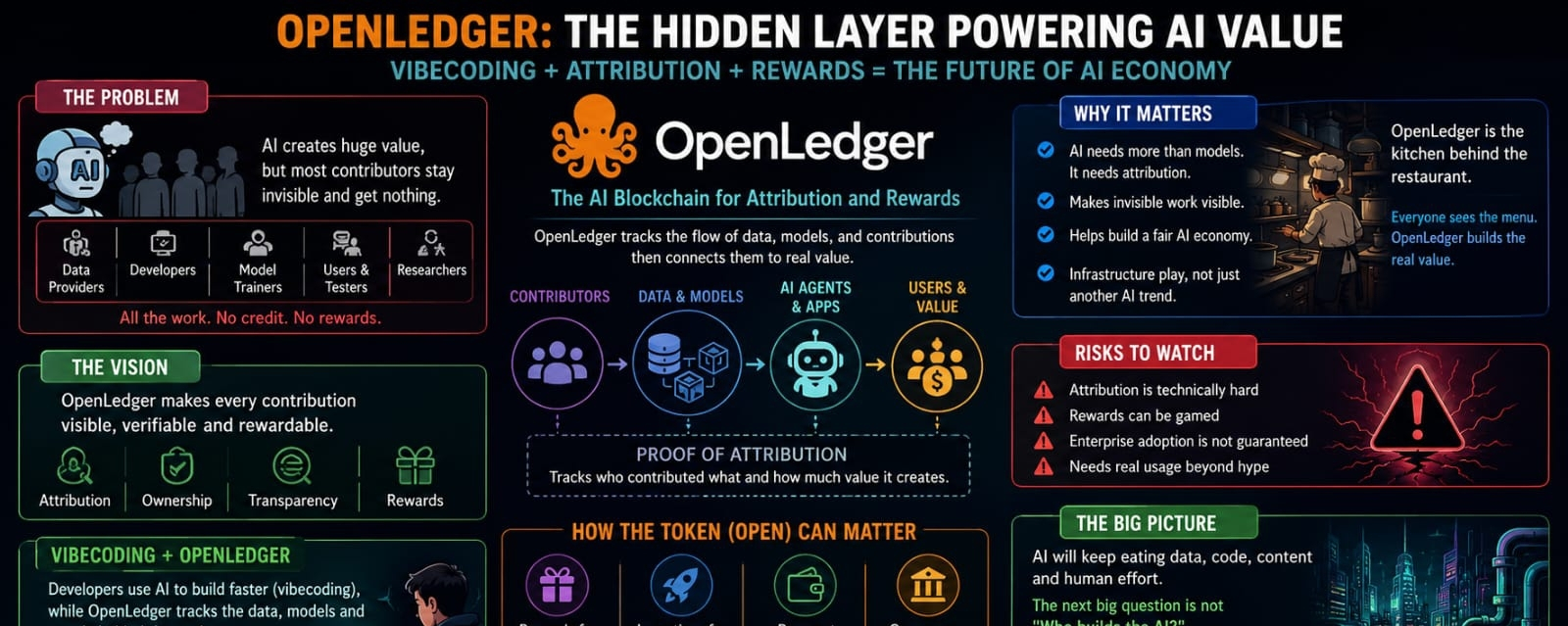
AI is not magic. It is built from data, training, feedback, prompts, models, users, and developers. A lot of people help create the value, but most of them disappear from the reward system. They become background noise. OpenLedger is trying to fix that by making contribution visible.
That is why I am paying attention.
The project is not only saying, “use AI.” It is saying, “let’s track who helped make the AI useful.” That is a much bigger idea. Because if AI keeps becoming part of coding, apps, agents, and online work, then attribution becomes important. Who gave the data? Who improved the model? Who created the useful output? Who deserves payment when that output creates value?
This is where OpenLedger starts to feel less like another AI token and more like infrastructure.
The vibecoding angle makes it even more interesting. Vibecoding sounds funny, almost like a developer just whispering wishes into a laptop and hoping the code behaves. Sometimes it works. Sometimes it gives you code that looks confident but has the emotional stability of a meme chart. But the important part is this: AI is already changing how people build.
OpenLedger is trying to sit underneath that shift.
If developers use AI to build faster, the next question is not only “who wrote the code?” The next question is “what data, model, and contribution helped create this?” That is the hidden layer. That is like finding the kitchen behind the restaurant while everyone else is busy taking photos of the menu.
OpenLedger wants to make that kitchen visible.
And that is where the token could matter. Not because every project needs a token. Most do not. Let’s be honest, some tokens are just loyalty points with a casino addiction. But if OpenLedger can create real activity around data, models, agents, attribution, and contributor rewards, then the token can become part of the system instead of just sitting there looking decorative.
It could help power incentives.
It could help reward contributors.
It could help connect AI work with economic value.
But the “if” is huge.
OpenLedger still has to prove that people will use it when the hype calms down. It has to prove that attribution can actually work at scale. It has to prove that rewards will not get farmed by spam, fake data, and people trying to squeeze the system like a free airdrop faucet. Crypto users are creative. Sometimes too creative.
That is the biggest risk.
A good idea is not enough. A clean thesis is not enough. Even good infrastructure can fail if nobody depends on it. The real test is whether builders, data contributors, developers, and AI projects keep using OpenLedger because they need it, not just because there are rewards.
Still, I think the market may be underpricing the direction.
People love loud narratives. They love shiny agents, viral demos, and charts that look like they drank three energy drinks. But OpenLedger is working on something less obvious: the accounting layer for AI value. That sounds boring until you realize every serious economy needs accounting.
Without accounting, value gets messy.
Without attribution, contributors get ignored.
Without rewards, good data disappears.
Without trust, AI becomes a black box with a marketing budget.
That is why OpenLedger interests me. It is not only chasing the AI trend. It is trying to answer one of the harder questions inside it: if AI becomes more powerful, who gets paid for making it powerful?
That question is bigger than one token.
And maybe that is the real point. OpenLedger is not exciting because it screams the loudest. It is interesting because it is standing near a problem that will get louder over time. If AI keeps moving deeper into development, agents, and digital work, then the market will eventually care about ownership, attribution, and payment.
Right now, people are staring at the slot machines.
OpenLedger is looking at the plumbing.
And in crypto, the plumbing usually looks boring until everyone realizes the whole casino runs through it.