
There’s something about the way AI systems are built right now that feels… incomplete. Not broken. Just unfinished in a way that’s hard to point at directly.
We talk about models like they appear out of nowhere. Clean interfaces. Clean outputs. Almost sterile, if I’m honest.
But underneath that neat surface? It’s chaos. Data pulled from everywhere. People contributing bits of information, behavior, structure, correction. Then somehow all of that gets compressed into a single model response that looks like it just… exists on its own.
That gap bothers me more than I expected it would.
OpenLedger is interesting because it stares directly into that gap instead of pretending it isn’t there.
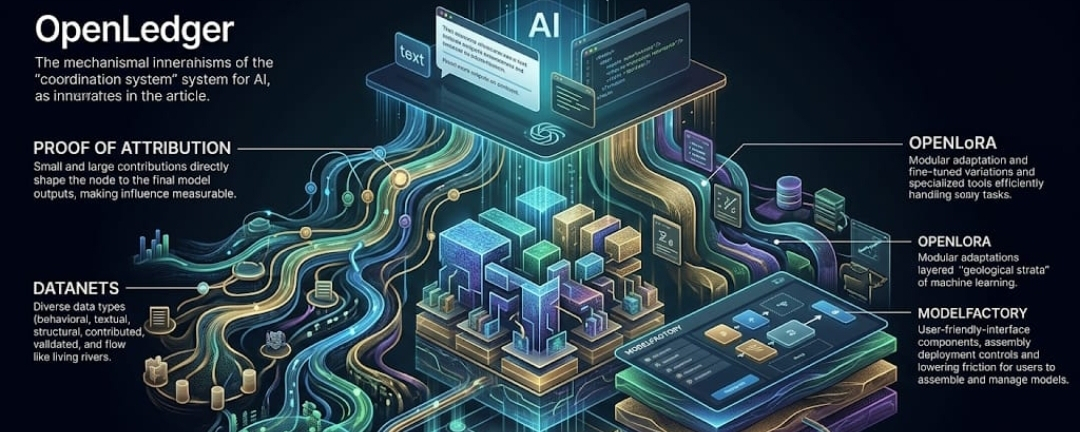
The thing they call Proof of Attribution sounds a bit academic at first. Maybe even overly formal. But the idea is actually pretty simple once you strip the language away.
If an AI output is influenced by data — and obviously it is — then you should be able to trace that influence back to where it came from.
Not in a vague “this model was trained on internet data” way.
More like: this specific contribution, from this source, actually shaped this result.
And yeah, I know what you’re thinking. That sounds messy. Probably borderline impossible at scale. Maybe it is.
But the direction matters more than the immediate feasibility.
Right now, nobody outside a handful of centralized labs really gets credit for anything. Data goes in. Value comes out. And the loop kind of forgets the middle.
That “middle” is exactly what OpenLedger is trying to make visible.
Then there are Datanets.
I’ll be honest — I didn’t immediately like the term. Sounds a bit too clean, too engineered. But the concept is more interesting than the branding.
Think of them less like datasets and more like living ecosystems of contribution.
People add data. Others validate it. Systems track how that data actually influences model behavior downstream. And rewards aren’t just for participation — they’re tied to measurable impact.
That last part is where things get tricky.
Because impact in machine learning isn’t always obvious. Sometimes a small dataset quietly improves performance in ways nobody notices. Other times, large datasets barely move the needle.
So now you’re trying to quantify influence across a system that doesn’t naturally want to be quantified at that level.
Still, the intent is clear: stop treating data as a commodity pile. Start treating it like a network of contributions with uneven weight.
Which… honestly feels closer to reality than what we do now.
There’s also OpenLoRA, which is more technical, but kind of important if you zoom out a bit.
Instead of relying on massive monolithic models for everything, it leans into modular adaptation — small fine-tuned variations that can run efficiently and scale across different use cases.
It’s the difference between one giant machine trying to do everything… and a set of specialized tools quietly handling different parts of the workload.
I keep thinking about how this changes the system dynamic.
Because once models become modular, attribution doesn’t just sit at the data layer anymore. It starts creeping into the model layer too. Who fine-tuned what. Which dataset influenced which adaptation. It becomes… layered.
A bit like geological strata, but for machine learning.
Maybe that’s a weird analogy. But it fits in my head.
ModelFactory sits on top of this whole stack like an interface layer that tries to make it usable without requiring deep ML expertise.
Drag, assemble, fine-tune, deploy. That kind of thing.
I’m always slightly skeptical of “no-code AI” claims — not because they’re false, but because they tend to hide complexity rather than remove it. It usually comes back later, in weird edge cases that nobody planned for.
Still, I get the direction. Lower friction means more participants. More participants means more data flow. More data flow means the attribution problem becomes unavoidable instead of theoretical.
That might actually be the point.
And then there’s the token layer — OPEN and gOPEN.
This is where things stop being abstract.
Now you’re talking about incentives. Payments for inference. Rewards for data contribution. Governance over datasets and models.
In other words, not just building AI infrastructure, but building an economy around it.
I’ll admit — this is the part that always makes me pause.
Because incentive systems are where good ideas usually get stress-tested. And sometimes they break in ways that are hard to predict from the outside.
But ignoring incentives isn’t an option either. We already know what happens when value accrues only at the platform level. We’ve seen that movie.
What sticks with me most isn’t any single component.
It’s the underlying shift in thinking.
AI isn’t being treated as a static product anymore. It’s being treated as a coordination system. A flow of contributions that need tracking, weighting, and redistribution.
That changes how you even think about “training data.” It stops being background material and starts looking like active infrastructure. Something that participates.
And that’s a subtle but uncomfortable shift, because it implies a lot of invisible labor has been sitting there unacknowledged for years.
I don’t have a clean verdict on OpenLedger.
Some parts feel ahead of their time. Some parts feel like they’ll run into friction the moment real-world incentives kick in. Probably both things can be true at once.
But I keep coming back to a simple thought while reading through it:
If AI systems are going to sit underneath everything we do in the next decade, then pretending attribution doesn’t matter feels… naïve at best.
And maybe that’s why this project lingers in my head longer than most.
Not because it solves the problem.
But because it refuses to ignore it.
