
Most AI conversations still feel strangely lightweight compared to where the technology is actually heading.
The public narrative is still dominated by chatbots, content generation, productivity tools, and automation features that make daily software interactions slightly faster or more convenient. That is the version of AI most people see right now. Something visible, interactive, and consumer-facing.
But underneath all of that, another transition has already started happening quietly.
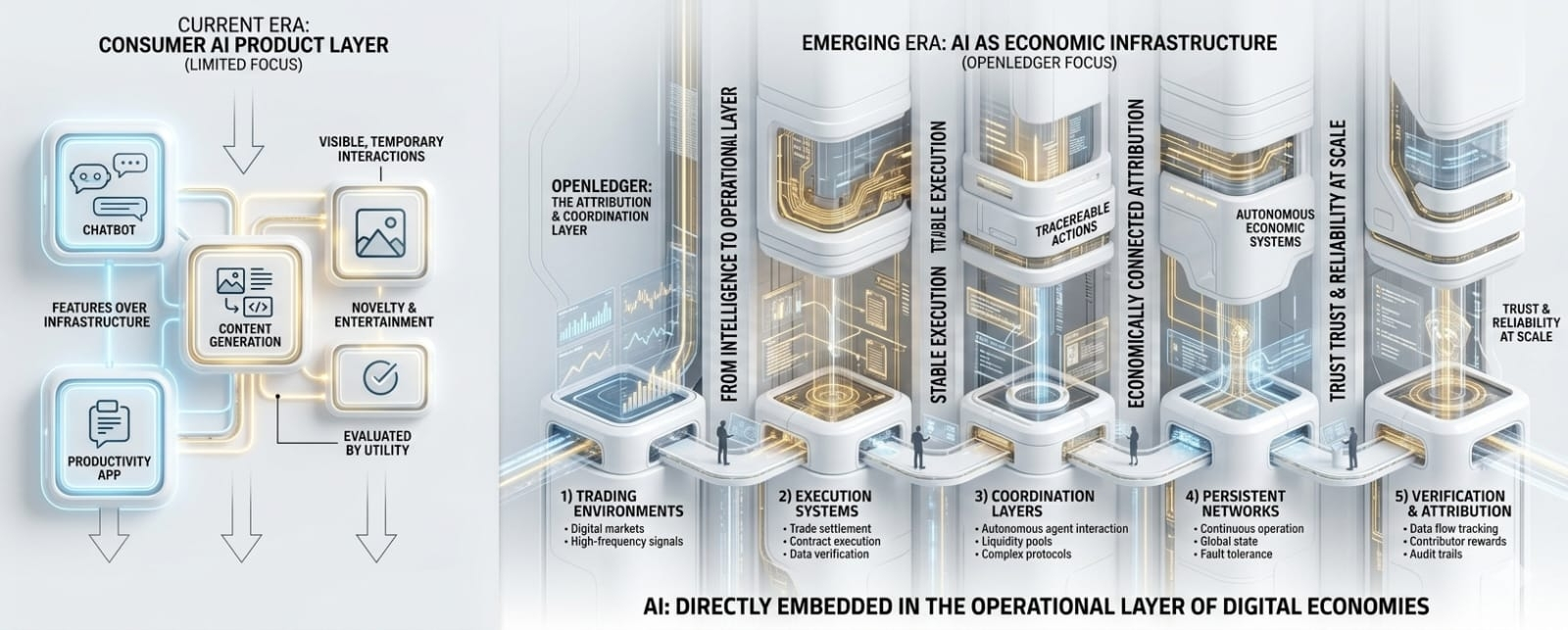
AI is slowly moving away from being treated like a product layer and closer toward becoming infrastructure.
That difference matters far more than most people realize.
Products are temporary interactions. Infrastructure is continuous operation. A chatbot gets evaluated by how useful or entertaining it feels in the moment. Infrastructure gets evaluated by whether it can operate reliably under pressure for years without failure.
The direction around OpenLedger increasingly feels connected to that second category.
What makes the project stand out is not simply the idea of AI itself. Thousands of projects already attach AI branding to almost everything now. The important part is the environment OpenLedger appears to be preparing for.
A future where AI systems are not just generating responses for users but actively participating inside economic systems that never stop moving.
Trading environments.
Execution systems.
Coordination layers.
Persistent operational networks.
Autonomous agents interacting with liquidity, data, and financial activity continuously.
Those environments create a completely different standard for reliability.
A social platform can experience downtime for several minutes and recover easily because the consequences are mostly emotional or temporary. Financial infrastructure does not operate that way. When systems are involved in execution, settlement, coordination, or autonomous decision-making, instability becomes expensive immediately.
That changes the entire conversation around AI.
The industry still spends most of its energy comparing intelligence itself:
Which model sounds smarter.
Which system reasons better.
Which chatbot feels more natural.
But once AI enters financial environments, intelligence alone stops being enough.
Operational consistency becomes more important than novelty.
Because autonomous systems handling economic activity eventually require:
stable execution,
traceable actions,
persistent memory,
coordinated decision-making,
verification layers,
and reliable attribution systems.
Without those things, intelligence becomes difficult to trust at scale.
That is one reason the attribution direction inside OpenLedger feels important.
Most of today’s AI economy operates through invisible extraction. Data flows into models, models produce outputs, and contributors often lose visibility into how their information created value in the first place. OpenLedger appears focused on creating systems where contribution and attribution can remain economically connected rather than disappearing behind centralized infrastructure.
That may sound like a technical detail initially, but it becomes extremely important once AI systems start interacting with real financial activity.
If autonomous agents are eventually executing trades, coordinating liquidity, managing assets, or interacting with decentralized systems independently, then attribution is no longer just about fairness. It becomes part of operational trust itself.
Who supplied the data.
Which model influenced the action.
Which system validated execution.
Which layer confirmed the result.
Financial environments eventually require traceability because systems operating without accountability become fragile very quickly.
This is also where the broader AI market still feels disconnected from reality.
Most people continue evaluating AI through visibility and consumer excitement. They focus on interfaces because interfaces are easy to understand. But historically, the most important technology layers are often the least visible ones.
People rarely think about cloud infrastructure, routing systems, database coordination, or execution architecture even though modern digital economies could not function without them.
Infrastructure usually matters precisely because it disappears into the background while everything else depends on it.
That is the atmosphere OpenLedger increasingly gives off.
Not necessarily a project trying to dominate attention through consumer interaction, but one positioning itself around the operational side of autonomous AI economies before that transition becomes obvious to the broader market.
The interesting part is that this shift already appears to be starting quietly across the industry.
AI agents are no longer being discussed only as assistants. More developers and researchers are exploring systems where agents maintain persistent state, coordinate transactions, interact with protocols, execute tasks autonomously, and operate continuously across changing environments.
Once that evolution accelerates, the infrastructure underneath those systems becomes more valuable than the interface itself.
Because autonomous economic systems require coordination before they require personality.
They require stability before entertainment.
They require verification before marketing.
And they require trust before scale.
That is why OpenLedger keeps standing out more over time.
The project increasingly feels less connected to the current wave of surface-level AI excitement and more connected to the longer-term possibility that AI eventually becomes embedded directly into the operational layer underneath digital economies themselves.
Not as a visible feature sitting on top of platforms.
But as infrastructure quietly powering the systems underneath them.
