May 27, 2026
A few days ago I caught myself watching an AI-generated market summary circulate across crypto Twitter. Thousands of people were quoting it, debating it, reacting to it, but almost nobody seemed interested in where the underlying information actually came from. Not the model. Not the interface. The data itsele
That disconnect keeps bothering me.
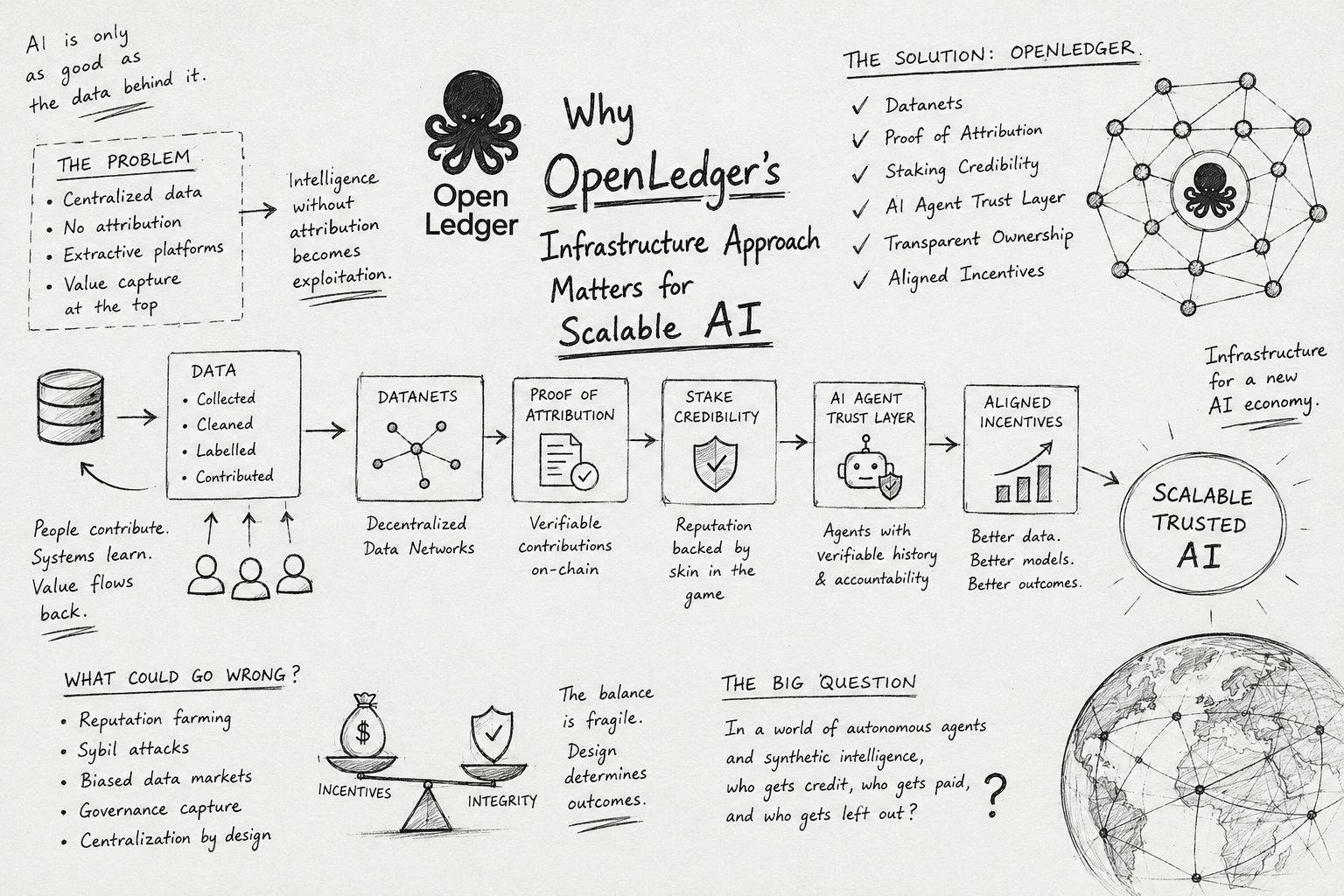
Most people still talk about AI infrastructure as if the model is the entire product. Bigger models, faster inference, smarter agents. But once AI systems start operating inside financial and coordination environments, the real bottleneck quietly shifts somewhere else: attribution, trust, and incentive alignment around data production itself.
That’s partly why OpenLedger’s infrastructure approach feels more structurally interesting than many of the AI narratives floating around crypto right now.
Not because it guarantees success. It definitely doesn’t. But because it is attempting to solve a less glamorous layer of the stack that most markets usually ignore until scaling pressure exposes it.
The strange thing about AI systems is that they become economically valuable long before they become economically accountable. Models absorb knowledge from millions of interactions, refinements, and corrections, yet the people contributing signal into those systems rarely maintain ownership, reputation, or measurable participation rights afterward. Data becomes vapor. Intelligence becomes centralized by default because attribution disappears upstream.
OpenLedger seems to be experimenting with the opposite assumption: that AI networks may eventually require persistent contribution tracking if they want scalable trust.
That sounds abstract until you think about what happens once autonomous agents start interacting with each other financially.
An agent recommending trades, filtering research, coordinating liquidity, validating governance proposals, or managing treasury actions cannot simply be “smart.” It has to become legible under pressure. People need ways to evaluate where its outputs came from, whether its training inputs were manipulated, which contributors influenced its reasoning, and how reputation compounds over time.
Without attribution layers, AI systems slowly drift into a black-box credibility crisis.
This is where concepts like datanets and Proof of Attribution become more important than people realize. Not because attribution magically fixes bad incentives, but because it introduces friction against invisible extraction. If contributors can prove they participated in shaping datasets or improving outputs, then the economic structure around AI starts looking less like pure platform capture and more like an evolving coordination market.
But there’s another side to this that makes me cautious.
The moment attribution becomes financialized, reputation itself becomes a target for manipulation.
Crypto already understands this dynamic better than most industries. Once incentives exist, optimization behavior appears immediately. If staking credibility becomes tied to rewards, users will inevitably attempt to game contribution quality, inflate reputation signals, or create synthetic consensus loops between AI agents and human validators. The infrastructure doesn’t just need intelligence scaling. It needs adversarial resilience.
That may become the harder problem.
A lot of decentralized AI conversations still assume openness naturally produces fairness. I’m not convinced. Open systems often produce spam unless reputation costs are meaningful. Closed systems produce efficiency but weaken transparency. OpenLedger seems to be exploring an uncomfortable middle ground where trust becomes partially programmable but never fully objective.
And honestly, that feels closer to reality.
Human coordination systems have never depended purely on truth. They depend on costly signaling, reputation persistence, institutional memory, and consequences for bad behavior. AI infrastructure probably inherits the same constraints.
What makes this especially relevant in crypto is that blockchains already solved one narrow version of distributed trust: transaction verification. But AI coordination is much messier because the output quality itself is subjective. A blockchain can verify whether a transaction happened. It cannot easily verify whether an AI-generated conclusion was useful, honest, manipulated, or contextually correct.
That creates a strange future market.
Instead of competing only on compute power, AI ecosystems may compete on credibility architecture. Which network tracks contribution integrity better? Which agents maintain reliable histories under volatility? Which systems preserve attribution without collapsing into surveillance? Which governance structures resist reputation cartels?
These are infrastructure questions, not product questions.
And infrastructure questions usually matter most when nobody wants to think about them yet.
I think that’s the deeper reason OpenLedger keeps appearing in serious AI infrastructure discussions. Not because the market has fully validated the model, but because it is probing a structural weakness that becomes harder to ignore as AI systems become more autonomous and economically embedded.
Still, there’s no guarantee these mechanisms scale cleanly. Coordination systems tend to behave very differently once real money, competition, and adversarial behavior intensify. Reputation markets can centralize. Attribution systems can become bureaucratic. Governance layers can slowly favor incumbents over contributors.
But maybe that uncertainty is exactly the point.
The next phase of AI infrastructure probably won’t be defined by who builds the smartest model. It may be defined by who designs the least fragile trust system around intelligence production itself.#openledger