
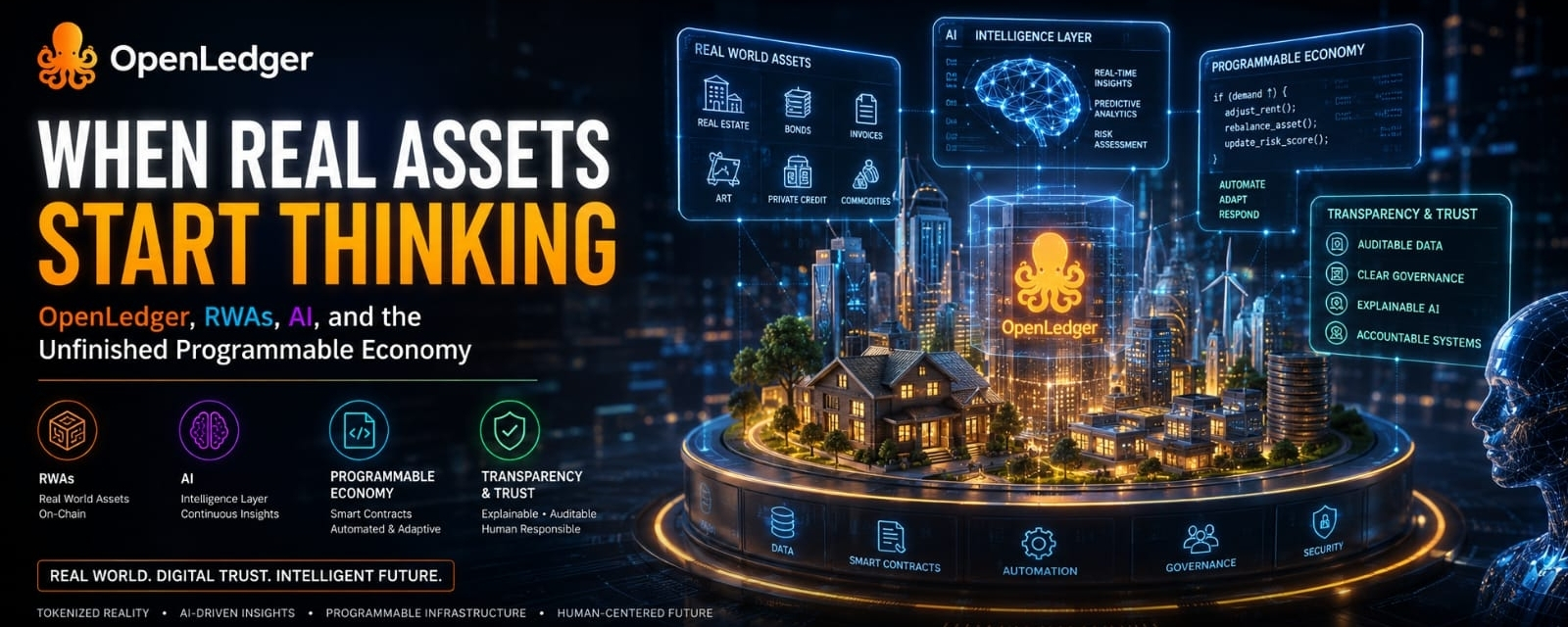
Sometimes a thought stays somewhere in the back of the mind and keeps returning quietly, especially when we look at the way Web3 and AI are slowly being joined together. From the outside, this whole new system looks very clear, almost too clean. RWAs bring real-world assets, AI brings intelligence, and together they create a programmable economy. It sounds like a simple line, something easy to repeat and even easier to believe. But when I think about it more deeply, I feel the reality is not that simple. Maybe we are only seeing a small part of a much bigger shift. Maybe the idea is still unfinished, still forming, still waiting for the world to understand what it is actually becoming. When @OpenLedger presents this vision, it does not feel like just another Web3 narrative. It feels like a question about how the real economy may behave when physical assets, data, automation, and intelligence start living inside the same system.
RWAs are usually explained in a very straightforward way. Land, houses, bonds, art, invoices, private credit, and other real-world assets are brought on-chain as tokens. On paper, it looks clean. Something exists in the physical world, a digital version of it is created, ownership becomes easier to divide, transfer, and track, and suddenly the asset becomes more liquid. But the real world does not become simple just because we put a token around it. A house is not only a house. It carries legal ownership, local regulations, maintenance issues, market mood, human disputes, paperwork, trust, location value, and sometimes even emotions. A bond is not only a token with yield. It depends on institutions, repayment ability, macro conditions, legal enforcement, and the behavior of people outside the blockchain. So when we say RWAs are coming on-chain, the real question is whether we are truly digitizing reality or only creating a new digital layer above it. And if that layer breaks away from the real asset, then who protects the connection between the token and the truth behind it?
This is where the idea becomes both powerful and complicated. Tokenization can make assets more accessible, more transparent, and easier to move, but it does not automatically remove the messiness of the world behind those assets. In some cases, it may even create a new kind of complexity, where law, code, data, custody, valuation, ownership, liquidity, and trust all need to work together at the same time. Maybe that is why RWAs are not just a technical upgrade. They are a coordination problem. They are an attempt to make the physical economy readable by digital systems. And once the real world becomes readable, the next question naturally appears: what happens when AI starts reading it continuously?
AI is often described as the intelligence layer in this story, but even that word needs to be handled carefully. Intelligence does not mean perfection. AI is not some flawless machine that understands every hidden detail of reality. It is built on data, and data can be incomplete, biased, delayed, manipulated, or unable to capture human context. If a tokenized building is being analyzed by AI, the model may see rent numbers, demand trends, maintenance costs, market signals, and investor behavior, but it may still miss the small human realities that exist outside the dataset. A neighborhood can change for reasons that do not appear clearly in numbers. A legal issue can slow down an asset even if the financial model looks healthy. A market can become irrational even when the indicators look normal. So the question is not whether AI can make the economy perfectly intelligent. It probably cannot. The better question is whether AI can help the economy become more responsive.
And this is where the OpenLedger-style idea starts to make sense. Maybe the goal is not to create perfect assets or perfect decisions. Maybe the goal is to create systems that can react faster, observe better, and coordinate more smoothly. Imagine a tokenized building where rent is changing, maintenance is becoming expensive, occupancy is moving up and down, and demand is shifting every month. In a traditional setup, people collect reports, hold meetings, wait for approvals, and often react late. But in a programmable system, AI could act like a live monitoring layer. It could notice patterns before humans notice them. It could suggest maintenance before the problem becomes costly. It could detect weaker demand before income starts falling. It could adjust projections, risk scores, or asset strategies based on real-time signals. The asset would no longer feel completely passive. It would start behaving more dynamically, almost as if it is responding to the world around it.
That idea sounds futuristic, but it also creates discomfort. If an asset can respond automatically, then who controls that response? Who decides what the AI is allowed to recommend? Who decides which rules become part of the smart contract? Who updates the system when reality changes? Who is responsible if the automated decision is logical for investors but unfair for people affected by it? This is where the word “programmable” becomes more than a tech phrase. It becomes a serious economic and ethical question. A programmable asset may be efficient, but efficiency alone is not enough. The real world is not a clean machine. It is messy, emotional, political, irrational, and full of exceptions. Code likes fixed logic, but life does not always follow fixed logic. If too much of the economy becomes programmable without enough human oversight, then we may not be reducing complexity. We may simply be hiding it inside systems that look intelligent from the outside.
Transparency becomes extremely important here. The more automation increases, the more decision-making can move away from human eyes. A system may decide to rebalance an asset, change risk exposure, adjust pricing, trigger payments, or update ownership conditions, but people will still need to know why that happened. Which data was used? Which model made the recommendation? Who designed the logic? Can the decision be challenged? Can the system be audited? If the answer is not clear, then the programmable economy could become a black box. It may look smooth, fast, and intelligent, but underneath, accountability may become harder to find. That is why trust in this kind of system cannot only come from technology. It also has to come from explainability, governance, and human responsibility.
Still, I do not think this vision should be ignored. Every major shift begins as an abstraction before it becomes normal. The internet abstracted communication. Cloud computing abstracted infrastructure. DeFi abstracted parts of finance. Now RWAs and AI may be trying to abstract the real economy itself. That does not mean the process will be clean. It will probably be uneven, imperfect, and full of friction. Some assets will work better on-chain than others. Some AI systems will help coordination, while others may create risk. Some platforms will build transparency, while others may hide behind complexity. But the direction is important because it shows that assets are no longer being imagined as static things. They are slowly being imagined as programmable, reactive, and data-aware systems.
Maybe this is the most interesting part of what @OpenLedger is pointing toward. It is not necessarily showing a finished future. It is showing a transition. RWAs bring pieces of the physical world into blockchain systems, and AI gives those pieces the ability to react to signals. Together, they create something that is not fully traditional finance, not fully DeFi, and not fully artificial intelligence either. It is something in between, and maybe that is why it feels difficult to define. We are standing in the middle of the shift, trying to understand the whole picture while the picture itself is still being drawn.
So for me, the real question is not whether RWAs plus AI will instantly create a perfect programmable economy. That would be too simple. The real question is whether this combination can create a more responsive economic layer without losing sight of the human world behind it. Can real assets become digital without becoming detached from reality? Can AI make asset behavior smarter without turning decision-making into a black box? Can programmable systems improve coordination without removing accountability? These questions do not have final answers yet, and maybe that is the honest part. The future being built around OpenLedger, RWAs, and AI is not a completed structure. It is an unfinished shape. Maybe it becomes the programmable economy of the future, or maybe it becomes a more advanced abstraction layer built on top of the same real-world problems. Either way, something is clearly changing, and we are still learning how to understand it.
$OPEN #OpenLedger @OpenLedger
